
Talaria Upgrades in the Right Order: Suspension, Brakes, Controller, Battery, Wheels
Most Talaria upgrades go wrong not because the part was poor but because it arrived out of sequence. A controller that doubles the power on a bike still running stock suspension and stock pads does not make the bike faster, it makes it frightening. This guide sets out the sequence of Talaria upgrades we recommend, in priority order, with what each step changes for the rider, what it demands of everything else on the machine, and the warranty and road legality consequences that come with a power increase.
Why the order of Talaria upgrades matters
A Talaria leaves the factory balanced. Every component is matched to the power the motor makes and the speed the chassis reaches, so change one element and the weakest link moves somewhere else. Good Talaria upgrades move that weak link forwards deliberately, rather than leaving you to find it at the bottom of a rutted descent.
Suspension comes first among Talaria upgrades because it decides how much of the existing power you can use. Brakes come second because they set how fast you dare enter a corner. Only then does more power make sense. Battery capacity follows, because a bigger pack is worth more once the bike can deploy what it has. Wheels and gearing are the fine tuning, not the foundation.
The one rule that never changes
Every step in a programme of Talaria upgrades should be ridden for a few sessions before the next one is fitted. Riders who fit four parts in a weekend cannot tell which one improved the bike and which one caused the new noise. One change at a time is slower and considerably cheaper in the long run.
Step one, suspension
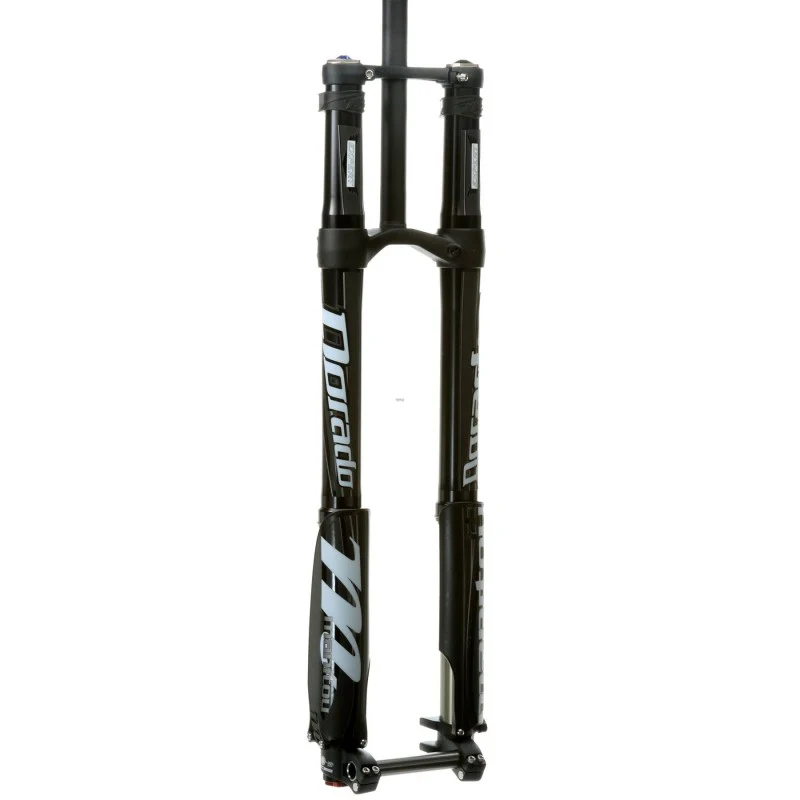
The factory forks on a Sting are competent and outclassed by the chassis they sit in. Of all the Talaria upgrades available, a fork change is the one riders most often call transformative, because it improves every corner rather than just the straights.
Manitou Dorado Expert
The Manitou Dorado Expert is an inverted fork built on a 37mm chassis that Manitou rates as 20 percent stiffer than the previous 36mm version. The inverted layout keeps the bushings and seals constantly lubricated, which is why it feels smooth from the first millimetre of travel, and it adds fore and aft stiffness while keeping torsional compliance so the front wheel still tracks over rough ground.
The Dorado Air Spring uses a balancing valve that equalises the positive and negative chambers as you fill it, so there is no dead spot in the stroke, and travel sets at 180mm, 190mm or 203mm without spare parts. The ABS+ damper offers low speed compression and rebound adjustment, TSR bleed screws release pressure build up in the outer legs mid ride, and the top drop crown recommended for electric bikes is included.
Manitou Dorado Comp
The Dorado Comp uses the same 37mm chassis with a coil spring instead of air. A coil gives maximum bump sensitivity and a consistent feel with no setup ritual, and servicing is simpler. Manitou recommends the XX Firm spring for electric bike use. If you would rather set the fork once and forget it, this is the better of the two Talaria upgrades here.
Both forks are listed to fit the Sting MX3, the Sting R MX4 and the Talaria XXX. If you would rather buy the fork already fitted, the Sting R MX4 Expert comes with the Dorado Expert as standard.
Step two, brakes
Braking is the second priority and the most frequently skipped of all Talaria upgrades. A Sting R runs 220mm rotors with four piston calipers and uprated master cylinders, and an MX5 Pro runs 220mm discs at 3mm thickness with larger calipers and redesigned DOT master cylinders. Both are strong systems, and both are strong for the factory power output.
Add a high power controller and the same brakes must shed far more energy every lap. The symptoms are familiar: a lever that comes further back as the session goes on, a burnt smell after a long descent, pads lasting a third as long. The fix is not exotic. Fresh fluid, sintered pads rated for the heat, braided hoses if the bike runs rubber, and a rotor in good condition.
Use the regen you already have
Every Talaria carries four levels of regenerative braking adjusted through the display, and the MX5 Pro adds a regenerative brake lever. Turning regen up costs nothing, reduces pad wear, recovers a little energy and gives a second, independent way of slowing the bike. Riders who fit expensive Talaria upgrades and leave regen on level one are leaving performance on the table.
Step three, the controller
Now the power. A controller swap is the single biggest change in performance available among Talaria upgrades, and the one that carries the most consequences. We stock three, and they suit different riders.
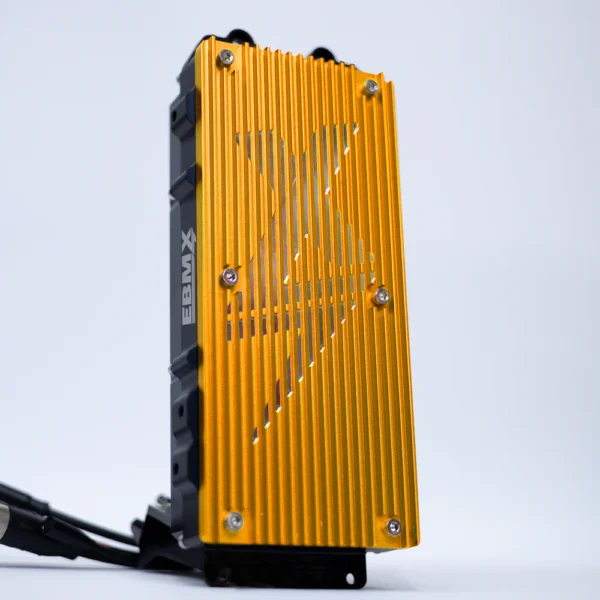
EBMX X9000 power kit
The EBMX X-9000 power kit runs VESC derived firmware that EBMX has modified in house, driving the motor under field oriented control. It is rated at 22 kW continuous, takes an input from 40V to 100V with a working range of 48V to 93V, delivers 1000A phase current continuous and 1500A burst, draws up to 500A from the battery, exceeds 95 percent peak efficiency and carries an IP67 rating. It ships with an air cooled heat sink, an SW102 display, a regenerative thumb throttle and harnesses for the Talaria MX3 and MX4.
Nucular Electronics performance controller
The Nucular performance controller is a plug and ride kit for the Sting MX3 and MX4. Nucular quotes a power gain of up to 30 percent when the bike keeps its standard 60V pack, rising to as much as 300 percent once a 72V pack is fitted behind it. That second figure tells you everything about the relationship between a controller and a battery: the controller can only deliver what the pack is willing to supply.
KO Moto Factory Spec Rush controller
The KO Moto Factory Spec Rush controller is the third option and a well regarded choice among Talaria upgrades on this platform. Our controller upgrade guide compares all three in more depth, including how each handles tuning and display integration.
What a controller demands of the bike
Heat management is the real constraint. The manufacturer guidance is to keep wide open throttle bursts short, somewhere around ten to fifteen seconds, to leave a gap between them rather than stringing runs together, and to back off on long sections where the throttle would otherwise sit near the stop. The motor is the component that pays for a heavy right hand, and temperature protection helps without making it indestructible.
Step four, the battery
Battery Talaria upgrades do two different jobs and it is worth being clear which one you want. A bigger pack at the same voltage buys range. A higher voltage pack buys power, but only in company with a controller that accepts it.
More range on the stock controller
The 60V 65Ah EBMX battery delivers close to double the range of a stock 60V pack with the same power output, runs on the stock controller and fits the OEM battery compartment. It is the least disruptive of all the Talaria upgrades on this page, and it has headroom for later, supporting up to 15 kW once an X9000 controller is fitted. The 60V 43.2Ah Sting MX4 pack is the option for riders who simply want a second battery to swap mid session.
Higher voltage
Going above 60V is the most involved of the battery Talaria upgrades, a package decision rather than a single part. The pack, the controller and the charger all change together, because a 60V charger cannot charge a 72V pack and a stock controller will not run one. Riders on the Sur Ron platform have the EBMX 72V 42Ah battery for the SurRon LBX as the equivalent step. Our Talaria battery guide covers voltage, capacity and cell chemistry in more detail, and end of life packs must be recycled under the UK batteries and accumulators guidance.
Step five, wheels and gearing
Wheels change what the bike is for. The stock 19 inch setup is a compromise that works everywhere, while a dedicated wheel set makes the machine much better at one thing and slightly worse at everything else. That is exactly why these Talaria upgrades come last.
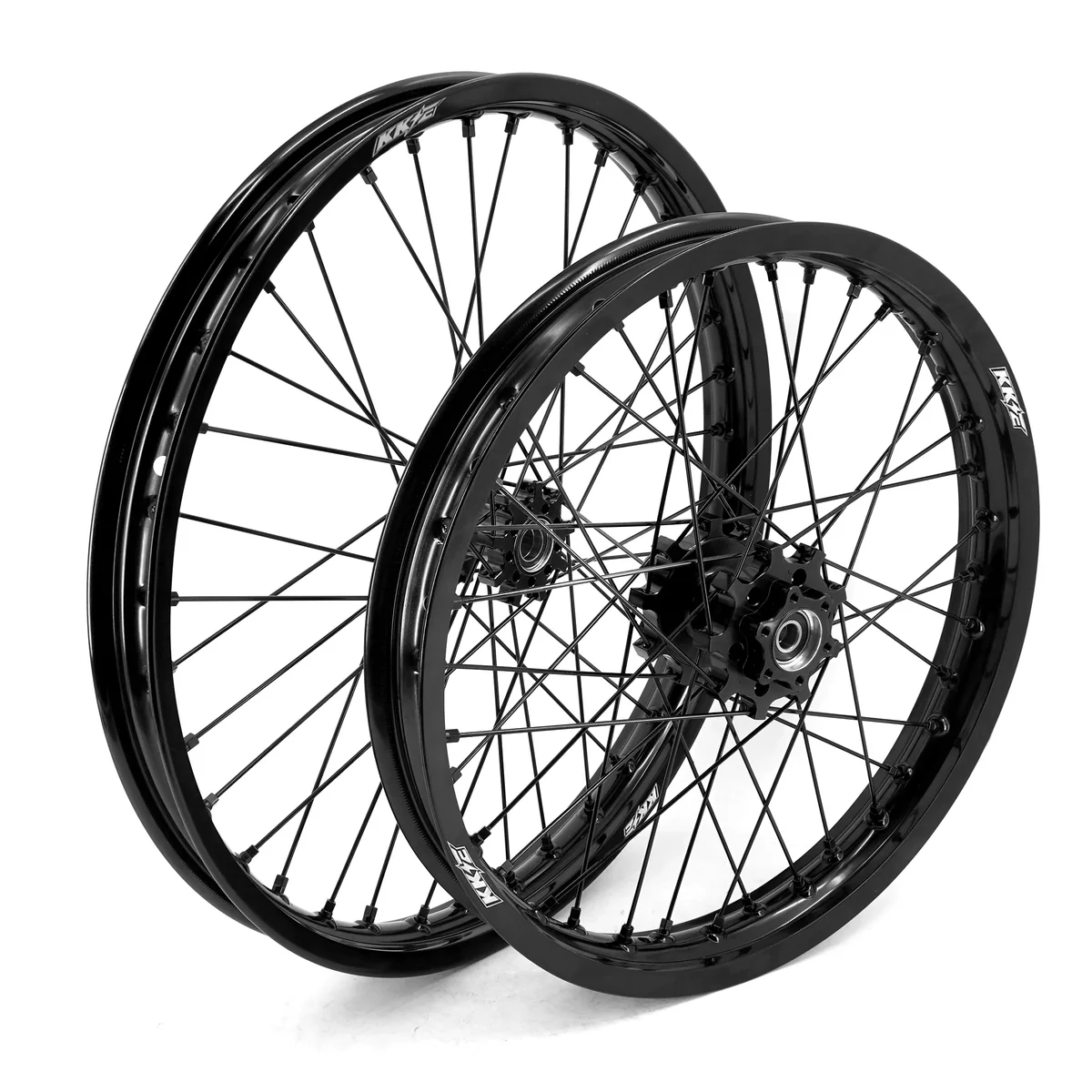
Off road wheel sets
The KKE 21 and 18 inch wheel set for the Sting MX3 moves the bike to full size motocross diameters. It uses a 6082 T6 aluminium CNC anodised hub, a 7050 T6 gloss rim and chemically blackened iron spokes with alloy nipples, and arrives complete with bearings, seals and spacers. Front rim is 1.6 by 21 inches, rear 1.85 by 18 inches.
Supermoto wheel sets
The 17 inch supermoto wheel set for the Sting MX4 and xXx is a complete kit with black rims and silver spokes, a 70 by 90 section front tyre, a 90 by 80 rear, a 40 tooth sprocket with a matching chain and 220mm rotors front and rear. It will fit a Sting MX3 but the discs must be swapped for 203mm items, which are not included. Note that the sprocket is part of the kit, so this is one of the few Talaria upgrades that changes gearing at the same time.
Individual rims and gearing
If you have damaged a single wheel, the 19 by 1.40 inch front rim assembly fits the Sting MX3, MX4 and X3, and the 16 by 1.85 inch rear rim is built on a black anodised 6061 T6 CNC hub with stainless spokes and brass nipples. On gearing, the Sting platform runs either a 44 tooth or a 48 tooth rear sprocket: the 44T gives a gear ratio of 8.35 and 284 Nm at the rear wheel on an MX3, while the 48T gives 9.18 and 309 Nm, trading top speed for drive. Tell the display which sprocket is fitted or the speedometer will read wrong, and a replacement Sting R display is available if yours is damaged.
Talaria upgrades compared by benefit and difficulty
The table ranks the Talaria upgrades covered above by what each one actually delivers and what it costs you in workshop time and in demands on the rest of the bike.
| Upgrade | What it changes for the rider | What it demands | Difficulty |
|---|---|---|---|
| Manitou Dorado Expert or Comp fork | Composure over rough ground, front end grip, confidence in corners | Correct spring or air pressure for rider weight, top drop crown | Moderate |
| Brake fluid, pads and hoses | Consistent lever feel, less fade on long descents | Bleeding the system properly, correct fluid specification | Low |
| Raising regenerative braking level | Extra deceleration, slower pad wear, small range gain | Nothing, it is a display setting | Very low |
| EBMX X9000 controller | Large power increase across the whole range | Heat management, matched battery, disciplined throttle use | High |
| Nucular or KO Moto controller | Substantial power increase and tuning options | Matched battery, upgraded brakes already fitted | High |
| 60V 65Ah battery | Close to double the range, same power | Nothing beyond the stock controller | Low |
| Higher voltage pack | More power and more range together | Compatible controller and a matching charger | High |
| KKE 21 and 18 inch wheel set | Full size motocross geometry and tyre choice | Tyre and tube purchase, disc compatibility check | Moderate |
| 17 inch supermoto wheel set | Road and hard surface grip, sharper steering | 203mm discs on an MX3, sprocket and chain included | Moderate |
| Sprocket change from 44T to 48T | More drive off the bottom, lower top speed | Chain length check and a display setting change | Low |
Warranty and road legality after a power upgrade
This is the part that deserves reading twice. Power Talaria upgrades carry consequences beyond performance, and no amount of enthusiasm changes them.
Start with legality, because it is not negotiable. A homologated L1e or L3e model received its type approval at one specific output. Raise that output with an aftermarket controller or a tune and the machine stops matching the certificate it was registered against, so its road legality ends the moment the part is fitted. What a road vehicle has to comply with is published in the DVSA guidance for motorcycle and moped riders, and the category definitions themselves sit in EU Regulation 168/2013 as retained in UK law. If your bike wears a number plate, leave the power alone.
On warranty, high power Talaria upgrades change what is covered. A motor damaged by sustained wide open throttle on an aftermarket controller is not a manufacturing defect. Our warranty page carries the terms and our guide to Talaria road legality covers each model.
Frequently asked questions
Which Talaria upgrades should I fit first?
Suspension, every time. A fork such as the Manitou Dorado lets you use the power the bike already makes, and it improves every corner rather than just the straights. Brakes come second, because more speed needs more stopping. Only after both are sorted does a controller make the bike genuinely faster rather than simply more alarming.
Will a controller upgrade damage my motor?
It can, and the manufacturers say so plainly. The advice is to avoid holding full throttle for more than 10 to 15 seconds, avoid repeated full throttle runs and avoid long stints above three quarter throttle. A stock bike in sport mode makes 5 to 6 kW. On a high power controller and matched pack it can reach 15 kW, which is three times the load on the same motor.
Do Talaria upgrades void the warranty?
Performance modifications change what a warranty covers, particularly where a failure traces back to the increased load. Fitting a fork or a wheel set is a different matter from fitting a 15 kW controller. If you are unsure where a specific part leaves you, ask before fitting and read the full terms on our warranty page.
Can I upgrade a road legal Talaria?
Chassis parts such as suspension, brake consumables and wheels are one thing. Power is another. Any change to the output of a homologated L1e or L3e machine breaks the type approval it was registered under and makes it illegal for road use. Keep the powertrain standard on a plated bike and put the performance Talaria upgrades on an off road machine instead.
What is the cheapest upgrade that makes a real difference?
The cheapest of the Talaria upgrades is turning the regenerative braking up a level or two, followed by fresh brake fluid and better pads. Between them they cost very little, improve control immediately and reduce wear. After that, a sprocket change from 44T to 48T transforms drive off the bottom for the price of a sprocket and a chain check.
Should I buy a bigger battery or a better controller first?
If the bike runs out of range before you run out of energy, buy the battery. If it runs out of drive on climbs while charge remains, buy the controller, but only once suspension and brakes are sorted. Of the two, a 60V 65Ah pack is the safer of these Talaria upgrades because it needs nothing else changed.
Next steps
Work through the Talaria upgrades in order. The Talaria parts category holds the forks, controllers, wheels and rims covered here, and the batteries and chargers category covers the power side. If you would rather buy a machine that already carries the best of these Talaria upgrades from new, the Sting MX5 Pro and the Sting R MX4 Expert are the two to compare.