
Uncategorized
Talaria Sting R Top Speed: Reading the Spec Sheet Line by Line
Jun
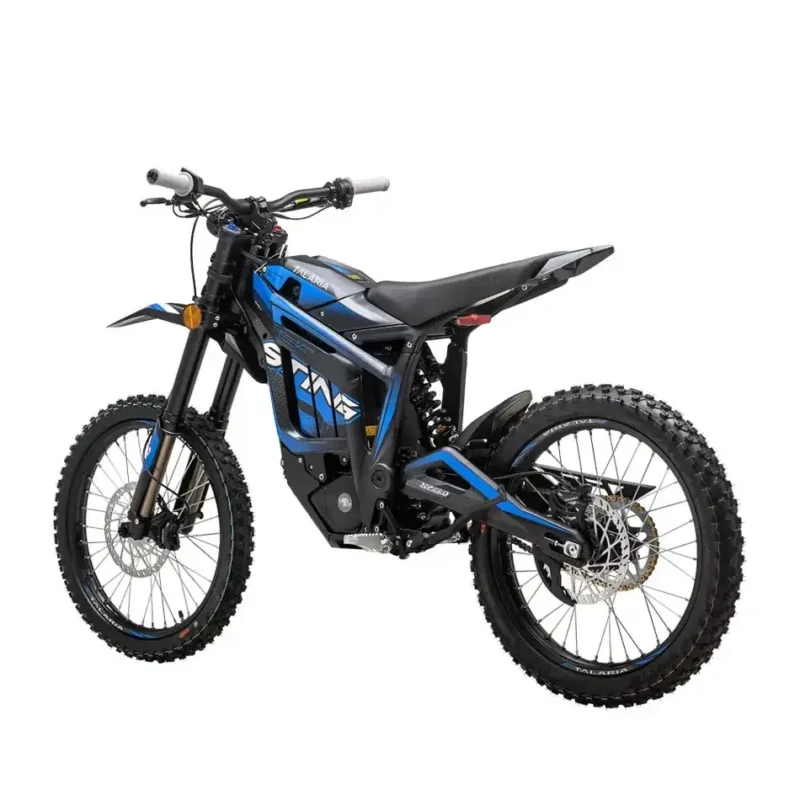
Talaria Sting R top speed is printed as a single line on the manufacturer’s sheet, 53 mph or 85 km/h, but that line only makes sense when you read the blocks around it. The power block explains where the figure comes from, the transmission block explains how it reaches the rear wheel, the battery block explains why it moves around during a ride, and the chassis block explains why the bike can carry it safely. This guide takes the Sting R MX4 specification as a document and reads it in order, version by version, with the UK road legal limits set out at the end.
The power system block
Open the Talaria Sting R MX4 specification and the section headed Power System carries five lines: nominal voltage 60V DC, continuous power 4000W, peak power 8000W, maximum speed 53 mph (85 km/h), nominal torque 45 Nm. Those five lines are the whole story of Talaria Sting R top speed and straight line performance, and the order they are written in is the order in which they matter.
Voltage sets the ceiling
An electric motor’s unloaded speed is proportional to the voltage across it. At 60V nominal the Sting R’s IPM motor spins to a fixed maximum rpm, and once the reduction ratios and the tyre are accounted for that rpm becomes the 53 mph Talaria Sting R top speed. This is why every 60V Talaria, from the Sting MX3 to the XXX Pro, lands within a few mph of each other, and why the 72V and 96V models in the range sit so far above them.
Power decides how the ceiling is reached
The 8000W peak figure is what separates the Sting R from the 6000W Sting MX3 and lifts Talaria Sting R top speed 13 percent above it, with noticeably stronger acceleration. Peak power is available for short bursts; the 4000W continuous rating is what the motor and controller sustain without heat limiting. Both matter for a Talaria Sting R top speed run, because a bike that can only touch peak briefly will fall away on a long straight or a slope.
Torque is the launch, not the ceiling
The 45 Nm motor torque figure, multiplied through the gearbox and chain, determines how hard the bike leaves a corner and has no direct bearing on the maximum. A torquier controller on a stock voltage system sharpens the launch and leaves Talaria Sting R top speed where it was.
Talaria Sting R top speed by version
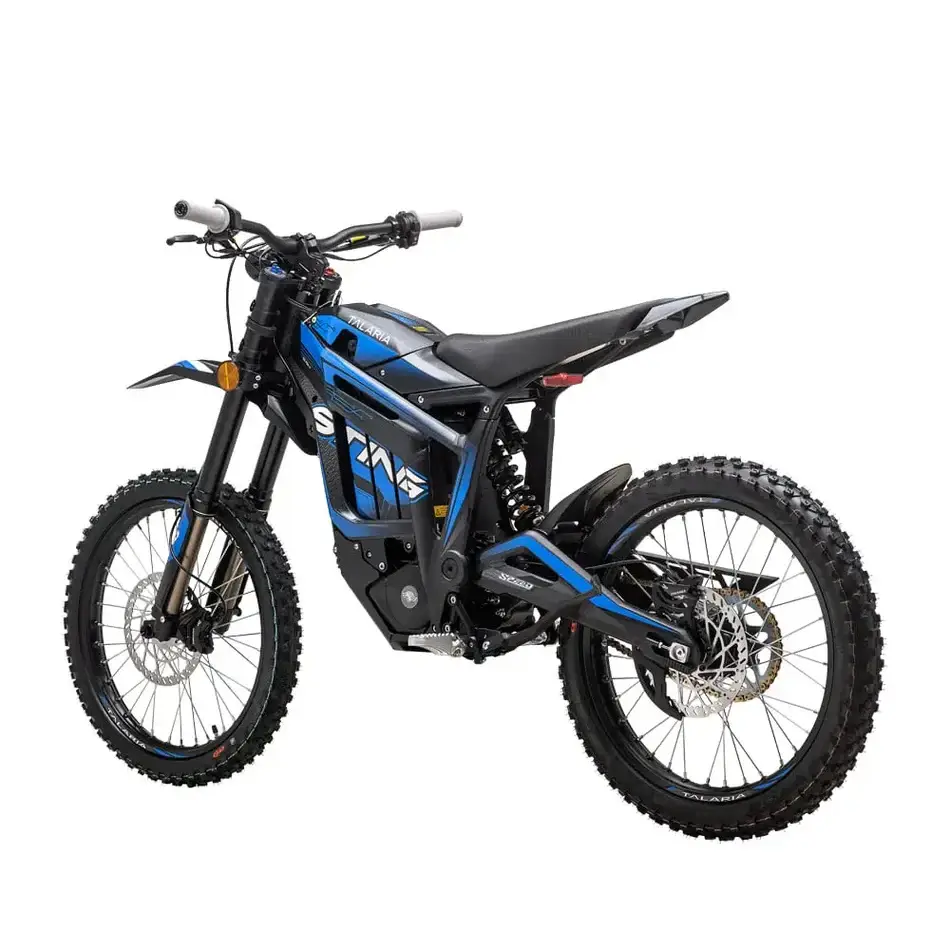
The Sting R name covers several bikes on one chassis, and their sheets do not all print the same Talaria Sting R top speed. The table below sets out each version we stock with its listed figure, its peak power and its motor torque, using the manufacturer’s numbers in both units. It is the reference for anyone asking about the Talaria MX4 top speed, the Expert, or the two road legal versions built on the same frame.
| Version | Listed maximum speed | Peak power | Motor torque | Battery | Weight with battery |
|---|---|---|---|---|---|
| Sting R MX4 (MX off road) | 53 mph (85 km/h) | 8000W | 45 Nm | 60V 45Ah, 2700 Wh | 66 kg |
| Sting R MX4 Expert, Manitou fork | 55 mph (about 88 km/h) | 10 percent above the MX4 | 50 Nm | 60V 45Ah, 2700 Wh | not listed separately |
| Sting R Off Road | 53 mph (85 km/h), listing also quotes up to 55 mph | 8000W | 45 Nm | 60V 45Ah, LG cells | 66 kg |
| Sting L3e road legal, 125 equivalent | 53 mph listed | 3500W | 34 Nm | 60V 45Ah | 71 kg |
| Sting R MX4 L1e street legal | 45 km/h (28 mph) for road registration | 8000W hardware, restricted | 45 Nm | 60V 45Ah, 2700 Wh | 66 kg plus lighting kit |
MX4 and Off Road
The MX4 and the Sting R Off Road share the 4000W continuous, 8000W peak drivetrain and the same 53 mph Talaria Sting R top speed; the Off Road listing also quotes up to 55 mph in its prose, which reflects the same bike measured under slightly kinder conditions. The Talaria Sting R MX4 top speed you should plan around is 53 mph, with 55 mph as the best case on a full pack and a light rider.
Expert, which riders call the Pro
The Sting R MX4 Expert is the bike most UK riders mean when they search for Sting R Pro top speed. Its sheet lists 55 mph, 50 Nm of motor torque and a 10 percent increase in peak power over the standard MX4, and it pairs those with a Manitou Dorado Expert fork and Magura MT5 brakes. The extra 2 mph over the standard Talaria Sting R top speed comes from the power increase, not from a voltage change, so it is a bike that reaches and holds its ceiling more readily rather than one with a different ceiling.
The transmission block
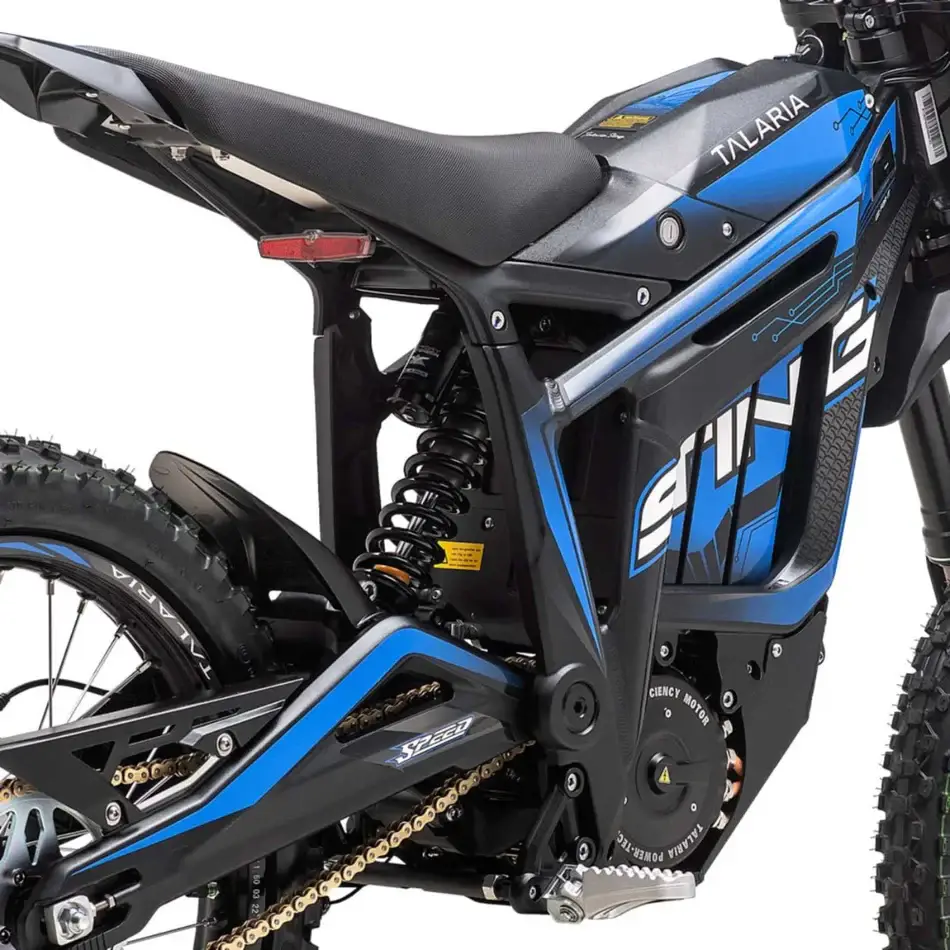
The next block on the sheet reads gear ratio 8.35 (44T) or 9.18 (48T), first transmission gearbox, second transmission chain. Three lines, and between them they decide how motor rpm becomes the wheel speed behind Talaria Sting R top speed. The Sting R uses a sealed internal gearbox as the primary reduction, then a chain to the rear sprocket, and the two rear sprocket options change the overall ratio by almost 10 percent.
44T against 48T
With the 44 tooth sprocket the overall ratio is 8.35 to one, which favours top speed and open ground. With the 48 tooth sprocket it rises to 9.18 to one, which favours acceleration, hill climbing and tight trails at the cost of a lower theoretical ceiling. The 53 mph Talaria Sting R top speed is the controller limited maximum, so on the 44T the bike sits under the limiter with a little in hand, and on the 48T it runs closer to its geared ceiling.
Why the gearbox matters for speed
A belt primary, as fitted to the X3 family, can slip under sustained peak load, which is one reason those bikes are capped below Talaria Sting R top speed. The Sting R’s gearbox tolerates the full 8000W indefinitely, needs only an oil change every 3000 to 5000 miles, and runs quietly enough that wind is the loudest thing you hear at 50 mph.
The battery block
Further down the sheet, the electronic block lists the battery pack as 60V 45Ah with LG 21700 cells at 5000 mAh each, a pack weight of 12.85 kg and dimensions of 170 by 140 by 380 mm. That is about 2700 watt hours, an 18 percent increase on the original Sting’s 38Ah pack, and it is the single line with the most influence on whether Talaria Sting R top speed is there at the end of a ride as well as the start.
Sag and the shape of a ride
A 60V pack sits above nominal when full and below it when nearly empty. Because the ceiling tracks voltage, the Talaria Sting R top speed available at 20 percent charge is measurably lower than at 90 percent, and the drop is steeper under heavy current draw. The 45Ah pack holds its voltage flatter than the 38Ah one for the same current, which is why the Sting R keeps its speed further into a ride than the MX3 does.
Charging and the 125A breaker
The listing quotes a charge time of around three hours from empty, and a 125 amp circuit breaker between the pack and the controller. That breaker is sized for the stock 8000W system. Riders who fit a more powerful controller from the Talaria parts range will usually find it trips under the new peak current, which is the pack telling you it was not specified for the change, and that chasing more than Talaria Sting R top speed is a whole bike project. Our Talaria battery guide covers pack choices in detail.
The chassis lines that matter
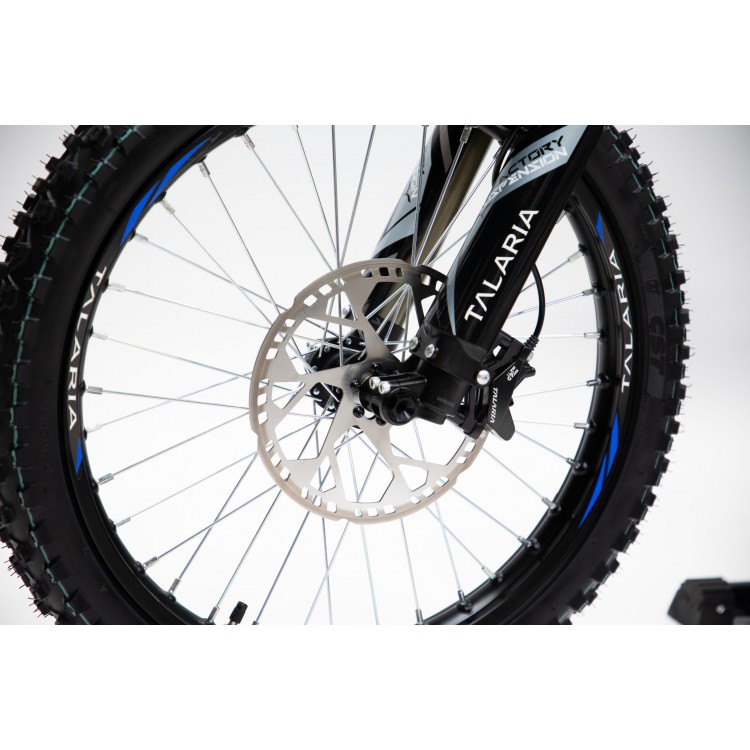
The bike block on the sheet is long, but only a handful of lines touch Talaria Sting R top speed. Net weight 66 kg including the battery. Wheel size 19 inch front and rear, with a 70/100 front tyre and an 80/100 rear. Seat height 840 mm. Brake discs 220 mm by 2.3 mm with four piston calipers. Ground clearance 300 mm. Dimensions 1880 by 770 by 1088 mm on a 1250 mm wheelbase.
Weight and tyre size
At 66 kg the Sting R is around 9 kg heavier than the X3 Concept, which costs a little in acceleration and returns it in stability at speed. The 19 inch wheels and 80/100 rear tyre give a taller rolling circumference than the X3’s 17 inch supermoto rear, which is part of why the same 60V motor family produces a 53 mph Talaria Sting R top speed here and 47 mph there. Change the rear tyre size and the true speed changes with it, so update the wheel setting on the display when you do.
Brakes sized for the ceiling
The 220 mm discs and four piston calipers were uprated because Talaria Sting R top speed rose from 47 to 53 mph, and stopping from the higher figure dissipates roughly a quarter more energy. Four level regenerative braking, adjustable on the display, slows the bike before the pads work, which extends pad life and range.
Holding 53 mph outside the lab
Talaria Sting R top speed assumes a full battery, a moderate weight rider and firm level ground. Outside those conditions a few simple rules apply, and knowing them settles most arguments about whose Sting R is faster.
- Rider weight: the Sting R is rated for a 100 kg load, and a rider near that figure will take longer to reach the ceiling and lose more of it on a gradient than a 70 kg rider
- Battery state: expect the best figure above roughly two thirds charge, with a gradual fall away below that
- Mode: the lower power mode trims peak current and softens the throttle, which slows the run to the ceiling without changing the ceiling itself
- Surface: wet grass, sand and loose gravel raise rolling resistance enough to keep the bike a few mph short of its maximum
- Wind and posture: above 40 mph aerodynamic drag grows quickly, and sitting upright into a headwind can cost more than any other single factor
- Temperature: a cold pack delivers less current, so a winter morning run will read lower than the same run in July
None of this changes the Talaria Sting R top speed printed on the sheet. It changes how often you see it. A rider who wants the number on the display to match the number in the brochure should ride a fully charged bike, in the higher mode, on firm ground, with the 44T sprocket, and tuck in.
Road legal versions and UK limits
Two road legal Stings share this chassis, and neither of them uses the full Talaria Sting R top speed on a public road. The Sting Road Legal L1e is registered as a moped class vehicle under EU Regulation 168/2013, which limits it to 45 km/h, a little over 28 mph; the listing rounds this to 30 mph. It can be ridden from 16 with a CBT, a provisional licence, registration, a number plate, insurance and a helmet.
The L3e, 125 equivalent
The Sting L3e Road Legal is homologated in the L3e A1 class, the 125 cc equivalent, with 3500W of rated power, a 45Ah pack, 71 kg all up and a listed maximum of 53 mph. Riding it needs age 17 plus a CBT, or an A1, A2 or A licence, together with registration, insurance and an MOT when due. The rules for each class are set out on the gov.uk motorcycle and moped licence pages.
Where the 53 mph belongs
The full Talaria Sting R top speed belongs on the MX off road versions, ridden on private land with the landowner’s permission. Off road Stings cannot be used on public roads, byways, bridleways, footpaths or pavements in the UK, and raising the limiter on an L1e bike takes it outside its registered category and voids the insurance. Our guide to whether Talarias are legal in the UK covers the paperwork in full.
Frequently asked questions
What is the Talaria Sting R top speed on the standard MX4?
The Sting R MX4 specification lists a maximum speed of 53 mph, which is 85 km/h, from a 60V system producing 4000W continuous and 8000W peak. That figure is the controller limited ceiling on a full battery with a moderate weight rider on firm level ground, and it applies to the MX off road version only.
Is the Sting R Pro top speed higher than the standard bike?
The bike riders call the Pro is the Sting R MX4 Expert with the Manitou fork. Its sheet lists 55 mph against the MX4’s 53 mph Talaria Sting R top speed, with 50 Nm of motor torque and a 10 percent increase in peak power. The gain comes from power rather than voltage, so it reaches the ceiling more readily rather than rewriting it.
Does the 48T sprocket lower the Talaria MX4 top speed?
The 48T sprocket raises the overall ratio from 8.35 to 9.18 to one, which improves acceleration and hill climbing and lowers the geared ceiling by almost 10 percent. Because the 53 mph figure is applied by the controller, the 44T sprocket runs under the limiter with headroom and the 48T runs closer to its mechanical maximum.
How fast is the road legal Sting R on UK roads?
The L1e version is limited to 45 km/h, a little over 28 mph, as a moped class vehicle. The L3e version, in the 125 equivalent class, lists 53 mph and needs age 17 plus a CBT or a full A1, A2 or A licence. Neither road legal version should be derestricted, as that removes it from its registered category and voids the insurance.
Why does my Sting R show less than 53 mph on the display?
The most common causes are a battery below two thirds charge, the lower power mode, soft or wet ground, a heavy rider sitting upright into a headwind, and a rear tyre size that does not match the wheel setting on the dash. Correct those and a healthy MX4 on the 44T sprocket will reach its listed Talaria Sting R top speed.
Next steps
Talaria Sting R top speed is a sheet figure you can now read properly. If the 53 mph MX4 or the 55 mph Expert is the right bike, the Talaria Sting range lists every version we stock, and our Talaria Sting R vs MX5 comparison sets it against the 72V bike for riders who want more. UK mainland delivery is available with timescales confirmed at checkout, and every Sting is covered by our UK warranty, full terms on the warranty page.
