
Uncategorized
Talaria Sting Pro Top Speed Against a Petrol 125 and a Petrol 250
Jun
Talaria Sting Pro top speed is usually discussed as a number on a sheet, when the question most UK riders are really asking is how the electric Sting stacks up against the petrol dirt bikes they grew up on. This guide sets out the speed figures for every Sting, from the MX3 through the Sting R to the Sting Pro MX5, using only the manufacturer sheets, then compares the family qualitatively with a four stroke 125 and a four stroke 250.
Which bike is the Sting Pro
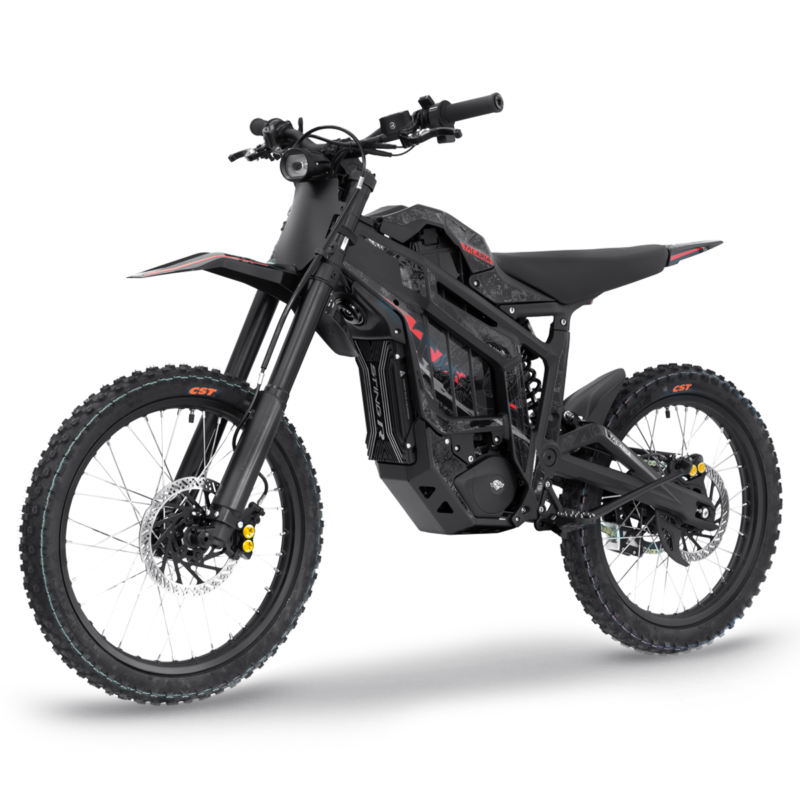
Talaria’s naming has drifted over three generations, so any Talaria Sting Pro top speed answer has to fix the terms first. The original Sting is the TL3000, sold today as the Sting MX3. The Sting R is the TL4000, sold as the Sting R MX4 and the MX4 Expert. The Sting Pro is the TL5500, the 72V bike most riders call the MX5 Pro. When someone asks about Talaria Sting Pro top speed they mean the 72V machine.
Three bikes, one chassis
All three share the forged aluminium chassis, a mid mounted motor driving through a gearbox and chain, and 19 inch wheels, so the gap between Talaria Sting Pro top speed and the rest is almost entirely electrical.
Talaria Sting Pro top speed on paper
The Sting Pro MX5 sheet is candid in a way that surprises people. Under Power it lists nominal voltage 72V DC, maximum speed factory limited to 32 km/h (20 mph), rated power 5.5 kW unrestricted and peak power 13.4 kW unrestricted. That 20 mph is the delivery state. Talaria prints no unrestricted top speed for the Pro on the sheet, so the honest statement of Talaria Sting Pro top speed is: 20 mph as shipped, with an unlocked figure the manufacturer does not publish.
Why the Pro is nevertheless the fastest Sting
Two lines on the same sheet place Talaria Sting Pro top speed at the top of the family without a number. The 72V pack sits 12V above the 60V Sting R, and pack voltage sets a permanent magnet motor’s maximum rpm. The 13.4 kW peak is a 45 percent increase over the 60V models. Higher ceiling, more power to reach it: the Pro is faster than a 53 mph Sting R once unlocked for private land, even if nobody prints by how much.
Hyper mode and the 428 chain
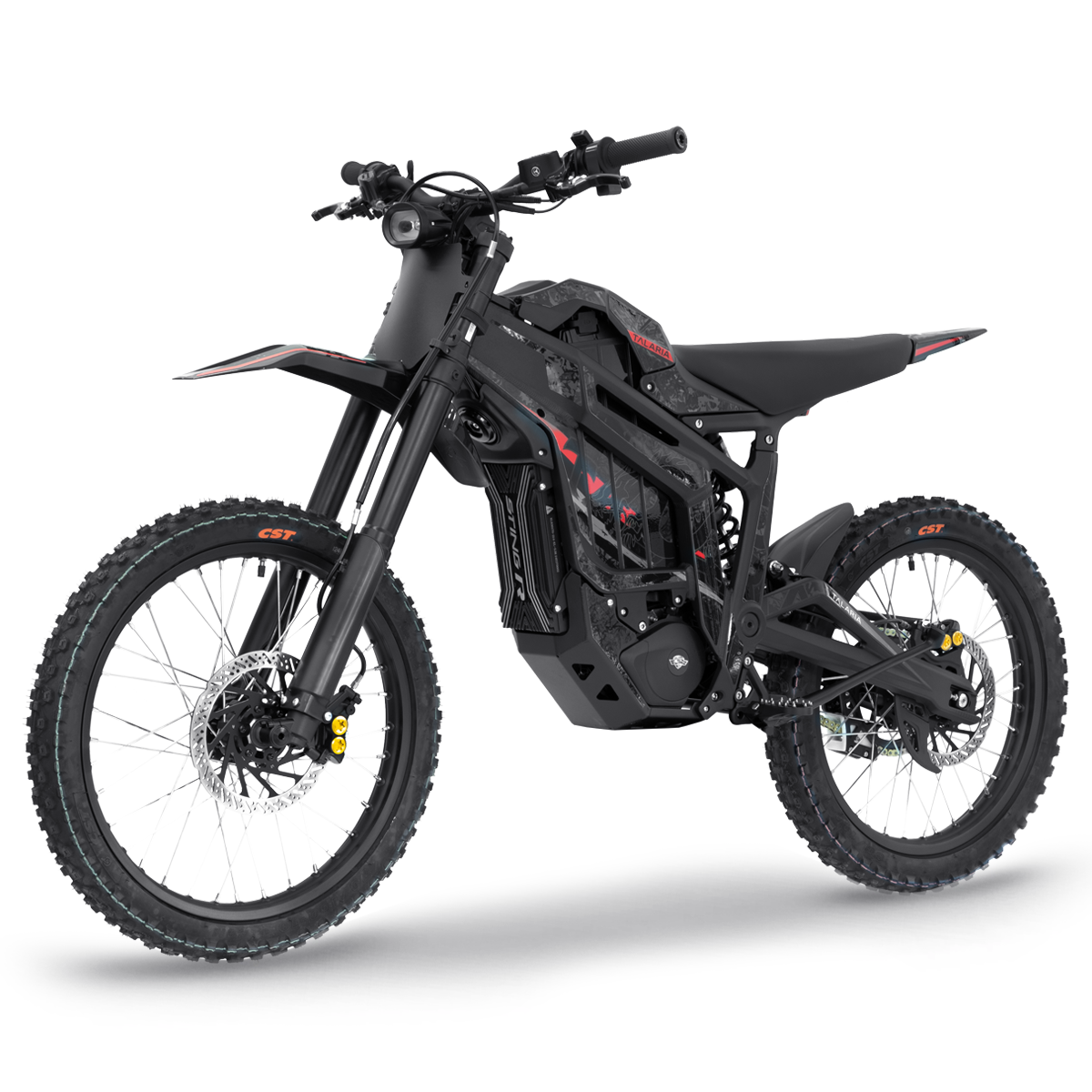
The Pro adds a third ride mode, Hyper, unique to the MX5 in the Sting range and the only mode that releases the full 13.4 kW, so it is the only mode in which Talaria Sting Pro top speed means anything. It also moves to a heavier 428 chain and 48T sprocket, quoted at 500 Nm at the rear wheel, gearing that favours acceleration and climbing over a long straight.
How fast does the Talaria MX3 go
How fast does the Talaria MX3 go? The MX3 sheet is the most complete in the family and gives a straight answer: maximum speed 47 mph, which is 75 km/h. That figure comes from a 60V permanent magnet synchronous motor rated at 3,000 W nominal and 6,000 W peak, producing 34 Nm at the shaft and 284 Nm at the rear wheel with the 44T sprocket, or 309 Nm with the 48T. The gear ratios are 8.35 and 9.18 respectively.
What feeds the MX3 figure
The MX3 carries a 60V 38.4Ah pack of LG 21700 cells, 2,280 Wh, weighing 12.85 kg, and a 7 kg motor with 92 percent peak efficiency. Talaria quotes 100 km of range at a steady 32 km/h and a charge time of around 3 hours. The Talaria MX3 top speed of 47 mph is the ceiling of a 6 kW, 60V system, and the baseline every other Sting steps up from.
MX3 against Sting R
Step to the Sting R MX4 and the sheet moves to 8,000 W peak, 45 Nm and a 53 mph (85 km/h) maximum, on the same 60V with a 45Ah pack and an IPM motor. The MX4 Expert adds 10 percent peak power and lists 55 mph. So the Talaria Sting top speed ladder runs 47, 53, 55 mph on the 60V bikes, then the 72V Pro, whose Talaria Sting Pro top speed sits above them all. Our Sting R top speed guide reads that sheet line by line.
The Sting ladder in one table
Every figure below, Talaria Sting Pro top speed included, is lifted from the product specifications on this site. Where a sheet does not give a figure the cell says not published, because that is more useful than a guess.
| Model | Voltage | Peak power | Battery | Sheet top speed | Use |
|---|---|---|---|---|---|
| Sting MX3 (TL3000) | 60V | 6 kW | 38.4Ah LG, 2,280 Wh | 47 mph (75 km/h) | Off road, private land |
| Sting R MX4 (TL4000) | 60V | 8 kW | 45Ah LG, 2,700 Wh | 53 mph (85 km/h) | Off road, private land |
| Sting R MX4 Expert | 60V | 10 percent above MX4 | 45Ah LG | 55 mph | Off road, private land |
| Sting Pro MX5 (TL5500) | 72V | 13.4 kW | 40Ah Samsung 50S, 2,880 Wh | Factory limited to 20 mph (32 km/h); unlocked figure not published | Off road version private land; road legal version at its homologated limit |
| Sting Road Legal L1e | 60V | 6 kW | 38.4Ah LG | Limited to 45 km/h (about 28 mph) as an L1e B moped | Public road, age 16 with CBT |
| Sting L3e Road Legal | 60V | Listed at 3.5 kW | 45Ah | Listed at 53 mph | Public road, age 17 with CBT or A1 licence |
Reading across the rows
The pattern is voltage first, power second. Every 60V bike lands between 47 and 55 mph regardless of battery size, because the ceiling is electrical rather than chemical. Only the 72V Pro escapes that band, which is why Talaria Sting Pro top speed is the family’s high mark even without a printed unlocked figure, and only the road legal versions sit below it, held there by law rather than hardware.
Sting against a petrol 125
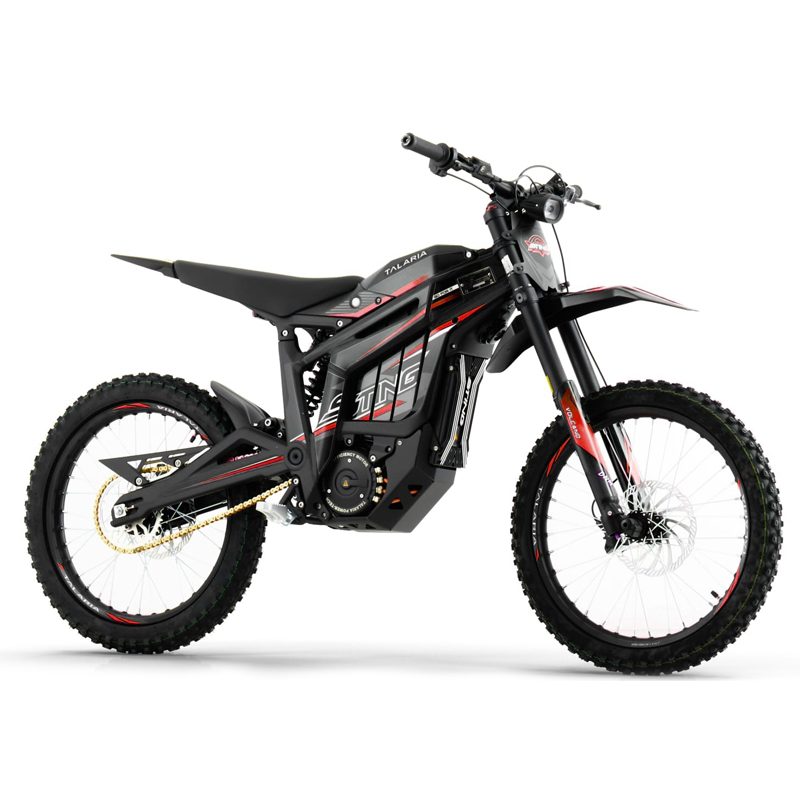
Most riders coming to a Talaria from petrol have owned a four stroke 125 trail bike, and the comparison is instructive because the headline speeds, Talaria Sting Pro top speed included, are close. On a long enough straight a geared 125 will run past a 47 mph MX3 and stay ahead of a 53 mph Sting R. That is the whole of the petrol bike’s advantage, and it is a narrow one.
Where the Sting is ahead
Everywhere the track is tight. A 125 four stroke makes its power high in the rev range and reaches it through a clutch and five or six gears. The Sting delivers its 284 Nm or more at the rear wheel from zero rpm, with no clutch, no gear to find and no stall. Out of a slow corner, up a short steep bank, through a wooded section where you never see fourth gear, the electric bike is simply gone before the 125 rider has found the power band, and none of that depends on Talaria Sting Pro top speed.
Where the 125 is ahead
Sustained speed. A petrol engine holds its top speed while there is fuel in the tank, whereas Talaria Sting Pro top speed and every 60V Sting ceiling drift down as pack voltage falls. A 125 also carries its performance up a long climb without heat limiting, where the Sting’s 3 kW or 4 kW continuous rating eventually asserts itself. On long open fire roads the 125 keeps company with a Sting R more easily than the sheet suggests.
Weight, noise and access
The road legal L1e Sting lists 58 kg with its battery and the Sting R 66 kg, far below a typical 125 dirt bike, and that is felt in every direction change and every pick up after a fall, on tight ground it matters more than Talaria Sting Pro top speed does. The Sting is also near silent, which is why landowners who will not tolerate a petrol bike often accept an electric one.
Sting Pro against a petrol 250
The 250 four stroke is a different conversation. A modern 250 enduro or motocross bike is a serious competition machine with a top speed and a sustained power output well beyond anything in the Sting range, and it would be dishonest to pretend the Talaria Sting Pro top speed puts it in the same bracket. The 250 will pull away on any open straight and keep pulling. The interesting question is where the Pro still holds its own.
The first fifty metres
From a slow corner the Pro’s 500 Nm at the rear wheel arrives instantly, and in Hyper mode the 13.4 kW peak needs no clutch or gear change. Over the first fifty metres out of a hairpin, on grip, a well ridden Pro is not embarrassed by a 250. Beyond that the petrol bike’s gearbox and sustained output take over, and Talaria Sting Pro top speed stops being the relevant number, and the Pro’s 5.5 kW continuous rating limits it on anything long or steep.
What the 250 rider gives up
Maintenance and access. A 250 four stroke needs valve checks, frequent oil changes, a clutch, and it makes the noise that closes land to riders. The Pro has an oil filled gearbox and a chain, and that is the service list, a fair trade for whatever Talaria Sting Pro top speed gives away on a straight. The Auto Cycle Union and local clubs are opening electric classes because a silent 76 kg bike can use ground a 250 cannot.
Picking between them honestly
If you race against the clock on fast open tracks, a 250 remains the tool. If you ride tight woods, private fields or land with a noise problem, a Sting Pro will get more riding days in a year than the 250, and on those days the Talaria Sting Pro top speed is rarely the limit. That case does not need an inflated figure to make it.
What moves the number on the day
Whether you are reading 47 mph on an MX3 or chasing Talaria Sting Pro top speed on private land, the same four variables decide what the display shows, and none of them are faults.
Ride mode
Eco and Sport on any Sting cap the power below peak, so Talaria Sting Pro top speed needs Hyper, the only mode that releases 13.4 kW. A run made in Sport shows a lower ceiling than one made in Hyper on the same bike, and neither reading is wrong.
Sprocket
The MX3 and Sting R sheets list 44T and 48T rear sprockets with ratios of 8.35 and 9.18. The 48T raises rear wheel torque from 284 Nm to 309 Nm on the MX3 and takes a slice off the top speed in return. The Pro ships on a 48T with the 428 chain, tuned for climbing and corner exit rather than for Talaria Sting Pro top speed.
Pack voltage
A pack starts above nominal and finishes below it, and Talaria Sting Pro top speed follows it down. Expect the last third of any Sting battery, 60V or 72V, to show a lower peak than the first third, and expect a cold pack in January to sag sooner than a warm one in July.
Tyres and surface
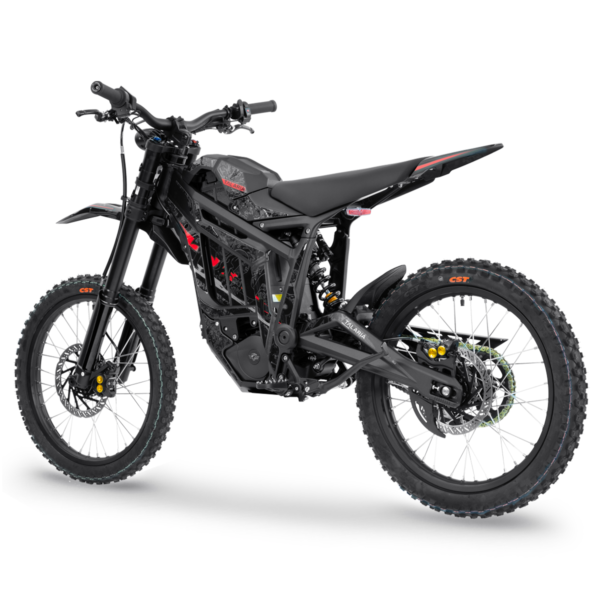
The 70/100 19 front and 80/100 19 rear off road tyres fitted across the family grip on loose ground and scrub speed on hard surfaces. Wet grass, deep ruts and a heavier rider each take a portion off whatever the sheet promises, and a light electric bike with a fixed voltage ceiling feels it more than a petrol bike does.
Road legal Stings and UK limits
Everything above, Talaria Sting Pro top speed included, applies to off road Stings on private land with the landowner’s permission. No off road Sting, MX3, Sting R or Pro, may be ridden on a public road, byway, bridleway, footpath or pavement in the UK, and lifting a limiter is for the off road versions only. For the road there are two homologated Stings, and their speeds are set by their vehicle class under EU Regulation 168/2013 rather than by the motor.
The L1e Sting
The Sting Road Legal L1e is an L1e B moped class vehicle limited to 45 km/h, about 28 mph, which the listing rounds to 30 mph. It can be ridden at 16 with a CBT and a provisional licence, with registration, a plate, insurance and a helmet. The limiter is part of the type approval and stays in place on the road.
The L3e Sting
The Sting L3e Road Legal sits in the L3e A1 125 equivalent class, ridable at 17 with a CBT or on an A1, A2 or A licence, with registration, insurance and an MOT when due. Its listing quotes 53 mph. The full licence steps are on the gov.uk motorcycle and moped guide, and our UK legality guide covers the detail.
Frequently asked questions
What is the Talaria Sting Pro top speed from the factory?
The Sting Pro MX5 sheet lists a maximum speed factory limited to 32 km/h, which is 20 mph, alongside 72V, 5.5 kW rated and 13.4 kW peak, both marked unrestricted. Talaria does not publish an unlocked Talaria Sting Pro top speed. Unlocking is for the off road version on private land only, and the Pro is faster than the 53 mph Sting R in that state.
How fast does the Talaria MX3 go compared with the Sting R?
The MX3 sheet gives 47 mph (75 km/h) from a 6 kW peak, 60V system. The Sting R MX4 gives 53 mph (85 km/h) from 8 kW peak on the same voltage, and the MX4 Expert lists 55 mph. All three are off road bikes for private land, and the difference between them is peak power rather than voltage.
Is a Talaria Sting faster than a petrol 125 dirt bike?
Out of corners and on tight ground, yes, because the Sting delivers its full rear wheel torque from zero rpm without a clutch or gears. On a long open straight a geared four stroke 125 will edge past a 47 mph MX3 and stay ahead of a 53 mph Sting R, and it will hold that speed for longer than a battery whose voltage is falling.
Can a Sting Pro keep up with a 250 four stroke?
Not on open ground, where Talaria Sting Pro top speed runs out first. A 250 enduro or motocross bike has a higher top speed and far more sustained output than the Pro’s 5.5 kW continuous rating. The Pro competes over the first fifty metres out of a corner thanks to 500 Nm at the rear wheel and Hyper mode, and it wins on silence, maintenance and the amount of land you are allowed to ride.
What is the Talaria Sting top speed on the road legal versions?
Neither figure is the Talaria Sting Pro top speed. The L1e Sting is limited to 45 km/h, about 28 mph, as an L1e B moped, and the L3e Sting lists 53 mph in the 125 equivalent class. Both limits are part of the type approval. Removing a limiter on a road legal Sting invalidates its approval and its insurance, so derestriction belongs only on the off road models on private land.
Next steps
Talaria Sting Pro top speed is only half of any buying decision. If the petrol comparison has settled which Sting you want, the full Talaria Sting range is available with UK mainland delivery, timescales confirmed at checkout. Riders moving from a 125 will find the Sting R MX4 the natural step; riders leaving a 250 should read the Sting Pro MX5 listing and our Sting R versus MX5 comparison.
