
A UK guide to the Talaria Komodo covering its place in the range, the 32 kW powertrain, chassis and electronics, who it suits, and where an owner can ride it.
Talaria Komodo
The Talaria Komodo is the most powerful bike Talaria has built, a 98 kg midweight with a 32kW peak motor, 754Nm at the rear wheel and a 96 volt battery, and it moves the brand into territory that used to belong to 350 and 450 class petrol enduro machines. This page covers where it sits in the range, the full specification, what the chassis and electronics actually do, and exactly where a UK owner can ride it.
Where the Komodo sits in the Talaria range
Until 2025 every Talaria was a lightweight: the Sting family at 58 to 76 kg and the X3 family at around 53 kg, all with 60 or 72 volt systems and peak outputs between 6kW and 13.4kW. The Talaria Komodo, model code TL6000, was shown to press and distributors on 17 April 2025 and released in July. It is a different class of vehicle. Wheels are 21 inch front and 18 inch rear, the seat is 910mm from the ground, and the battery alone weighs 24.5 kg.
The closest comparison inside the brand is the Talaria Dragon, which shares the 21 and 18 inch wheel sizes and a similar weight but uses an 88 volt pack and a 28kW peak motor. The Talaria Komodo is the more powerful of the two and the one aimed squarely at riders stepping across from petrol enduro bikes. Both sit in their own categories; the Dragon has its own Talaria Dragon page.
One bike, one specification
Unlike the Sting, there is a single Talaria Komodo 2025 listing rather than a ladder of versions, and it is sold as an off road vehicle. There is no L1e or L3e Talaria Komodo in the UK range at the time of writing. If a homologated version is released it will appear on our road legal Talaria category alongside the Sting L1e and L3e.
Talaria Komodo specifications
The figures below are the factory specification for the Talaria Komodo. Range and top speed are quoted at a steady speed on a flat surface; both fall on rough ground, in Hyper mode and with a heavier rider.
| Area | Specification |
|---|---|
| Motor | Mid mounted permanent magnet synchronous, air cooled, 8.6kW rated, 32kW peak |
| Torque | Over 90Nm peak at the motor, 754Nm peak at the rear wheel |
| Battery | 97.2V nominal, 45Ah, Samsung 50S or LG H51 21700 cells, 24.5 kg, IP67 |
| Top speed | 105 km/h (about 65 mph) |
| Range | 115 km at 45 km/h |
| Ride modes | Eco, Sport, Hyper and Reverse |
| Regenerative braking | Four levels, adjusted by a handlebar button |
| Transmission | Gearbox primary, 520 chain, 14 or 15 tooth front, 50 or 53 tooth rear |
| Frame | Forged alloy |
| Front suspension | Dual chamber air fork, 43mm tubes, 850mm length, 250mm travel |
| Rear suspension | Air shock, 350mm length, 90mm stroke, 500 to 720 lb spring |
| Wheels | 1.6 x 21 front, 2.15 x 18 rear |
| Tyres | CST 70/100 front and 90/100 rear, or Maxxis 80/100 front and 110/90 rear |
| Brakes | Hydraulic discs front and rear |
| Dimensions | 2,200 x 810 x 1,220mm, 1,380mm wheelbase |
| Seat height | 910mm |
| Ground clearance | 315mm |
| Weight | 98 kg net |
| Maximum load | 160 kg |
| Display | TFT, 320 dpi, 167 degree viewing angle |
Powertrain: 32kW, 754Nm and a 96 volt pack
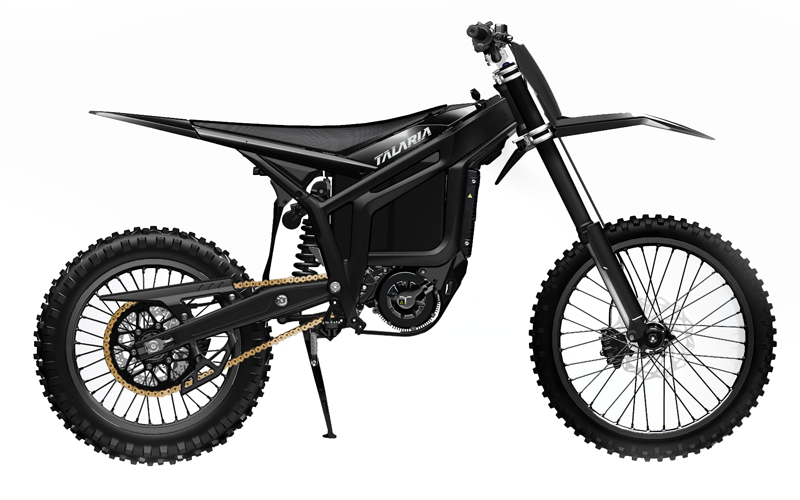
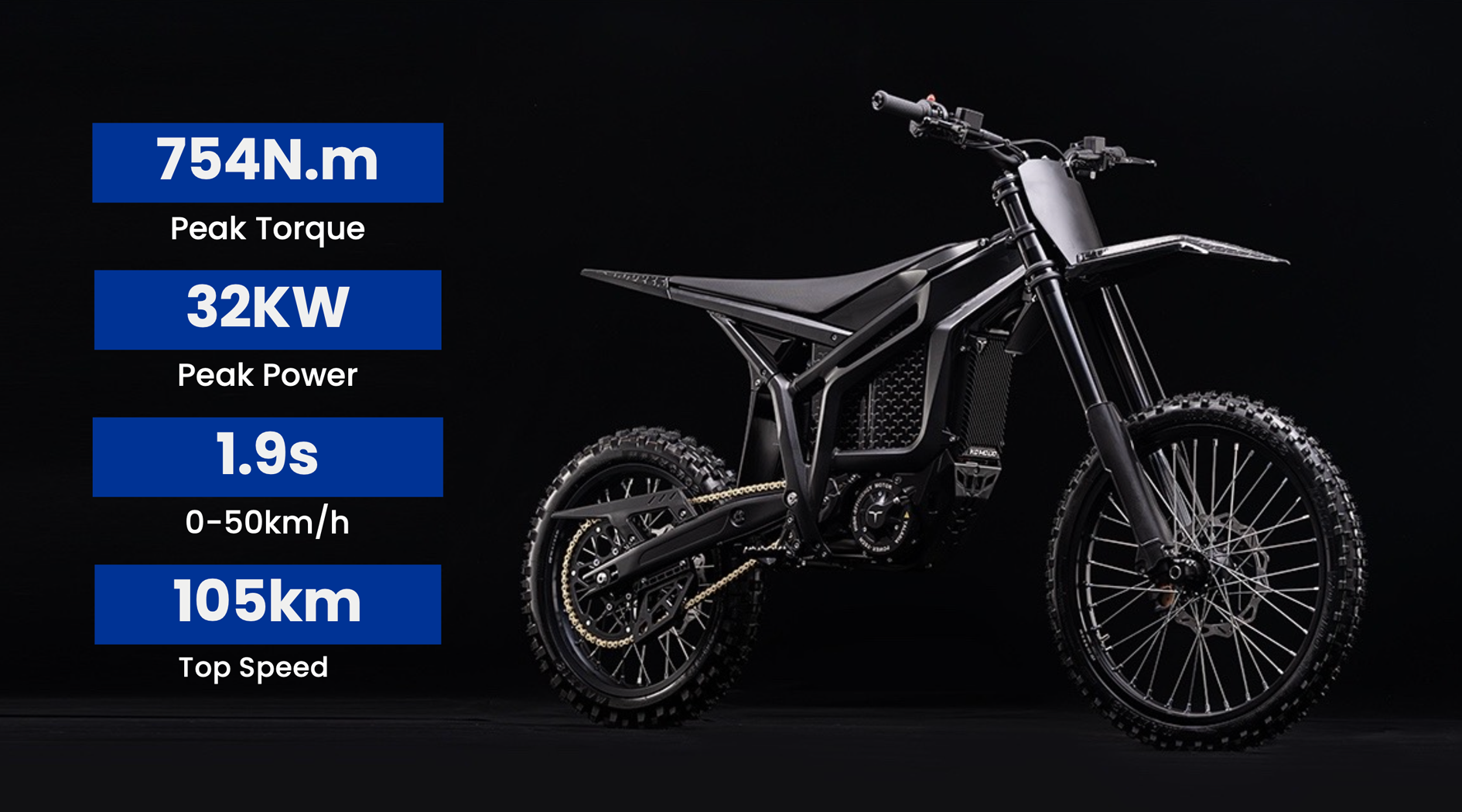
The Talaria Komodo motor is a mid mounted, air cooled permanent magnet synchronous unit rated at 8.6kW continuous with a 32kW peak. Peak torque at the motor is quoted at over 90Nm, and the gearbox primary drive and 520 chain multiply that to 754Nm at the rear wheel. For context, the Sting R MX4 delivers 8kW peak and the MX5 Pro 13.4kW, so the Komodo has more than double the output of anything else in the lightweight range.
Power for the Talaria Komodo comes from a 97.2 volt nominal pack, usually described as 96 volt, built from Samsung 50S or LG H51 21700 cells at 45Ah. That is roughly 4.4kWh of stored energy, sealed to IP67 and weighing 24.5 kg. The pack is removable, and the factory range figure is 115 km at a steady 45 km/h. Charging uses the supplied charger; the higher voltage means it is not interchangeable with any Sting or X3 charger.
Ride modes and regen
Four modes are selectable from the bars. Eco softens the throttle map and caps power for range and slippery surfaces. Sport is the everyday setting. Hyper unlocks the full 32kW and is the mode that produces the acceleration the Talaria Komodo is known for. Reverse is a low speed backwards crawl, which sounds like a gimmick until you have to extract 98 kg from a ditch on your own. Regenerative braking has four levels set from a dedicated button, so you can raise it for a long descent and drop it for a loose climb without stopping.
Komodo top speed
The factory quotes 105 km/h, about 65 mph. Our Talaria Komodo top speed article explains why the figure depends on sprocket choice (14 or 15 tooth front, 50 or 53 tooth rear), rider weight and remaining charge, and why a 96 volt system holds its speed as the pack drains better than a 60 volt bike does.
Chassis, suspension and brakes
The Talaria Komodo frame is forged alloy rather than welded tube, which is where much of its stiffness comes from. The geometry is full size enduro: a 1,380mm wheelbase, 26 degrees of forward tilt, a steering angle beyond 45 degrees and a minimum turning radius of 2.1 metres. Ground clearance is 315mm, and a 520 chain guide protects the drive from rocks and roots.
The Talaria Komodo runs air suspension at both ends. The fork is a dual chamber air unit with 43mm tubes, 850mm long, giving 250mm of travel. The rear shock is 350mm long with a 90mm stroke and a 500 to 720 lb spring range. Wheels are a 1.6 x 21 front and 2.15 x 18 rear, the standard sizes for a full size dirt bike, which means tyre choice is wide open: the factory fits CST 70/100 and 90/100 or Maxxis 80/100 and 110/90 sections.
Brakes
Hydraulic discs front and rear, with the factory quoting braking efficiency figures of 3.64 and 3.09 metres per second squared. With 98 kg of Talaria Komodo plus rider and 754Nm on tap, the four level regen matters as much as the discs: run a higher regen level on descents and the mechanical brakes stay cool for when you need them.
Controller, throttle and display
The Talaria Komodo controller is a 140 volt platform using 36 high power MOSFETs and an M4 core microprocessor. The higher voltage headroom is what lets it sustain output rather than sag, and the faster processor supports more sophisticated motor control than the standard controllers in the Sting range. It is tuned specifically for this motor and battery; it is not a generic unit.
Dual hall throttle
Most electric motorcycles use a single hall sensor throttle. The Talaria Komodo uses two, with automatic switching if one path fails and cross checking between them to reject signal noise from electromagnetic interference, temperature drift and vibration. The practical result is a throttle that feels precise at low speed, where a 32kW bike could otherwise be snatchy, and that keeps working if a sensor is damaged in a crash.
Display
The Talaria Komodo dash is a TFT at 320 dpi with a 167 degree viewing angle, so it stays readable when you are standing on the pegs looking down at an angle. It shows speed, mode, battery state, regen level and the usual trip data, and it is where the sprocket and wheel settings are adjusted.
Who the Komodo is for, and who should buy a Sting
The Talaria Komodo electric bike is for riders who already ride a full size dirt bike, or who have outgrown a Sting and want the next step without leaving the brand. With a 910mm seat, 98 kg and 32kW, it rewards experience. A first electric dirt bike it is not, and we would rather say so than sell one to the wrong rider.
- Buy the Talaria Komodo if you are coming from a 250 to 450 class petrol enduro or motocross bike, you ride private land or organised events with real climbs and jumps, and you want a Komodo ebike that will not be embarrassed alongside petrol machines.
- Buy the Sting MX5 Pro if you want the most powerful lightweight, with 72 volts and 13.4kW, at 76 kg and an 840mm seat.
- Buy the Sting R Off Road if you are newer to the sport, ride tighter woodland, or want a bike you can lift into a van alone.
The Komodo versus Sting R comparison puts the two side by side on weight, power, seat height and running costs. The short version: the Sting R is a big electric mountain bike with a motorcycle motor; the Komodo is a motorcycle.
UK law: an off road machine
The Talaria Komodo is sold as an off road vehicle. It cannot be ridden on public roads, byways, bridleways, footpaths or pavements anywhere in the UK, and no amount of lights or mirrors changes that, because road use requires type approval in one of the L categories defined by Regulation 168/2013, followed by registration with the DVLA and insurance. The Komodo has neither approval nor a route to it in its current form.
Where you can ride it: private land with the landowner's permission, motocross and enduro practice tracks that accept electric bikes, and competition under the rules of the Auto Cycle Union. Searches for "Talaria Komodo road legal" usually come from riders hoping for an L3e version; there is none in the UK today, and our guide to Talaria legality explains what would need to change for that to happen.
Protective equipment
Off road use does not carry the legal helmet requirement that road use does, but a 65 mph, 98 kg motorcycle is not the place to economise. A helmet meeting the standards described in the GOV.UK helmet guidance, boots, knee braces and body armour are the minimum we would ride it in.
Living with a Komodo
Running costs are the reason many petrol riders switch to a Talaria Komodo. There is no fuel, no air filter to oil after every ride, no valve clearances and no exhaust. The gearbox holds oil and follows a change interval, the 520 chain and sprockets wear like any dirt bike's, and air suspension wants a pressure check before each outing. Wash it with a hose, not a pressure washer aimed at the battery or controller connectors, and dry it before storage.
Battery care
The 24.5 kg pack is IP67 rated, so rain and river crossings are fine, but the charging port and connectors deserve a dry cloth before plugging in. Store the bike part charged rather than full if it will sit for weeks, keep it above freezing, and never charge immediately after a hard ride in cold weather; let the cells come up to room temperature first. When a pack eventually reaches end of life, the GOV.UK batteries guidance explains responsible disposal.
Transport and storage
At 98 kg the Talaria Komodo needs a proper ramp and ideally a second pair of hands to load into a van, and a motorcycle stand rather than a bicycle stand for maintenance. It is 2,200mm long and 1,220mm tall, so measure the van before buying. Delivery is UK mainland, timescales confirmed at checkout, and the bike is covered by our UK warranty, full terms on the warranty page. Spreading the cost is possible through the Talaria finance page.
Frequently asked questions
Is it Talaria Comodo or Komodo?
Komodo, with a K, after the Komodo dragon. "Talaria Comodo" is a common misspelling in searches and on marketplace listings, so if you are looking for a used bike, search both spellings. The model code on the frame is TL6000, which is the reliable way to confirm what you are looking at regardless of how the seller has spelled it.
What is the Talaria Komodo top speed?
The factory figure is 105 km/h, about 65 mph, in Hyper mode with the standard gearing. The final drive offers a 14 or 15 tooth front sprocket and a 50 or 53 tooth rear, so owners can trade top speed for acceleration. A heavier rider, knobbly tyres and a pack below half charge all reduce the figure, as on any electric motorcycle.
How far does the Komodo go on a charge?
The quoted range is 115 km at a steady 45 km/h from the 45Ah, 97.2 volt pack. Hard off road riding in Hyper mode uses several times the energy of a steady cruise, so plan on a fraction of that for a day of enduro loops. Eco mode and a high regen level stretch the range considerably; our range guide covers the trade offs in detail.
Is the Talaria Komodo road legal in the UK?
No. The Komodo is sold as an off road vehicle without L category type approval, so it cannot be registered, insured or ridden on public roads, byways or bridleways. Private land with permission and organised events are the lawful options. If you need a road legal Talaria, the Sting L1e and L3e are the current choices and are listed on our road legal category page.
How does the Komodo compare with the Dragon?
Both are full size 21 and 18 inch wheel electric enduro bikes at around 100 kg. The Talaria Komodo runs a 97.2 volt, 45Ah pack with a 32kW peak motor and 754Nm at the wheel; the Dragon runs an 88 volt, 58.5Ah pack with a 28kW peak and 630Nm. The Komodo is the more powerful bike, the Dragon carries more energy. Each has its own category page with the full specification.
Do I need a licence to ride a Komodo electric bike?
No licence, CBT, registration or insurance is required to ride it on private land with the landowner's permission, because it is an off road vehicle used off the public highway. Those exemptions end the moment the bike touches a public road, byway or bridleway, where it cannot be used at all. Some practice tracks and event organisers require their own membership or day licence, so check before you travel.
Next steps
If you have read this far and the seat height, weight and power sound right, the Talaria Komodo 2025 product page has the colour options and specification in full. If you are not sure whether you are a Komodo rider or a Sting rider yet, read the Komodo versus Sting R comparison, or contact us with your riding background and we will give you a straight answer.