
Talaria Bikes Explained: Model Names, Generations and What the Numbers Mean
Talaria bikes are sold under a naming system almost nobody decodes on the first attempt, because one machine can appear as an X3, an XXX, a Triple X and an xXx depending on who wrote the listing. This is the range explainer, not a shortlist. It sets out how the families are named, how the Sting moved from MX3 to MX4 to MX5, where the Komodo and Dragon sit, why L1e and L3e are versions rather than models, and what each figure changes for a rider.
How Talaria names its bikes
Every name in the Talaria model range is assembled from three stacked parts: a family, a generation and a build. Once those layers separate in your head, the naming of Talaria bikes stops looking arbitrary. The factory also gives each platform a TL code, the most dependable identifier, because it survives whatever marketing name gets attached later.
The family
Three families cover all current Talaria models. The Sting is the gearbox platform. The xXx family, written XXX or X3 depending on the market, is the smaller belt driven platform. The Komodo and Dragon form the full size platform on 21 inch front wheels. Most questions about Talaria bikes resolve the moment the family is settled, because families differ in ways no specification tuning can bridge.
The generation
Inside the Sting family of Talaria bikes, the MX number is a generation marker, not a trim level. MX3 came before MX4, and MX4 before MX5. A higher number means a later revision of the same chassis carrying more voltage, more power and better brakes. The xXx family skips MX numbers and marks generations with words, most recently Pro.
The build
The suffix on Talaria bikes states what the machine is homologated as. MX is the off road build, L1e the moped class build, L3e the 125 equivalent build. Pro signals a higher specification within one generation, R marks the uprated Sting, and Expert, Black Edition and Competizione are builds layered onto a generation that already exists.
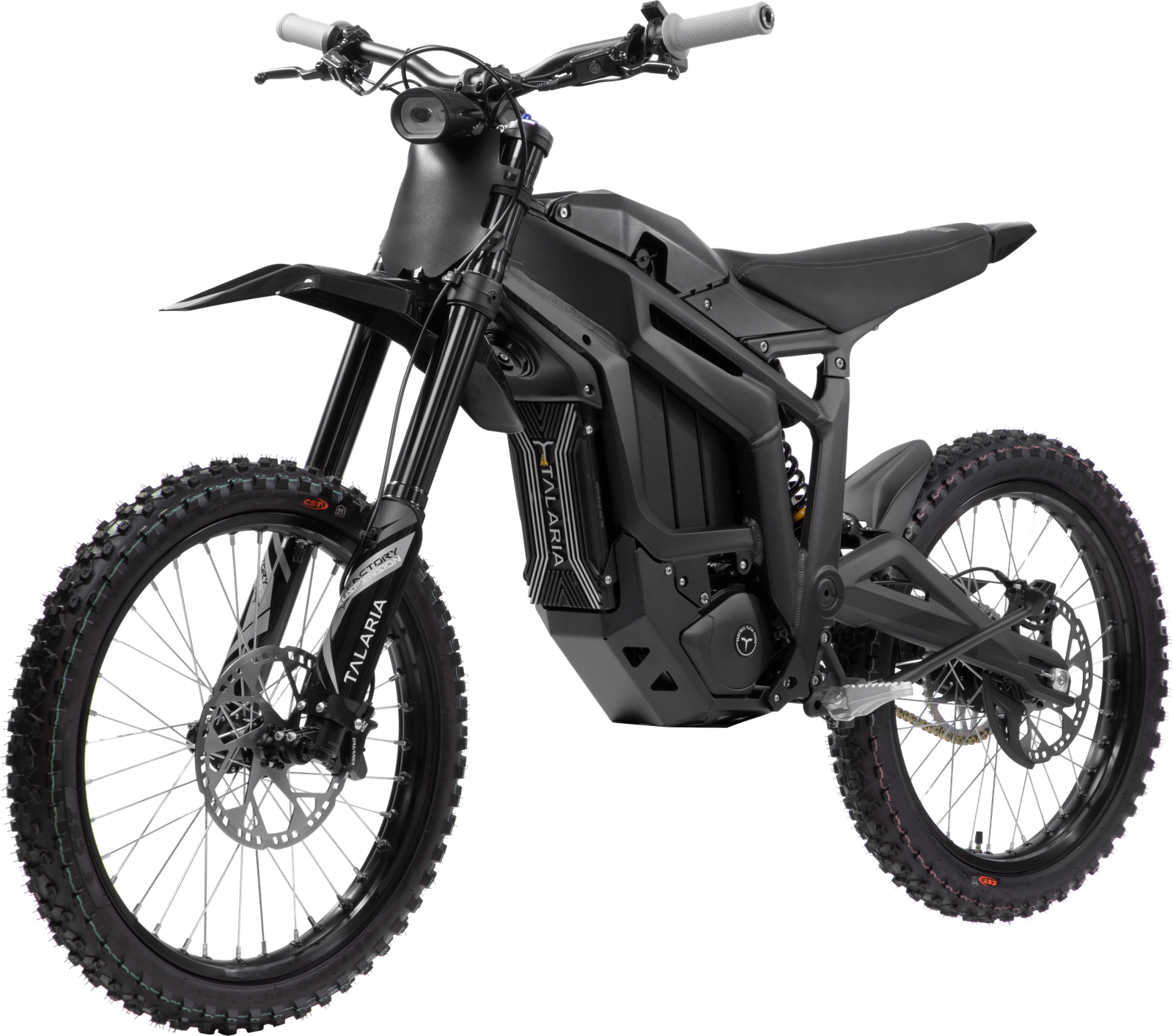
Why the same machine appears as X3, XXX, Triple X and xXx
This causes more confusion than everything else about Talaria bikes put together. X3, XXX, xXx, Triple X and 3X all describe the same lightweight platform, carried by the factory as TL2500. Three X characters read as a triple X, which shortens to XXX, which in turn gets typed as X3 by anyone describing three of them. The factory itself writes the platform as Talaria X3 (xXx).
What genuinely differs between these Talaria bikes is the build. The X3 Concept is the supermoto styled version on 17 inch wheels with an RFID start. The standard Talaria XXX and its XXX Black Edition sibling are the same platform in different colourways with a reinforced seat subframe. The XXX Pro 2025 is the real generational step.
The Pro replaced the single pivot rear end with a linkage lifting rear travel from 120mm to 160mm, fitted a 200mm travel fork, swapped supermoto wheels for a 19 inch front and 17 inch rear on knobbly tyres, and adopted the MX5 colour TFT display. At 53 kg it is the lightest of all current Talaria bikes. All share a 60V pack built from 128 LG M50 21700 cells wired 16s8p, quoted as 40Ah maximum and 38.4Ah nominal, or 2400Wh. The family sits in the Talaria XXX and X3 category.
The Sting generations, MX3 to MX4 to MX5
The Sting is the spine of the Talaria range and the reason most people start looking at Talaria bikes at all. Its defining feature has never changed across three generations: an internal gearbox drives the chain rather than a belt. That makes it quieter and takes belt replacement off the maintenance list, at the cost of a periodic oil change. The family lives in the Talaria Sting category.
MX3, the TL3000 generation
The Sting MX3 runs a permanent magnet synchronous motor, 3000W rated and 6000W peak, fed by a 60V 38.4Ah pack of LG 21700 cells holding 2280Wh. Peak motor torque of 34 Nm becomes 284 Nm at the rear wheel on a 44 tooth sprocket, and the rated maximum is 75 km/h.
MX4, the TL4000 generation
The fourth generation changed the motor type. The Sting R MX4 uses an interior permanent magnet motor with a magnetic encoder in place of hall sensors, rated at 4000W with an 8000W peak, on a 60V 45Ah pack holding 2700Wh. Rotors grew to 220mm with four piston calipers and the rated maximum rose to 85 km/h. It weighs 66 kg with the battery.
Two builds sit on that generation. The Sting R Off Road is the private land specification. The Sting R MX4 Expert brings CNC hubs, pegs and linkage, a Manitou Dorado Expert fork, Magura MT5 brakes on a 220mm disc, and roughly ten percent more peak power.
MX5, the TL5500 generation
The fifth generation is the voltage step. The Sting MX5 Pro moves to 72V with a 40Ah Samsung 50S pack holding 2880Wh, rated at 5.5 kW with a 13.4 kW unrestricted peak. It gains a third riding mode called Hyper alongside Eco and Sport, an adjustable air and dual spring fork with 220mm of travel, and a colour TFT display. Kerb weight is 76 kg.
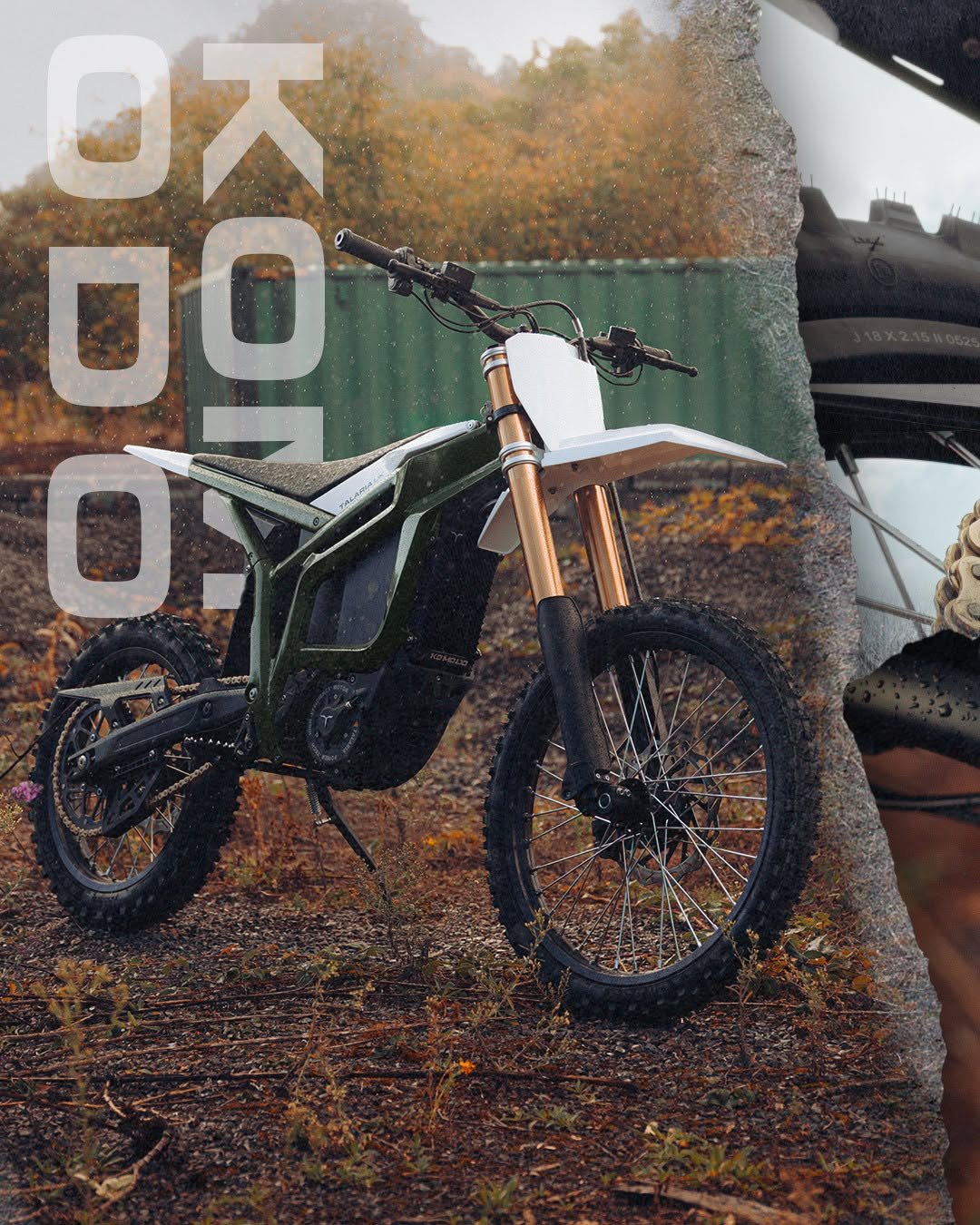
Komodo and Dragon, the full size platform
The third family is a different class of machine, not the next rung of one ladder. Both run 21 inch front and 18 inch rear wheels, weigh close to a petrol enduro bike, and carry seat heights that rule them out for shorter riders. Of all the Talaria bikes here, these two behave like full size motorcycles.
The Komodo 2025, carried as TL6000, uses a 96V 45Ah pack of roughly 4.4 kWh, rated at 8.6 kW and peaking at 32 kW, with 754 Nm reaching the rear wheel and a rated 105 km/h. It has a dual chamber air fork giving 250mm of travel, a 520 chain, four modes including reverse and a 910mm seat at 98 kg. See the Komodo category.
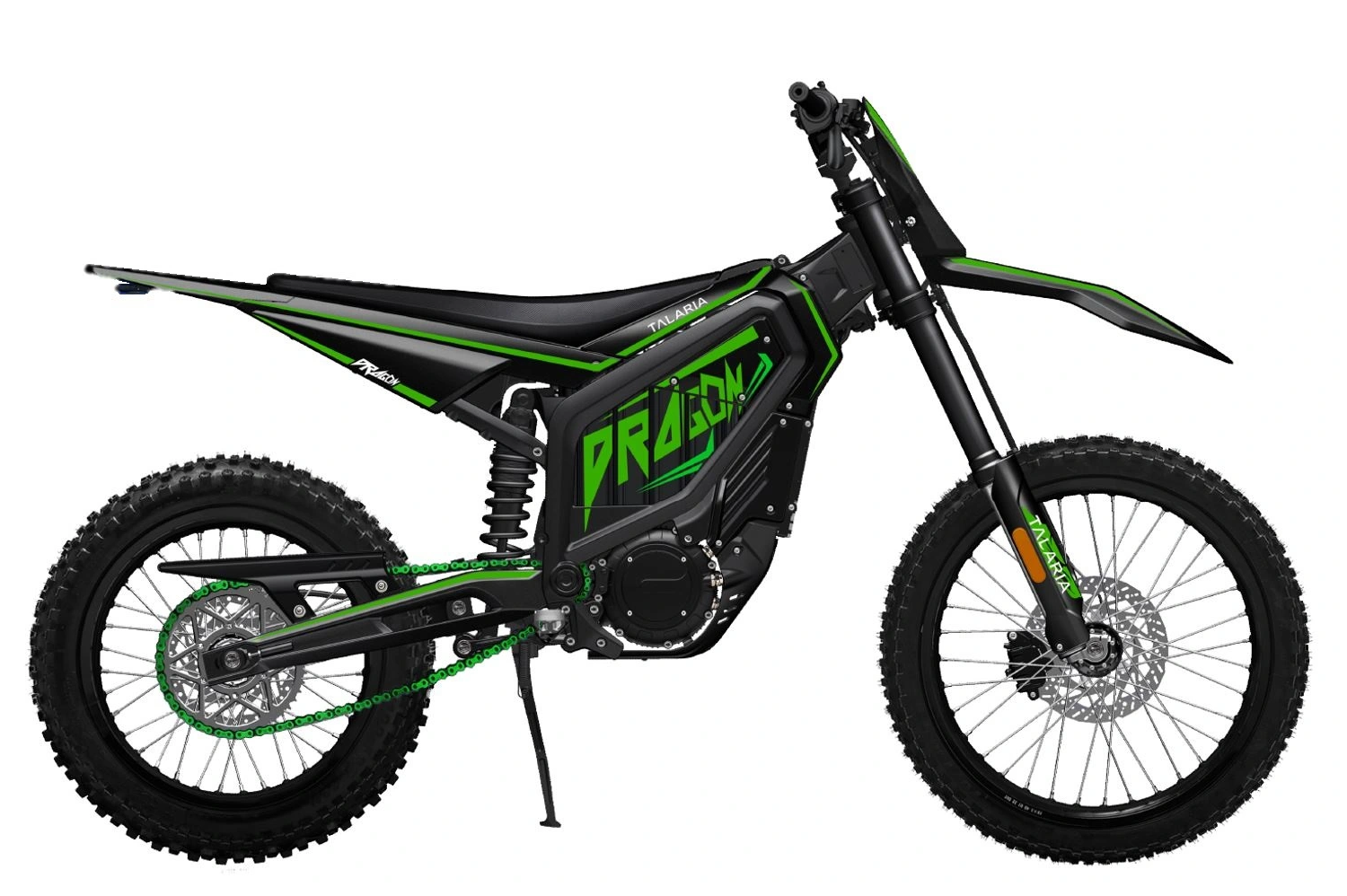
The Dragon 2025 goes further with a 5.2 kWh pack, 28 kW peak from 10 kW nominal, 630 Nm at the rear wheel on a 48 tooth sprocket, 150 km of range at 25 km/h and a rated 110 km/h, the longest figures across all Talaria bikes. At 100 kg it is offered as an off road build or an L1e road legal build with horn and indicators, in its own Dragon category.
L1e and L3e are versions, not separate models
A common mistake treats the road legal Talaria bikes as a model line of their own. They are not. An L1e or L3e Talaria is an existing model taken through type approval and fitted with the lighting, mirrors, horn, indicators and plate mounting the category demands. The chassis, motor and pack underneath are described above. The categories come from EU Regulation 168/2013 on the approval of L category vehicles, which the UK retained.
The Sting Road Legal L1e is the MX3 generation carrying moped class homologation, restricted in line with that category, ridable from 16 with a CBT, and supplied with a road legal headlight, brake light, mirrors, indicators and plate holder. The Sting L3E Road Legal covers the 125 equivalent class on a 60V 45Ah pack with a 3500W motor, 375 Nm at the rear wheel and a rated 53 mph at 71 kg.
All other Talaria bikes are off road equipment for private land with the landowner’s permission, and a plate bracket changes nothing about that. Licence and registration rules are in the government guidance on motorcycle and moped licences, the homologated selection is gathered in the road legal Talaria category, and closed course competition is governed separately by the Auto Cycle Union.
What the numbers on a specification sheet actually mean
A specification sheet for any of these Talaria bikes quotes a dozen figures, and only a handful change how the machine feels underneath you.
Voltage, amp hours and watt hours
Voltage sets how hard the system can push, amp hours how much charge it holds, and multiplying the two gives watt hours, the only figure that compares two packs fairly. A 60V 45Ah pack holds 2700Wh. A 72V 40Ah pack holds 2880Wh. The second is smaller in amp hours and larger in energy. Packs are also quoted two ways: the xXx pack is 40Ah maximum and 38.4Ah nominal, and nominal is the working figure.
Peak power against rated power
Rated power is what the system holds continuously. Peak power is what it delivers briefly before heat pulls it back. The MX4 is 4000W rated and 8000W peak. The gap matters because Talaria bikes worked up a long climb live nearer the rated figure, so two machines sharing a peak feel different.
Torque at the motor against torque at the rear wheel
The two figures differ by the gearing between them. The MX3 makes 34 Nm at the motor but 284 Nm at the rear wheel on a 44 tooth sprocket, rising to 309 Nm with a 48 tooth. On Talaria bikes, rear wheel torque is a property of the sprocket as much as the motor.
Gearbox against belt drive
The Sting, Komodo and Dragon use a gearbox for the primary drive. The xXx family uses a belt. A gearbox runs quieter and asks for oil. A belt is lighter and asks for inspection and eventual replacement. Neither is better in the abstract, and it is the one difference owners of Talaria bikes notice most in daily use.
Talaria bikes lineage at a glance
This table maps all current Talaria electric bikes to platform code, generation, pack and drive. It is the quickest way to place an unfamiliar listing and to see which Talaria bikes are the same thing under a different name.
| Model | Code | Generation | Battery | Primary drive | Wheels |
|---|---|---|---|---|---|
| X3 Concept | TL2500 | xXx supermoto | 60V 40Ah, 2400Wh | Belt | 17 inch |
| Talaria XXX | TL2500 | xXx standard | 60V 40Ah, 2400Wh | Belt | 17 inch |
| XXX Black Edition | TL2500 | xXx colourway | 60V 40Ah, 2400Wh | Belt | 17 inch |
| XXX Pro 2025 | TL2500 | xXx 2025 revision | 60V 40Ah, 2400Wh | Belt | 19 and 17 inch |
| Sting MX3 | TL3000 | Sting third | 60V 38.4Ah, 2280Wh | Gearbox | 19 inch |
| Sting R MX4 | TL4000 | Sting fourth | 60V 45Ah, 2700Wh | Gearbox | 19 inch |
| Sting R MX4 Expert | TL4000 | Sting fourth uprated | 60V 45Ah, 2700Wh | Gearbox | 19 inch |
| Sting MX5 Pro | TL5500 | Sting fifth | 72V 40Ah, 2880Wh | Gearbox | 19 inch |
| Competizione 50s and 45B | TL5500 base | Sting fifth, in house | 82V, 4060Wh or 3645Wh | Gearbox | 19 inch |
| Komodo 2025 | TL6000 | Full size | 96V 45Ah, 4.4 kWh | Gearbox, 520 chain | 21 and 18 inch |
| Dragon 2025 | Dragon | Full size | 88V, 5.2 kWh | Chain | 21 and 18 inch |
Builds that sit outside the factory range
Two entries in the catalogue are not standard factory Talaria bikes. The Competizione 50s and the Competizione 45B are MX5 Pro chassis rebuilt in house around an 82V pack and an EBMX X9000 V2 controller. The 50s carries 220 Samsung 50S cells for 4060Wh and 21 kW. The 45B uses Molicel P45B cells for 3645Wh and 23 kW, trading roughly ten percent of range for the power.
Both are private land Talaria bikes for experienced riders and neither can be homologated. Controllers, motors and packs live in the Talaria parts category, with cells and chargers in batteries and chargers. Clubs, hire fleets and resellers should start at Talaria wholesale.
Frequently asked questions
What is the difference between the Talaria XXX and the Talaria X3?
In naming terms there is none, because both refer to the same TL2500 platform. In build terms the X3 Concept is the supermoto specification on 17 inch wheels with an RFID start, while the XXX is the same chassis in other colourways. Only the XXX Pro 2025 is genuinely different.
What does the MX number on a Sting mean?
It is the generation of the Sting platform, counted upwards over time. MX3 is the 3000W generation, MX4 the 4000W generation with the interior permanent magnet motor, and MX5 the 72V generation. It is not a trim level, and it says nothing about the suspension, which varies by build.
Is the Sting R the same bike as the MX4?
Yes. R is the uprated designation applied to the fourth generation Sting, so Sting R and MX4 describe one machine, used interchangeably. The Off Road and Expert builds are variants of it. A listing carrying both terms is not describing two Talaria bikes, only repeating one identifier twice.
Which Talaria bikes can be ridden on a UK road?
Only the homologated builds: the Sting Road Legal L1e in the moped class, the Sting L3E Road Legal in the 125 equivalent class, and the L1e version of the Dragon. All other Talaria bikes are off road equipment, usable on private land with the landowner’s permission and nowhere else, not byways, bridleways or footpaths.
Do all Talaria bikes use the same battery?
No, and packs are not interchangeable across families. The xXx family uses a 60V 2400Wh pack built into the frame. The Sting uses a swappable 60V pack at 2280Wh or 2700Wh, or 72V and 2880Wh on the MX5. The Komodo runs roughly 4.4 kWh at 96V and the Dragon 5.2 kWh, both far heavier.
Does a higher voltage always mean a quicker machine?
Not on its own, and it is the most common mistake made when comparing Talaria bikes. Voltage raises the ceiling, but the controller decides how much current passes and the gearing decides what reaches the rear wheel. The MX5 at 72V beats the MX4 at 60V because the controller and motor were changed to suit.
Next steps
Now browse Talaria bikes by family: the Sting range for the gearbox platform, the XXX and X3 range for lightweight belt driven machines, and the Komodo or Dragon for full size bikes. If you are choosing between two candidates, the buying shortlist ranks models by rider type. To spread the cost, start at the finance page.