
Uncategorized
Talaria Range Guide: How Far Does a Talaria Go on One Charge?
Jun
Talaria range is the question we field more than any other at The Talaria UK, and the honest answer is that it depends on which model you ride, how fast you ride it and what the ground is doing under you. Talaria publishes a range figure for every bike, but each one is tied to a specific test speed, and a number recorded at a steady 25 km/h says very little about a muddy afternoon in Hyper mode. This guide sets out the official figures with their conditions, explains what actually drains a pack, and gives you a realistic picture of each model.
What the spec sheet range figure really means
Every Talaria range figure on a spec sheet is a maximum, and every one of them has a speed attached to it. The Sting R MX4 is rated at 120 km at 25 km/h. The Sting MX3 is rated at 100 km at 32 km/h. The Komodo is rated at 115 km at 45 km/h. Those speeds are not incidental. They tell you the bike was ridden at a constant, gentle pace on level ground with no stops, no climbs and no wheelspin, which is the kindest test an electric motorcycle can face.
Why a constant speed test flatters every bike
At 25 km/h a Talaria motor is barely working. Aerodynamic drag is tiny, the controller is drawing a fraction of its rated current and the gearbox is turning at a speed where its efficiency is high. Double the speed and the drag roughly quadruples. Add a climb and the motor has to lift the combined weight of bike and rider against gravity, which is where the real current goes. So every published Talaria range figure is a ceiling, not an average, and the same convention applies across the electric dirt bike market.
Watt hours are the currency of range
If you want one number that predicts how far does a talaria go, it is the energy stored in the pack, expressed in watt hours. Amp hours alone can mislead, because a 40Ah pack at 72V holds more energy than a 45Ah pack at 60V. Multiply voltage by amp hours and you get a figure you can compare across the whole Talaria range, and the differences between models become obvious.
- Sting MX3: 60V 38.4Ah, quoted at 2280 Wh
- X3 and XXX: 60V 40Ah maximum, 38.4Ah nominal, 128 LG 21700 cells, 2400 Wh
- Sting R MX4 and MX4 Expert: 60V 45Ah, LG 21700 cells, 2700 Wh
- Sting MX5 Pro: 72V 40Ah, Samsung 50S cells, 2880 Wh
- MX5 Pro Competizione 45B: 81.4V 22s pack, 3645 Wh
- MX5 Pro Competizione 50s: 81.4V 22s pack, 4060 Wh
- Komodo: 97.2V 45Ah, quoted at 4.4 kWh
- Dragon: 88V 58.5Ah, approximately 5200 Wh
The Dragon carries more than twice the energy of a Sting MX3, and the Komodo roughly 60 percent more than a Sting R MX4. Energy is not the whole Talaria range story, because a heavier, more powerful bike spends more of it per kilometre, but it is the foundation everything else sits on. The Talaria battery guide goes deeper into cell types, BMS behaviour and how packs age.
What drains a Talaria battery on a real ride
Speed and throttle style
Speed is the biggest single factor in Talaria range. Holding a Sting R at 50 mph on an open track uses many times the energy of trundling along a private bridleway at 15 mph. Throttle style matters almost as much. Repeated hard launches out of corners pull peak current from the pack every time, and peak current is the least efficient way to use lithium cells. Smooth riders always go further than aggressive riders, on every model in the Talaria range.
Terrain, climbing and weather
Soft ground is a constant drag on the rear tyre, and wet clay and deep sand are the worst offenders. Climbing is the other big drain: every metre of ascent is paid for in energy, and a hilly enduro loop can halve the distance you would cover on flat forestry track. Cold weather cuts Talaria range by reducing the usable capacity of lithium cells and raising their internal resistance, so winter rides are shorter than summer rides on the same pack, and a battery stored in a warm room before you leave performs better than one left in a cold van overnight.
Talaria range by model and riding style
The table puts the official Talaria range figure next to a qualitative description of what to expect in three riding styles. We have deliberately not invented mileage numbers for trail and hard riding, because any figure we gave would be wrong for someone. The descriptions tell you how each bike behaves relative to its own headline number, which is the comparison that actually helps when choosing.
| Model | Pack | Official range and test speed | Steady, easy ground | Mixed trail riding | Hard riding, Sport or Hyper |
|---|---|---|---|---|---|
| Sting MX3 | 60V 38.4Ah, 2280 Wh | 100 km at 32 km/h | Close to the quoted figure | A comfortable half day | Short sessions, plan to swap |
| Sting R MX4 | 60V 45Ah, 2700 Wh | 120 km at 25 km/h | Longest of the 60V Stings | A full trail morning | Noticeably shorter, 8000W is expensive |
| Sting MX5 Pro | 72V 40Ah, 2880 Wh | 100 km at 25 km/h | Similar to the MX4 in Eco | Good, Sport mode trims it | Hyper empties it fastest of the three |
| XXX Pro 2025 | 60V 40Ah, 2400 Wh | 100 km at 25 km/h | Efficient at 53 kg | Keeps pace with the MX3 | Shorter, though 6 kW spends slowly |
| X3 and XXX | 60V 40Ah, 2400 Wh | 60 to 80 km at 25 km/h | Top of the quoted band | Bottom of the quoted band | Under the band, keep loops short |
| Komodo | 97.2V 45Ah, 4.4 kWh | 115 km at 45 km/h | A long day, tested at a harder speed | Strong, absorbs climbs well | 32 kW drains it, still a serious session |
| Dragon | 88V 58.5Ah, 5.2 kWh | 150 km at 25 km/h | The longest range electric dirt bike here | Comfortably the furthest | Hyper shortens it, still last to go flat |
Talaria Sting R range across MX3, MX4 and MX5
Most UK buyers are choosing between the three Sting variants, so it is worth looking at talaria sting r range in more detail. All three share a forged 6061 aluminium chassis, an 840 mm seat height, 19 inch wheels and a gearbox primary drive, which means the differences in Talaria range come almost entirely from pack energy, motor output and the modes available.
Sting MX3: the efficient entry point
The Sting MX3 pairs a 3000W nominal, 6000W peak PMSM motor with the 38.4Ah pack. Because peak power is the lowest of the three, it is hard to spend energy quickly, which flatters its Talaria range, and the 100 km at 32 km/h rating was recorded at a higher test speed than the MX4. Riders who cover ground rather than attack it will often finish with a healthier state of charge than on the larger siblings, despite the smaller pack.
Sting R MX4: the benchmark at 60V
The Sting R MX4 combines the largest 60V pack, 45Ah with LG 21700 cells, and an IPM motor rated at 4000W continuous and 8000W peak. Its 120 km at 25 km/h is the highest Talaria range figure of any 60V model. Ridden gently it is the distance king of the Sting family, but used hard the extra power drains 2700 Wh faster than the MX3 drains 2280 Wh. The MX4 Expert shares the same battery, so its behaviour is the same with 10 percent more peak power on tap.
Sting MX5 Pro: more energy, more ways to spend it
The Sting MX5 Pro moves to 72V and a 2880 Wh Samsung 50S pack, yet Talaria rates it at 100 km at 25 km/h, below the MX4. The reason that Talaria range figure sits lower is weight and power: 76 kg with battery against 66 kg, and 13.4 kW peak against 8 kW. In Eco the MX5 behaves much like an MX4. In Hyper it is a different animal, and riders who buy it for that mode should plan around shorter, more intense sessions. The Sting R versus MX5 comparison covers the choice in full.
Talaria Komodo range and the Dragon
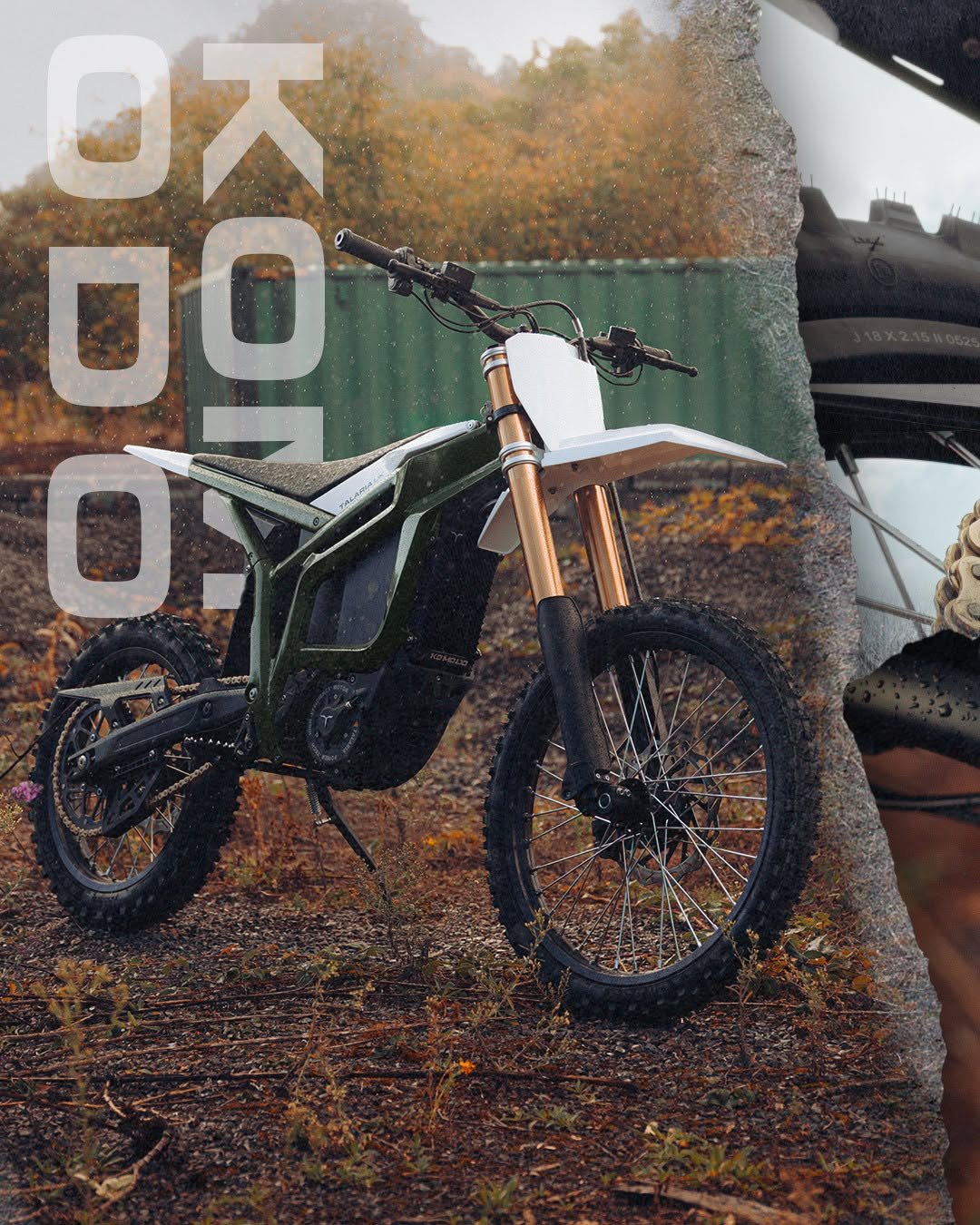
The two largest bikes change the Talaria range conversation because their packs are in a different class. Talaria komodo range is quoted at 115 km, and unusually the test speed is 45 km/h, a pace at which a Sting would already be well down on its own headline. The 97.2V 45Ah pack, built from Samsung 50S or LG H51 cells and weighing 24.5 kg on its own, gives the Komodo a reserve that lets it shrug off climbs and mud in a way the 60V bikes cannot.
What 32 kW does to a big pack
The other side of the Komodo equation is a 32 kW peak motor and Hyper mode. Use all of it and the pack empties quickly, because peak power costs the same regardless of how large the reservoir is, and Talaria range falls accordingly. The difference is that even a hard session leaves a meaningful distance in hand, and a charge time of approximately 1.5 hours makes a mid day top up practical in a way it is not for most electric dirt bikes.
The Dragon: the longest quoted figure in the family
The Dragon carries an 88V 58.5Ah pack of about 5200 Wh, the largest in the Talaria range, and is rated at 150 km at 25 km/h. Nominal power is 10 kW and peak is 28 kW, so it can spend energy as fast as the Komodo, but it starts with more. For riders whose priority is Talaria range, the Dragon is the clear answer, and the Dragon first look examines the whole specification.
Range on the road legal Sting models
Talaria range on the road legal Stings is rated in miles at 25 mph, a faster test than the 25 km/h used for the off road bikes. The Sting Road Legal L1e is quoted at 43 miles at 25 mph on its 60V 38.4Ah pack, and the Sting L3e at 53 miles at 25 mph on 45Ah. Both carry a 3.5 hour charge time on the spec sheet.
Why tarmac is kinder to range
Tarmac flatters Talaria range because it has low rolling resistance and no mud, and an L1e bike is limited to 45 km/h, so the motor never sees the sustained peak draw that trail riding demands. A commuter on a Sting L1e at moped speeds is riding close to the conditions of the official test, which is why road legal owners tend to report figures nearer the sheet. The L3e is not limited to moped pace, and at 60 mph drag would shorten its 53 mile figure considerably. Both models are listed in our road legal Talaria category.
How to ride further on the pack you have
None of the following will turn a 2280 Wh pack into a 5200 Wh one, but together they make a real difference to Talaria range and to how much margin you finish with.
- Use Eco for transit sections and save Sport or Hyper for the parts of the ride that deserve them.
- Raise the regen level in flowing terrain and use it as your first brake.
- Roll on the throttle rather than snapping it. Peak current is the enemy of every lithium pack.
- Carry a charged spare. Sting packs swap in seconds, and the X3 and XXX packs come out in around five minutes.
A spare pack is the single biggest Talaria range upgrade for anyone who regularly runs the display down to the last bar. Our batteries and chargers category covers OEM Sting packs and higher capacity EBMX alternatives, and the charger guide explains the quoted charge times. Recycle old packs properly, as the UK government battery guidance sets out. The Trail Riders Fellowship covers lawful green lanes for road legal machines, and the Auto Cycle Union lists events where off road models can be ridden.
Frequently asked questions
Which Talaria has the longest range?
The Dragon, with its 88V 58.5Ah pack of approximately 5200 Wh and an official figure of 150 km at 25 km/h. The Komodo follows with 115 km, though that was measured at 45 km/h, a harder test. Among the Stings, the highest quoted Talaria range is the Sting R MX4 at 120 km at 25 km/h.
How far does a Talaria Sting R go on real trails?
Well short of the 120 km headline, because that Talaria range was recorded at a steady 25 km/h on easy ground. On mixed trail riding with climbs, mud and Sport mode, expect a full morning rather than a full day from the 2700 Wh pack, and less again if you spend a lot of time at the 8000W peak. A spare pack removes the worry entirely.
Does the Komodo really go further than the numbers suggest?
In Talaria range terms, yes. Its 115 km figure was measured at 45 km/h, while the Stings and the Dragon were measured at 25 km/h. Ridden at the same gentle pace as those bikes, the Komodo would cover more than 115 km. Its 4.4 kWh pack and 24.5 kg battery weight show how much energy it carries.
Why is the MX5 Pro rated below the MX4 when it has a bigger battery?
Weight and power. The MX5 Pro weighs 76 kg with battery against 66 kg for the MX4, and its 13.4 kW peak motor can spend 2880 Wh faster than the MX4 can spend 2700 Wh. In Eco mode the two bikes behave similarly. The 100 km at 25 km/h figure reflects the heavier, more powerful package.
Does cold weather reduce Talaria range?
Yes. Lithium cells deliver less usable capacity and suffer higher internal resistance when cold, so a winter ride on the same pack will be shorter than a summer ride. Keeping the battery indoors until you set off makes a noticeable difference, and capacity returns as the pack warms up in use.
Next steps
If distance is your priority, start with the Talaria Dragon or the Talaria Komodo. If you want the best balance of range, weight and cost at 60V, the Sting R MX4 is the benchmark. Every bike is covered by our UK warranty, full terms on the warranty page, with UK mainland delivery, timescales confirmed at checkout. Spread the cost with Talaria finance and add a spare pack so Talaria range is never the reason a ride ends early.
