
Uncategorized
Talaria vs Surron Ultra Bee: Which Big Electric Dirt Bike Suits UK Riding
Jul
Talaria vs Surron Ultra Bee is a newer argument than the Light Bee one, and it needs its own answer because the Ultra Bee is not a bigger Light Bee, it is a different kind of machine. Riders arriving at this question have usually outgrown a 19 inch wheeled e moto and want full size wheels, more travel and a bike that holds a line at speed. This guide keeps every Talaria number sourced from our own spec sheets and restricts the Sur Ron description to well established public facts.
Why this is a different question
We already publish a Talaria versus Sur Ron comparison covering the Light Bee family against the Sting platform, and nothing in that guide needs repeating here. The Light Bee argument turns on a belt against a gearbox in two bikes of almost identical size. Talaria vs Surron Ultra Bee turns on something else entirely: what happens when a lightweight brand builds a full size machine, and which Talaria you should compare it with once it does.
Get that pairing wrong and the whole exercise falls apart. Put an Ultra Bee against a Sting MX3 and the Sur Ron looks unanswerable. Put it against a Komodo and the picture changes completely. Most of the confusion in the ultra bee vs talaria conversation comes from comparing machines that were never in the same class.
So this guide does the pairing work first, then compares the things that actually differ. Along the way it stays honest about the fact that we sell one of these brands and not the other, which is exactly how a talaria vs surron ultra bee guide should be read.
Where the Ultra Bee sits in the Sur Ron line
Sur Ron built its reputation on the Light Bee, a compact belt driven machine on 19 inch wheels. The Ultra Bee arrived above it as a full size bike: 21 inch front and 18 inch rear wheels, longer travel suspension, a taller seat and a considerably greater mass. It is the bike Sur Ron built for riders who wanted to stop apologising for wheel size on rough ground, and it is why talaria vs surron ultra bee became a question worth asking.
Three things about it are well established and worth knowing before any talaria vs surron ultra bee comparison. First, Sur Ron publishes a 74V architecture for it rather than the Light Bee’s 60V. Second, the belt primary drive is gone, so drive reaches the rear wheel by chain. Third, the pack is integrated into the frame rather than lifting out as a spare, which changes how you plan a long day.
It also carries a colour TFT display, selectable ride modes and adjustable regenerative braking, and Sur Ron has offered homologated versions in some European markets. Beyond that we will not quote output, mass or range, because those are Sur Ron’s figures to publish and they move between model years and markets.
Which Talaria is the right opponent
Talaria builds three machines that could reasonably stand opposite an Ultra Bee, and picking the right one is the most useful thing a talaria vs surron ultra bee guide can do.
The Komodo
The Talaria Komodo is the full size answer. It runs 21 inch front and 18 inch rear wheels, a dual chamber air fork with 250 mm of travel, 98 kg net weight, a 910 mm seat and 315 mm of ground clearance. Peak power is 32 kW with 8.6 kW rated and 754 Nm of peak torque, fed by a 97.2V 45Ah pack of about 4.4 kWh using Samsung 50S 21700 or LG H51 cells. Talaria quotes 105 km/h and 115 km at 45 km/h.
The Dragon
Where a talaria vs surron ultra bee buyer wants distance rather than lap times, the Talaria Dragon takes the same full size wheel package in an endurance direction: 10 kW nominal, 28 kW peak, 630 Nm, 110 km/h, and the biggest battery Talaria sells at 88V and 58.5 Ah, about 5.2 kWh, quoted at 150 km with a four hour charge. It weighs 100 kg.
The Sting MX5 Pro
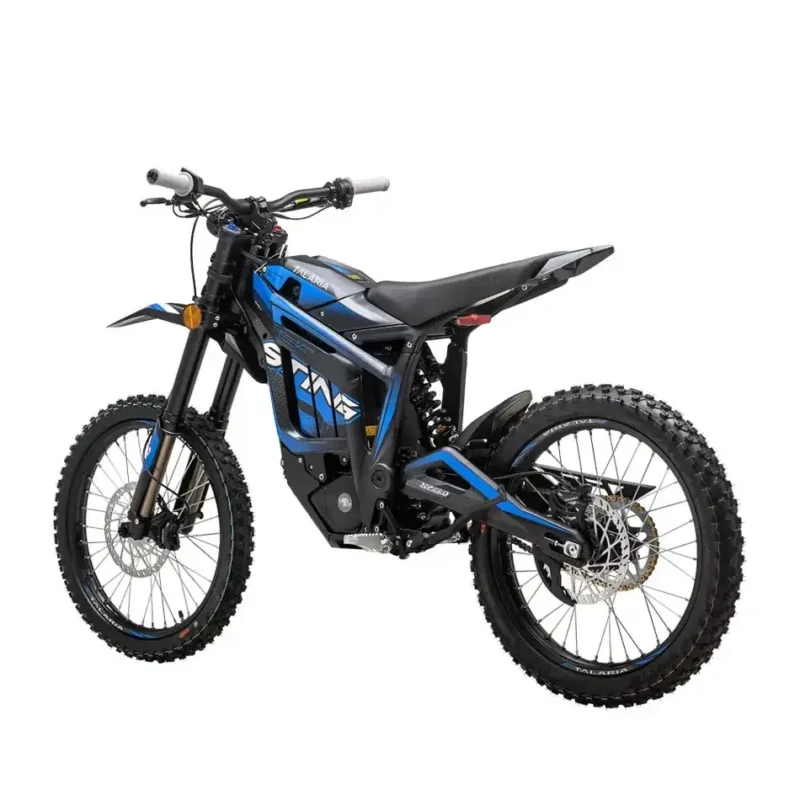
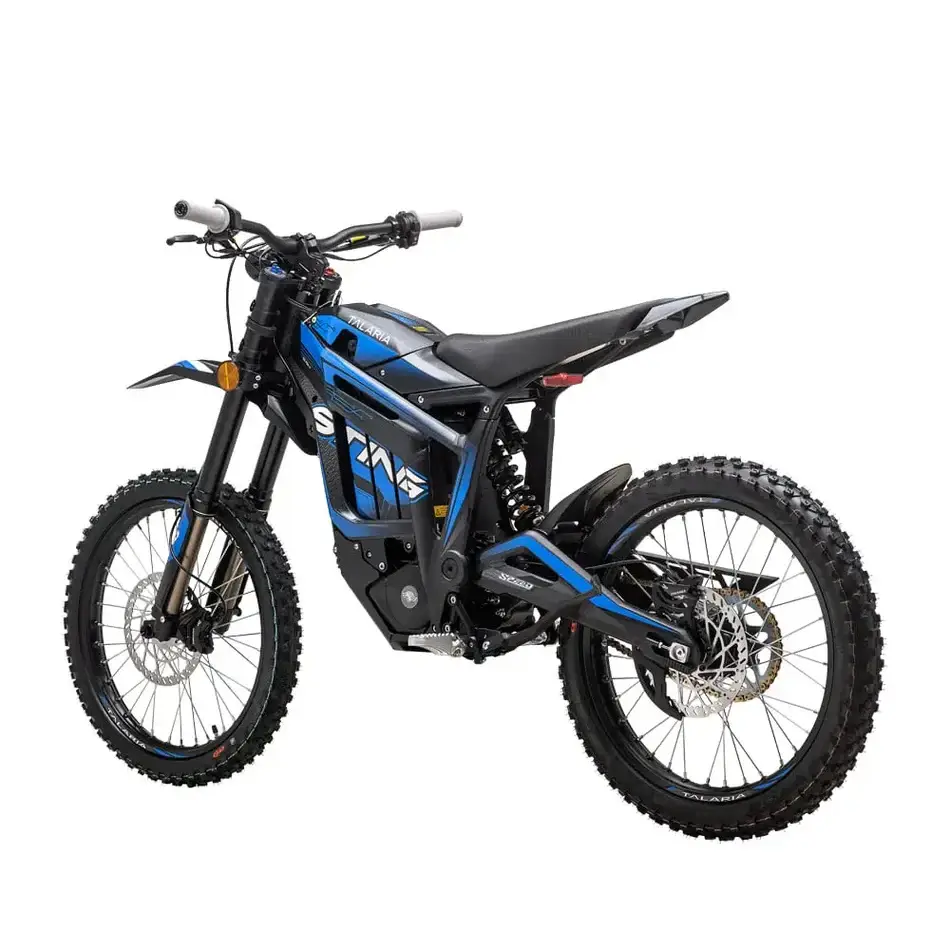
The Sting MX5 Pro stays on 19 inch wheels but brings 72V, a 40Ah Samsung 50S pack of 2880 Wh, 5.5 kW rated and 13.4 kW peak unrestricted, at 76 kg. It is the talaria vs surron ultra bee pairing for a rider who wants power without the size.
Drivetrain and power delivery
Dropping the belt was the right call for a heavier bike, and it removes the single biggest talking point from the old Light Bee argument. In talaria vs surron ultra bee terms, both machines now put their power down through a chain, so the differences move to what happens before the chain.
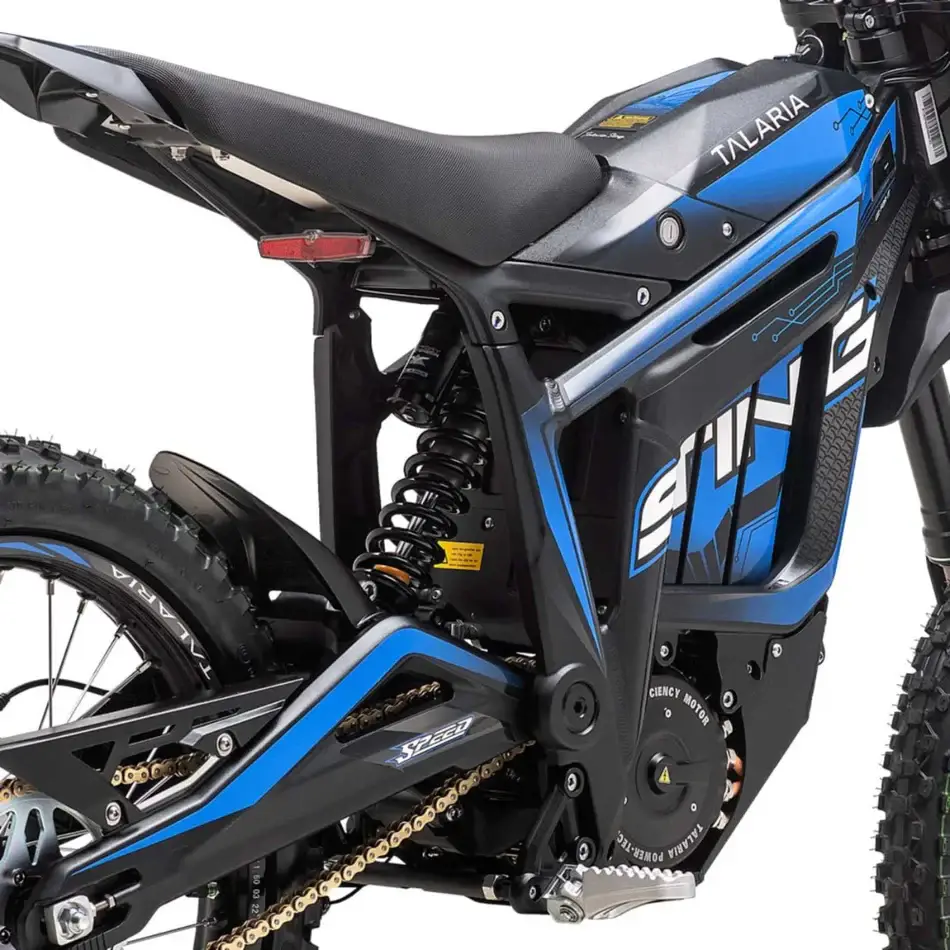
Talaria’s big bikes use a mid mounted air cooled permanent magnet motor through a gearbox primary, which is why a Komodo is quiet enough at trail speed that you mostly hear tyres. The Komodo motor is rated above 14 Nm continuous and above 90 Nm peak at the shaft, multiplied by a 520 chain running 14 or 15 tooth front and 50 or 53 tooth rear sprockets to reach that 754 Nm rear wheel figure. That gearbox primary is the mechanical heart of the talaria vs surron ultra bee difference.
Modes and control in talaria vs surron ultra bee terms
The Komodo offers Eco, Sport, Hyper and Reverse, which is a genuinely useful feature when you are pointing 98 kg uphill in a gateway. Regenerative braking runs to four levels on a thumb control. Both brands now give you software modes, so the practical ultra bee vs talaria difference is less about how much power exists and more about how finely you can meter it with a wet boot on a wet peg.
Battery architecture and charging
This is where talaria vs surron ultra bee produces the clearest practical split, and it has nothing to do with capacity.
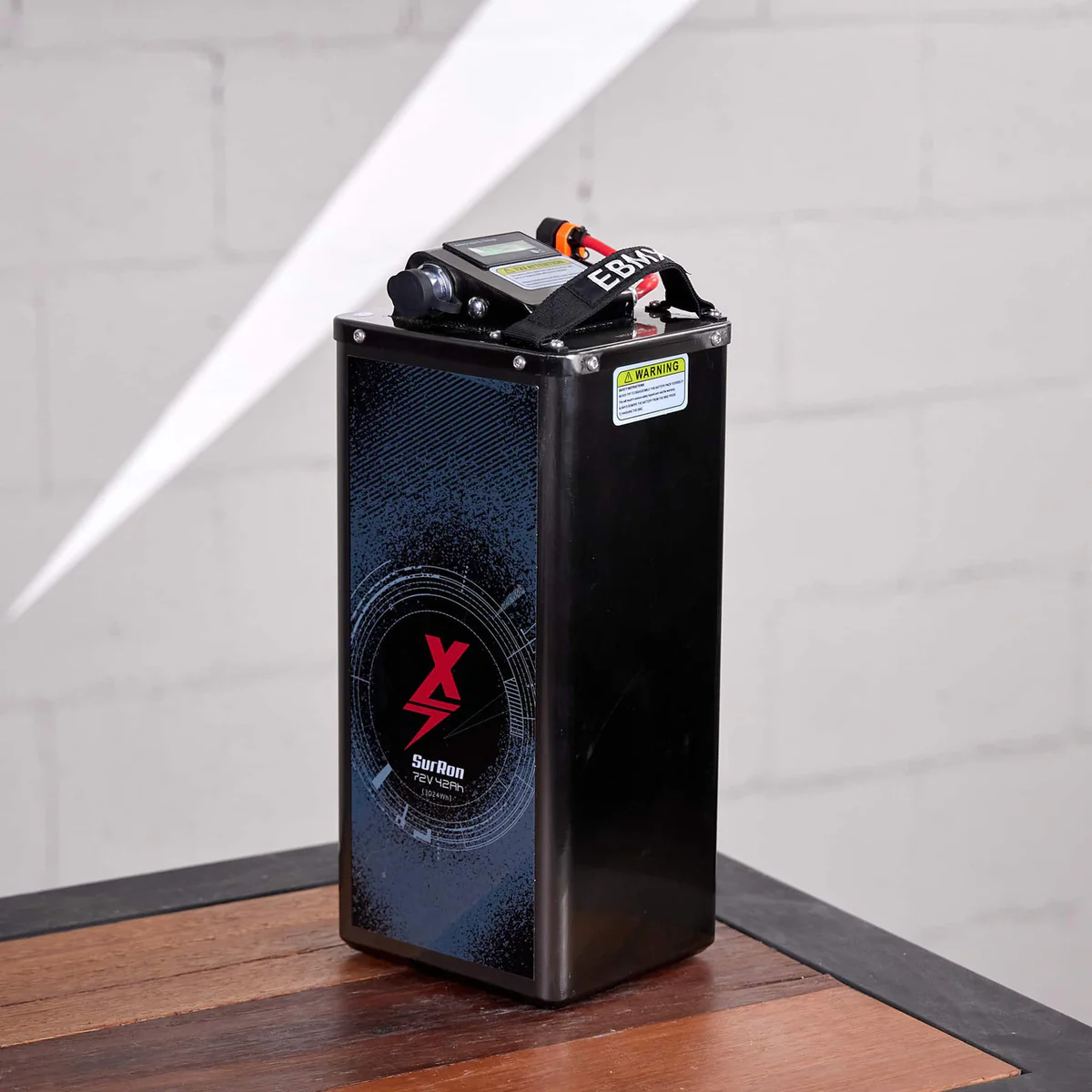
A Komodo pack lifts out. It weighs 24.5 kg, carries an IP67 rating and charges in roughly an hour and a half. That means the battery comes into a warm house while the bike stays in a cold garage, which matters more in a British winter than most buyers expect. It also means a spare pack turns a morning into a full day. An integrated pack cannot be handled that way, so charging happens wherever the bike is parked and a spare is not an option.
Against that, an integrated pack lets a designer use the case as structure and place mass where they want it. Neither approach is wrong. In talaria vs surron ultra bee terms what matters is whether your riding day involves a van, a shed with no socket, or a second pack, and our Talaria battery guide and charger guide explain how to plan around either.
Talaria vs Surron Ultra Bee comparison table
The talaria vs surron ultra bee table below uses our own published Talaria figures. The Sur Ron column is deliberately descriptive, because a number we cannot verify is worth less than an honest blank.
| Aspect | Talaria Komodo | Talaria Dragon | Sur Ron Ultra Bee |
|---|---|---|---|
| Wheels | 21 in front, 18 in rear | 21 in front, 18 in rear | 21 in front, 18 in rear |
| Peak power | 32 kW | 28 kW | Published by Sur Ron |
| Rated power | 8.6 kW | 10 kW | Published by Sur Ron |
| System voltage | 97.2V | 88V | 74V architecture |
| Battery energy | About 4.4 kWh | About 5.2 kWh | Integrated in the frame |
| Pack removable | Yes, 24.5 kg, IP67 | Yes | Not a lift out spare |
| Charge time | About 1.5 hours | About 4 hours | Published by Sur Ron |
| Weight | 98 kg | 100 kg | Much heavier than a Light Bee |
| Seat height | 910 mm | 34.6 in | Full size enduro height |
| Front travel | 250 mm dual chamber air | Adjustable air spring fork | Long travel, full size |
| Primary drive | Gearbox, then 520 chain | Gearbox, then chain | Chain, no belt |
| Quoted top speed | 105 km/h | 110 km/h | Published by Sur Ron |
| Reverse | Yes | Not listed | Published by Sur Ron |
| Talaria vs Surron Ultra Bee verdict | Closest on wheels, travel and peak power | Closest on energy and road legal path | The full size Sur Ron benchmark |
Talaria Sting R vs Ultra Bee for the upgrader
A large share of the people researching talaria sting r vs ultra bee already own a Sting R or a Light Bee and are deciding whether to go up a class at all. That is a different question from which full size bike is better, and it deserves a plain answer before any talaria vs surron ultra bee shortlist is written.
The Sting R MX4 weighs 66 kg with its battery, runs 19 inch wheels, an 840 mm seat and a 60V 45Ah LG 21700 pack of 2700 Wh, making 4000W continuous and 8000W peak for a quoted 53 mph and 120 km at 25 km/h. It charges in about three hours. Nothing about a full size machine makes those figures worse, but a full size machine does make tight woodland harder, van loading heavier and solo recovery from a bog a genuine event.
When the talaria vs surron ultra bee question does not apply
If your riding is trails, farm land and the odd practice track, the talaria vs surron ultra bee question may simply not apply to you, and the honest recommendation is a Sting R or an MX5 Pro. Our Sting R versus MX5 guide covers that choice, and Komodo versus Sting R covers the step up in detail.
UK road legal status and where you ride
Both brands sell off road machines and homologated ones, so talaria vs surron ultra bee is settled in UK law by vehicle category rather than by badge. An off road Komodo, an off road Dragon and an off road Ultra Bee are private land and licensed venue machines, usable with the landowner’s permission, at pay and ride tracks, or at events run under the Auto Cycle Union. They may not be used on a road, a byway, a bridleway, a footpath or a pavement.
The Dragon’s L1e version is registered, plated and insured as a moped class vehicle limited to 45 km/h and ridable from 16 with a provisional licence and CBT. The licence framework sits on GOV.UK, and the lawful green lane position is set out by the Trail Riders Fellowship. Our detailed explainer is are Talarias legal in the UK. Whatever you conclude about talaria vs surron ultra bee, sort out where you will ride before you order.
Looking for a Surron Ultra Bee alternative
Riders searching for a surron ultra bee alternative usually want one of three things, and in talaria vs surron ultra bee terms they are not the same thing at all.
If the appeal is full size wheels and serious travel, the Komodo is the closest match in the Talaria range, with 21 and 18 inch wheels, 250 mm of fork travel and 32 kW. If the appeal is riding all day without thinking about charge, the Dragon carries about 5.2 kWh and a quoted 150 km, and it is the one with a road legal path. If the appeal was really just more power than a Light Bee, the honest ultra bee vs talaria answer is that a 72V MX5 Pro delivers that in a 76 kg package you can still pick up.
The one thing no talaria vs surron ultra bee verdict from us will claim is that the Ultra Bee is a poor bike. It is a well judged machine and it moved the whole category on. It is simply large, and large has consequences that a spec sheet never shows.
Frequently asked questions
Which Talaria is the fairest match in a talaria vs surron ultra bee comparison?
The Komodo answers talaria vs surron ultra bee best, because both are full size machines on 21 inch front and 18 inch rear wheels with long travel suspension and a tall seat. The Dragon is the fairer match if you value range over peak output. Comparing an Ultra Bee with a Sting MX3 or a Sting R is comparing across two different classes and will mislead you.
Does the Ultra Bee still use a belt like the Light Bee?
No. Sur Ron moved the Ultra Bee to a chain drive, so the belt argument that dominates the Light Bee comparison does not apply here. Talaria’s Komodo and Dragon use a gearbox primary and then a chain, so in drivetrain terms the two brands are now much closer than they used to be.
Can I carry a spare battery for either bike?
On the Talaria side, yes, and it is one of the clearest talaria vs surron ultra bee splits. The Komodo pack lifts out, weighs 24.5 kg and is IP67 rated, and Talaria packs across the range are designed to be swapped. The Ultra Bee pack is integrated into the frame, so a spare is not part of the plan. If your rides are long and remote, that is a real difference.
Is either one road legal in the UK?
Only in homologated form, and only once registered, plated and insured. Talaria offers the Dragon in an L1e version, a moped class vehicle limited to 45 km/h, ridable from 16 with a CBT and a provisional licence. Off road versions of either brand cannot be used on public roads, byways, bridleways, footpaths or pavements.
I am upgrading from a Sting R, is a full size bike worth it?
It depends on the ground. A Sting R MX4 at 66 kg with 8000W peak is easier in tight woodland and easier to load alone. A full size bike is calmer at speed and better over rough terrain. Anyone researching talaria sting r vs ultra bee should ride both before spending, because the gap is in handling rather than in the numbers.
Do Sur Ron parts fit the Talaria Komodo?
Some generic components cross over, but the Komodo is a different platform from the Light Bee that most shared parts were designed around. Check fitment with a specialist before ordering anything, and browse our Talaria parts category for items we know fit.
Next steps
If the talaria vs surron ultra bee question has settled in favour of full size wheels, compare the Komodo category with the Dragon category and read both spec sheets properly. If it has pushed you back toward something lighter, the Talaria Sting range is where to look. Tell a UK Talaria specialist how and where you ride and you will get a straight recommendation rather than the biggest number on the shelf.
