
Uncategorized
How Much Is a Talaria? What Actually Drives the Cost of an Electric Dirt Bike
Mar
How much is a Talaria is the first question almost every buyer asks, and it is the one question a guide like this should not answer with a number. Figures move with model year, specification, exchange rates and stock, so any number printed here would be out of date before you read it. What does not change is the engineering that sits behind the number. This guide explains the six things that genuinely move the cost of an electric dirt bike, so you can read any quote and know what you are actually paying for.
Why this guide prints no number
Ask how much is a Talaria in a forum and you will get a dozen answers, all correct on the day they were typed and all wrong now. Model years change specification. Batteries move between cell suppliers. Import duty, shipping and currency all shift. A guide that froze a figure in place would simply mislead people who found it a year later.
The live answer to how much is a Talaria sits on each model’s own product page, updated as things change. What this guide gives you instead is the part nobody publishes: which engineering choices carry real cost, and which are marketing. Understand those and you can look at two bikes that appear similar and see immediately why one costs what it costs.
This matters because the cheapest quote is rarely the cheapest bike. A machine bought on headline talaria price uk searches alone, with a smaller pack and unbranded cells, can cost far more across three years than the one that looked dearer on the day.
Battery capacity and cell brand
The pack is the single largest item in the bill of materials, and it is the reason two bikes that look identical can sit a long way apart. When people ask how much is a Talaria, the honest first answer is: how big is the battery and whose cells are in it.
Capacity and voltage: where how much is a Talaria begins
Talaria packs run from the 60V 38.4Ah unit in the Sting MX3, worth 2280 watt hours, up through the 60V 45Ah 2700 Wh pack in the Sting R MX4, the 72V 40Ah 2880 Wh pack in the Sting MX5 Pro, the 97.2V 45Ah pack of roughly 4.4 kWh in the Komodo and the 88V 58.5Ah pack of about 5.2 kWh in the Dragon. Energy is expensive. Doubling watt hours roughly doubles the cost of the most expensive component on the bike, which is why how much is a Talaria tracks pack size so closely.
Whose cells
Cell brand matters as much as capacity, and it is the part of how much is a Talaria that buyers overlook most often. Talaria specifies LG 21700 cells rated at 5000 mAh each in the Sting range, Samsung 50S in the MX5 Pro, and Samsung 50S or LG H51 in the Komodo. Named cells from a major manufacturer cost more than anonymous ones, hold their capacity better over time and behave predictably under load. A pack described only by its amp hours, with no cell brand named, is the clearest warning sign in this market. Our Talaria battery guide explains how to read a pack specification properly.
Motor, controller and delivered power
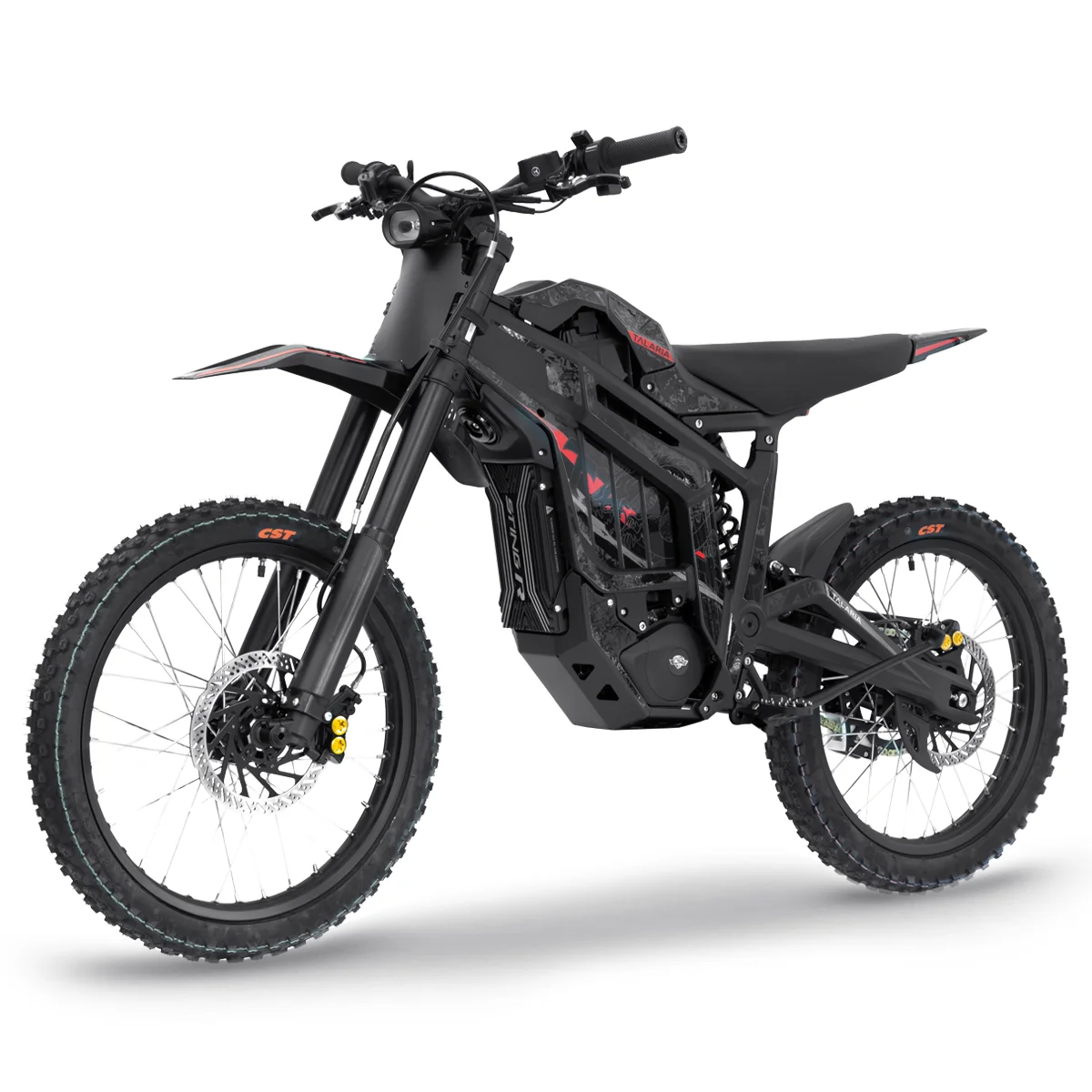
Motors are not all the same, and the difference shows up in both the invoice and the ride, which makes the motor a larger share of how much is a Talaria than a spec comparison suggests. The Sting MX3 uses a PMSM motor making 3000W nominal and 6000W peak. The Sting R MX4 moves to an interior permanent magnet motor with a magnetic encoder instead of hall sensors, quoted at 94 percent peak efficiency, making 4000W continuous and 8000W peak. The MX5 Pro steps up again to 5.5 kW rated and 13.4 kW peak unrestricted.
A more efficient motor costs more to build and returns range as well as power, which is part of the answer to how much is a Talaria: you are buying watt hours you do not have to carry.
The controller, the hidden half of how much is a Talaria
The controller is the least visible expensive part. A field oriented control unit with proper transient current handling, temperature protection and error detection is a different product from a basic unit, and it is what allows a manufacturer to promise a power figure without cooking the motor. The Komodo controller runs a 140V platform with 36 high power MOSFETs and an M4 core microprocessor. When riders later spend on the aftermarket upgrades in our controller guide, they are buying exactly this, which tells you what it is worth.
Suspension tier, brakes and chassis
Suspension is the clearest example of a cost driver you can feel on the first ride. Within the Talaria range the ladder runs from DNM units on the entry bikes, through Fastace and Talaria factory items on the Sting R, to the adjustable air and dual spring fork with 220 mm of travel on the MX5 Pro, to a Manitou Dorado Expert fork on the MX4 Expert, to the 850 mm dual chamber air fork with 250 mm of travel on the Komodo.
Brakes follow the same pattern. Four piston calipers on 220 mm rotors are standard across the Sting range, with 2.3 mm rotors on the MX4 and 3 mm on the MX5 Pro, and the MX4 Expert moves to a Magura MT5 system. Chassis cost is real too: every Talaria frame is 6061 T4 and T6 aluminium alloy forged under 6000 tonnes of pressure, then anodised, which is a more expensive process than welding tube and a quiet contributor to how much is a Talaria.
If you are weighing talaria cost against a cheaper machine, this is usually where the saving was made, and it is the hardest saving to undo later. Suspension is the part of how much is a Talaria you feel on every single ride.
Road legal homologation
A road legal Talaria costs more than the same machine in off road form, and the reason is paperwork as much as parts, which is the least intuitive element of how much is a Talaria. Homologating a vehicle into the L1e or L3e category means type approval, a compliance certificate, and hardware that has to be fitted and certified rather than bolted on afterwards.
The Sting Road Legal L1e adds a larger OLED screen, a road legal headlight, a reactive brake light, mirrors, indicators and a tail tidy plate holder, and it is speed limited to satisfy the moped class. The Sting L3e is homologated to the 125 equivalent class with a 3500W rated motor, CE EEC certification and a 45Ah pack. Both then need registration, a plate and insurance before they move.
So when someone asks how much is a Talaria and compares an off road model with a homologated one, they are not comparing like with like at all. The road legal Talaria category shows which models are offered in which form, the L category definitions sit in Regulation 168/2013, and the licence rules are set out on GOV.UK.
Warranty, aftercare and UK stock
This is the cost driver buyers discount most heavily when they ask how much is a Talaria, and the one they regret most often. A bike bought from a UK specialist arrives assembled, checked and covered by our UK warranty, full terms on the warranty page, with parts on a UK shelf and someone who will diagnose a fault over the phone. That support is a real cost to the retailer and it is priced in.
What sits behind a UK bike, and behind how much is a Talaria
Pre delivery inspection, torque checks, a charged and balanced pack, correct documentation for a homologated machine, UK mainland delivery with timescales confirmed at checkout, and a stock of controllers, motors, forks, rims and packs in the Talaria parts category so a broken part does not end your season. None of that appears on a spec sheet, and all of it is part of the answer to how much is a Talaria.
What a grey import skips
A machine shipped direct from overseas skips most of the above. It may arrive in a crate needing assembly, with a charger for the wrong mains supply, without the documentation a UK registration requires, and with a warranty you would have to enforce across a border. That is not automatically a bad deal, but it is a different product.
How much is a Talaria: cost drivers table
Read this table as a translation guide for how much is a Talaria. Each row is something that moves a quote, and the right hand column is what it actually buys you on the ride.
| Cost driver | What changes | What it buys you |
|---|---|---|
| Battery capacity | 2280 Wh to about 5.2 kWh across the range | Duration, and fewer charge stops in a day |
| Cell brand | Named LG or Samsung 21700 cells versus unnamed | Predictable output, slower capacity fade, safer BMS behaviour |
| System voltage | 60V, 72V, 88V, 97.2V | Headroom for power without pushing current |
| Motor type | PMSM versus IPM with magnetic encoder | Efficiency, heat tolerance, reliability under load |
| Controller | Basic unit versus a full FOC controller | Usable peak power and protection against damage |
| Suspension tier | DNM, Fastace, Talaria factory, Manitou, dual chamber air | Control on rough ground and adjustability |
| Brakes | Rotor thickness, caliper pistons, master cylinder | Stopping power and fade resistance |
| Homologation | Off road versus L1e or L3e type approval | The legal right to use the road once registered |
| Warranty and aftercare | UK cover and UK parts versus overseas | Days ridden rather than days waiting |
| UK stock versus import | Assembled and inspected here versus crated abroad | Certainty on duty, mains supply and documentation |
Comparing two quotes fairly
Once you stop asking how much is a Talaria and start asking what each quote contains, comparison becomes straightforward. Work through the same eight questions for both, in writing.
- What is the pack, in volts and amp hours, and whose cells are in it?
- Is the quoted power figure nominal or peak, and is it restricted as delivered?
- Which fork and shock, by manufacturer, and are they adjustable?
- Is the machine off road or homologated, and to which category?
- Does the figure include UK mainland delivery and a pre delivery inspection?
- What does the warranty cover, who administers it, and where are the parts?
- Which charger is supplied and is it correct for a UK mains supply?
- Is a spare pack available for that model, and is it in stock?
Answer those and how much is a Talaria stops being a mystery. A seller who answers all eight without hesitation is selling a known quantity.
One who answers three of them is selling a photograph. That is a more reliable test of talaria cost than any comparison of headline figures, and it works just as well on a used bike.
What a cheap import really costs over three years
Riders hunting the cheapest talaria they can find are usually comparing day one figures against day one figures, which ignores everything that happens afterwards. Look at three seasons instead.
Where how much is a Talaria stops being a day one question
An unnamed cell pack that fades faster reaches the point of replacement sooner, and a replacement pack is the most expensive part on the bike. A charger for the wrong mains supply has to be replaced before the first ride. Parts sourced from abroad arrive slowly, and each wait is a weekend not ridden. A machine that cannot be registered because its documentation is incomplete can never do the road job you bought it for.
The things that save money
A bigger named cell pack degrades more slowly and holds value better. A gearbox primary drive replaces belt consumables with a periodic oil change, described in our oil change guide. Good suspension and brakes reduce crash damage. And a bike with a UK service history sells more easily, which is the point made in our new versus second hand guide for anyone watching the talaria x3 second hand market.
None of this means a cheap talaria is always a mistake. It means the sticker is one line in a longer sum, and asking how much is a Talaria without asking how long it lasts gives you half the answer.
Frequently asked questions
So how much is a Talaria, really?
Current figures for every model we stock are shown on their own product pages and updated as specification, stock and duty change. We deliberately do not publish a figure in a guide, because a stale number is worse than no number. Start with the model that matches your riding, then check its live page.
Which is the cheapest Talaria to run rather than to buy?
Running costs are dominated by the pack and the consumables. Every Sting uses a gearbox primary rather than a belt, so the routine job is an oil change rather than belt replacement, and named LG or Samsung cells hold capacity longer. A smaller bike with a smaller pack is the cheapest talaria to charge, but it is not automatically the cheapest to own.
Does a road legal model always cost more?
Yes, and it is one of the clearest steps in how much is a Talaria. For the same base machine, homologation adds type approval, certified lighting, mirrors, indicators, a plate holder and a compliance certificate. You then add registration and insurance before riding. Whether that is worth it depends entirely on whether you need to use public roads.
Is finance available?
Yes. Our Talaria finance page sets out the options available through The Talaria UK and what you need to apply. Spreading the cost also changes the calculation above, because a better pack and better suspension often cost very little more per month than the compromise version.
Should I buy used instead?
Sometimes. A used bike with a documented history and a healthy pack can be excellent value, and the X3 is the most common model on the second hand market. Check pack health, hidden controller modifications and paperwork first, using the inspection checklist in our new versus second hand guide.
Why do two sellers quote different figures for the same model name?
Because the model name is not the specification, and how much is a Talaria follows the specification rather than the badge. Battery size, cell brand, suspension, fork brand, restricted or unrestricted delivery, homologation category, charger and warranty all vary. Ask the eight questions listed above and the gap usually explains itself.
Next steps
The practical answer to how much is a Talaria lives on the product pages, not in a guide. Browse the Talaria Sting range for current specification and pricing, compare it with the XXX and X3 category if you want something lighter, and read our best electric dirt bike UK guide if you are still choosing a model. Tell a UK Talaria specialist how you ride and you will get a straight recommendation rather than an upsell.
