
Uncategorized
Talaria Specs and Weight: Every Model on One Page
Jul
Comparing Talaria specs across the range is harder than it should be, because Talaria publishes figures in different units, on different sheets, and occasionally contradicts itself in one document. This guide puts every bike we stock into one master table, then explains what the numbers mean for a UK rider. Where sources disagree, we say so.
How to read the Talaria specs
Four numbers in the Talaria specs decide how a bike feels: nominal pack voltage, capacity in amp hours, peak motor power, and kerb weight with the battery. Everything else, from rotor diameter to ground clearance, adjusts things at the margins.
Voltage sets the ceiling: a 60V bike and a 72V bike with identical motors do not behave the same, because higher voltage spins the motor faster before it runs out of headroom. Amp hours set endurance, and volts multiplied by amp hours gives watt hours, the only figure in the Talaria specs that compares capacity fairly across voltages.
Peak power is not continuous power
The Talaria specs quote a nominal and a peak figure for most models. Nominal is what the motor holds all day, peak is a short burst before heat forces it back. A Sting R MX4 at 8000W peak is a 4000W bike most of the time.
Weight always means with the battery
Every kerb figure in the Talaria specs below includes the pack. Packs are heavy in their own right: 12.85 kg on the 60V Sting units, 24.5 kg on the Komodo.
Talaria specs: the master comparison table
These are the Talaria specs for every bike we stock, drawn from the sheets supplied with each one. Read it as a starting point, then use the commentary below to see why two bikes with similar numbers ride nothing alike.
| Model | Battery | Peak power | Weight with battery | Seat height | Wheels | Quoted top speed |
|---|---|---|---|---|---|---|
| Sting MX3 | 60V 38.4Ah, 2280 Wh | 6000W | Not published, 58 kg as an L1e | 840 mm | 19 inch front and rear | 47 mph (75 km/h) |
| Sting R MX4 | 60V 45Ah, 2700 Wh | 8000W | 66 kg | 840 mm | 19 inch front and rear | 53 mph (85 km/h) |
| Sting R Off Road | 60V 45Ah, 2700 Wh | 8000W | 66 kg | 840 mm | 19 inch spoked | 53 mph, 55 mph elsewhere |
| Sting MX5 Pro | 72V 40Ah, 2880 Wh | 13.4 kW | 76 kg | 840 mm | 19 inch | Shipped limited to 32 km/h |
| MX5 Pro Competizione 50s | 81.4V 22s, 4060 Wh | 21 kW | Pack alone 19.2 kg | 840 mm | 19 inch CNC | Around 70 mph |
| MX5 Pro Competizione 45B | 81.4V 22s, 3645 Wh | 23 kW | Pack alone 19.2 kg | 840 mm | 19 inch CNC | Around 70 mph |
| X3 Concept | 60V 40Ah, 2400 Wh | 6000W | 125 lb, about 57 kg | 805 mm | 17 inch supermoto | 47 mph |
| XXX and XXX Black Edition | 60V 40Ah, 2400 Wh | 6000W | 125 lb, about 57 kg | 805 mm | 17 inch supermoto | 47 mph |
| XXX Pro 2025 | 60V 40Ah, 38.4Ah nominal | 6 kW | 53 kg | 810 mm | 19 inch front, 17 inch rear | 75 km/h |
| Komodo 2025 | 97.2V 45Ah, 4.4 kWh | 32 kW | 98 kg | 910 mm | 21 inch front, 18 inch rear | 105 km/h |
| Dragon 2025 | 88V 58.5Ah, 5.2 kWh | 28 kW | 100 kg | About 880 mm | 21 inch front, 18 inch rear | 110 km/h (70 mph) |
| Sting Road Legal L1e | 60V 38.4Ah, 2280 Wh | 6000W | 58 kg | 840 mm | 19 inch | 45 km/h as homologated |
| Sting L3e Road Legal | 60V 45Ah, 2700 Wh | 3500W rated | 71 kg | 840 mm | 19 inch | 53 mph |
Sting family: MX3, MX4 and MX5 Pro
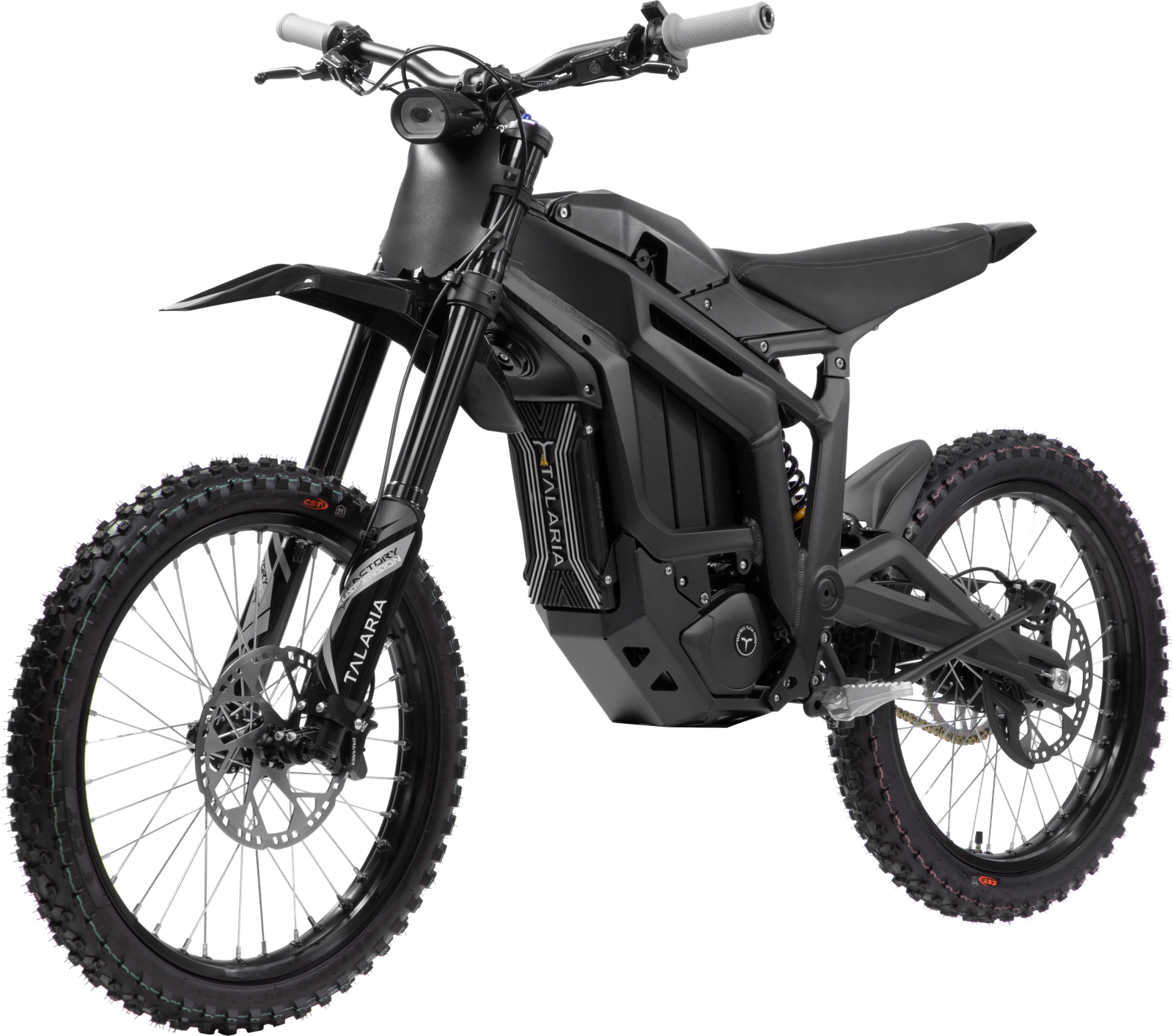
The Sting is the platform every other set of Talaria specs is measured against, and the three generations in stock show real engineering progression rather than a cosmetic one.
Sting MX3
Anyone searching for Talaria MX3 specs is usually checking whether the entry bike is enough. It runs a permanent magnet synchronous motor rated at 3000W with 6000W peak, 34 Nm at the motor shaft and 284 Nm at the rear wheel on the 44 tooth sprocket, rising to 309 Nm on the 48 tooth. Range is quoted at 100 km at a steady 32 km/h.
Sting R MX4
The Sting R MX4 moves to an interior permanent magnet motor with a magnetic encoder in place of hall sensors, 4000W nominal and 8000W peak, and a 45Ah pack. It measures 1880 mm by 770 mm by 1088 mm, with a 1250 mm wheelbase and 300 mm of ground clearance. Range is quoted at 120 km at 25 km/h, and these are the Talaria specs most owners measure everything else against.
Sting MX5 Pro and the Competizione builds
The MX5 Pro is the 72V machine: 5.5 kW rated and 13.4 kW unrestricted, 220 mm of fork travel, an 85 mm stroke linkage shock and a 100 kg maximum load. The two Competizione builds swap in an 81.4V 22 series pack and an EBMX X9000 controller, which is where the 21 kW and 23 kW Talaria specs come from.
Compact bikes: X3, XXX and XXX Pro
These three share one battery architecture in their Talaria specs: 128 LG M50 21700 cells in a 16s8p layout, 2400 watt hours, built into the frame and removable in about five minutes once the rear wheel and shock quick release are out. That is a storage solution, not a trailside swap.
The X3 Concept and the XXX ride on 17 inch supermoto wheels, use a single pivot rear end and a belt primary drive rather than the Sting gearbox, and share the Sting R motor. Seat height is 805 mm, top speed 47 mph.
What changed on the XXX Pro 2025
The XXX Pro is the same family reworked for dirt: linkage rear suspension with 160 mm of travel against 120 mm on the single pivot design, a 200 mm travel fork, a 19 inch front and 17 inch rear on knobbly tyres and the colour TFT display from the MX5. Ground clearance is 260 mm, wheelbase 1240 mm, maximum load 100 kg, and the Talaria specs quote the motor at 2.5 kW rated with 6 kW peak.
Komodo and Dragon: the heavyweights
These two sit apart from the rest of the Talaria specs here, closer to a 350 or 450 petrol enduro bike in mass and power than to a Sting.
Komodo
The Talaria Komodo specs that matter are the 97.2V nominal pack at 45Ah, 32 kW peak against 8.6 kW rated, and 754 Nm of peak torque at the rear wheel. It carries a 24.5 kg IP67 battery, a 520 chain, dual chamber air forks with 250 mm of travel and a 2200 mm by 810 mm by 1220 mm footprint. Wheelbase is 1380 mm, ground clearance 315 mm, maximum load 160 kg and range 115 km at 45 km/h. The Komodo 2025 is the only bike here with a reverse mode.
Dragon
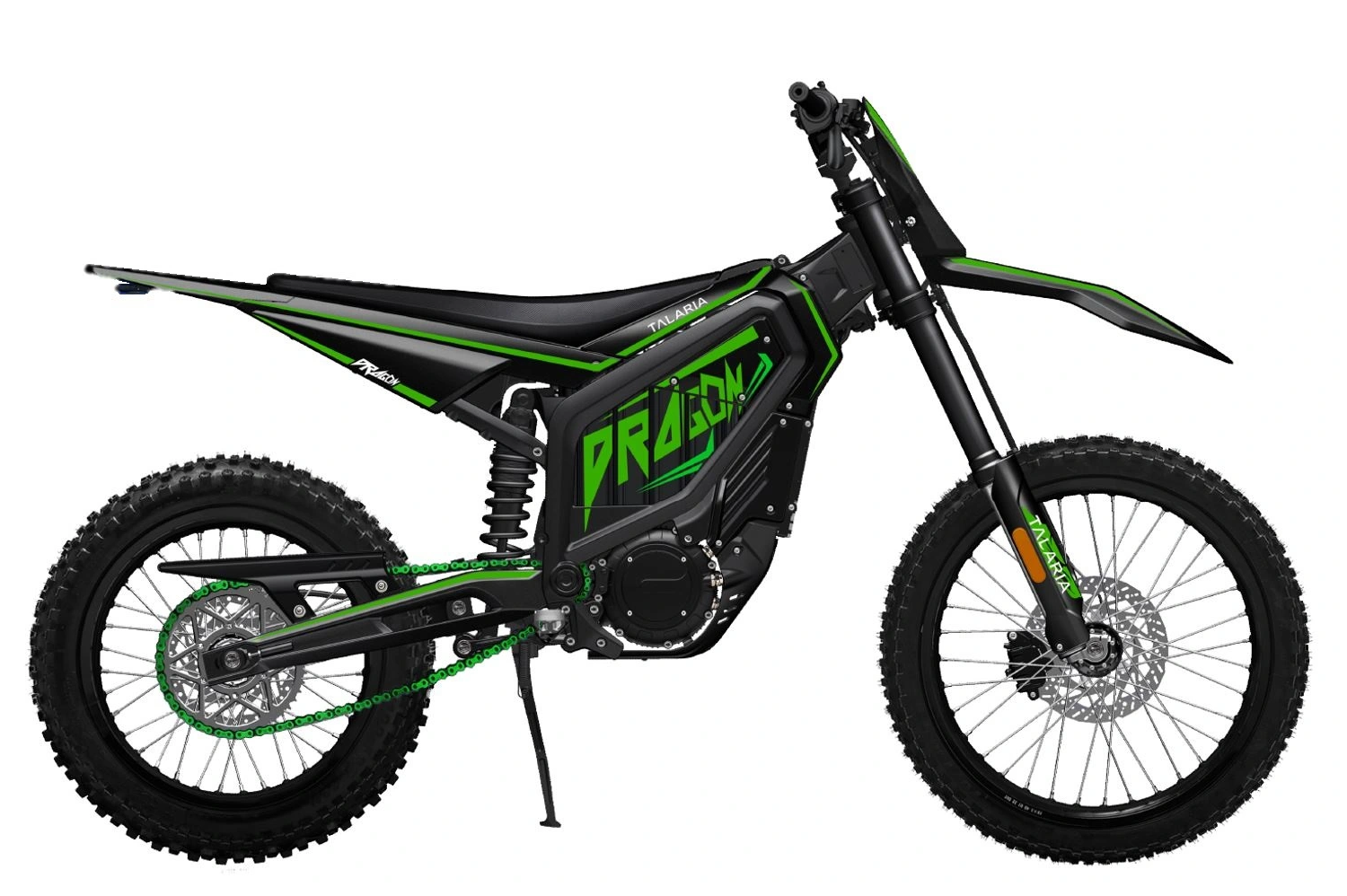
Among all the Talaria specs here the Dragon runs the largest pack, at 88V and 58.5Ah, roughly 5.2 kWh, for a quoted 150 km at 25 km/h. Peak output is 28 kW against 10 kW nominal, with 630 Nm at the rear wheel on the 48 tooth sprocket, and charging takes about 4 hours.
Road legal L1e and L3e figures
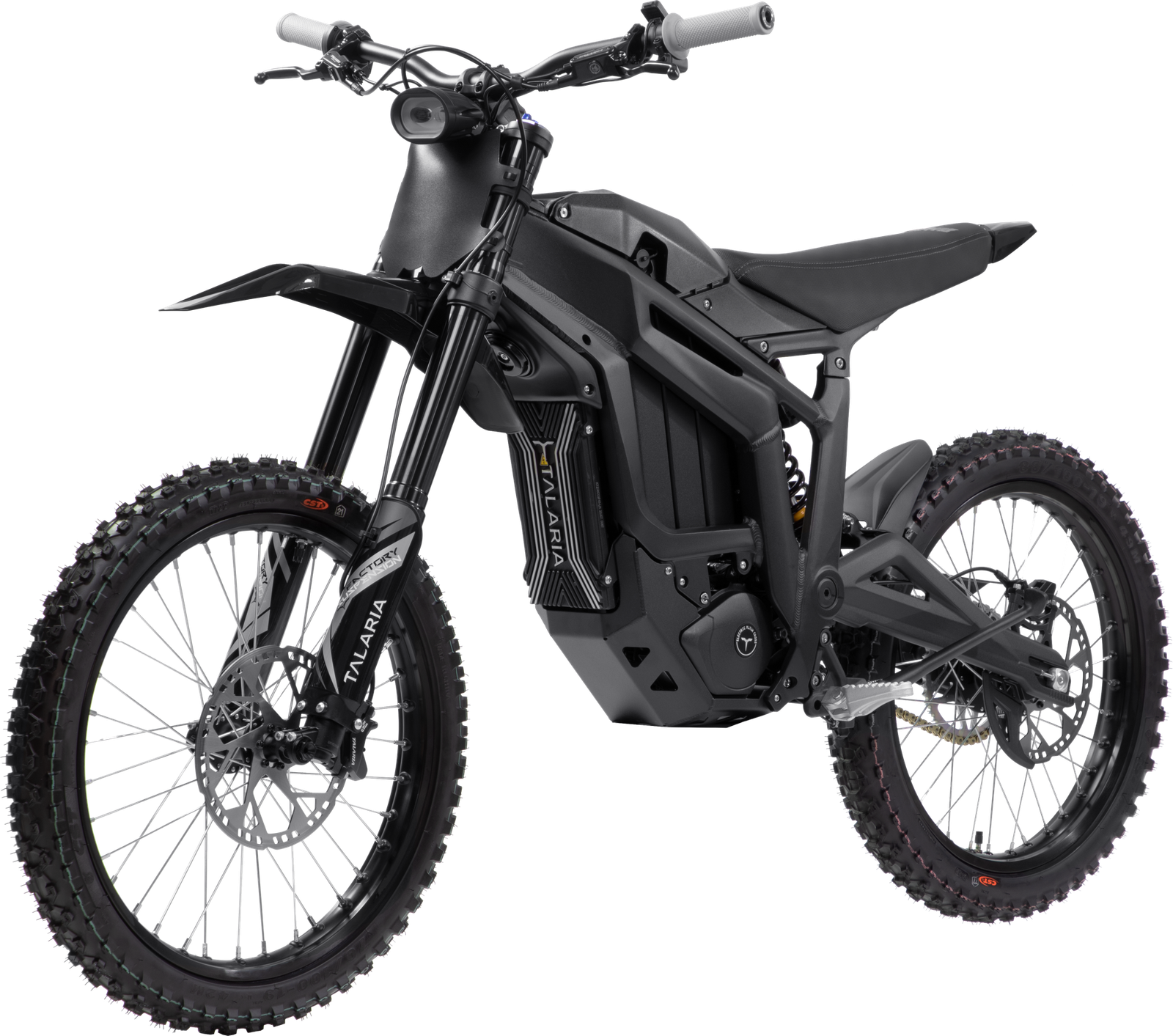
Two Sting variants are built for UK registration, and their Talaria specs differ from the off road bikes in more than lights and mirrors.
The Sting Road Legal L1e uses the 38.4Ah pack, a 3000W rated and 6000W peak motor, IP67 sealing, 3.5 hour charging and a 58 kg kerb weight with a 100 kg maximum load. It adds a larger OLED screen, homologated lighting, mirrors, indicators and a plate holder. As an L1e moped class vehicle it is limited to 45 km/h in use, whatever the rest of its Talaria specs suggest the platform could do.
The Sting L3e is the 125 equivalent, aimed at the L3e A1 class. It carries the 45Ah pack, an air cooled interior permanent magnet motor rated at 3500W, 375 Nm at the rear wheel, a 53 mph top speed, a 14 kg battery and a 71 kg kerb weight. Both are type approved under Regulation 168/2013, and the licence steps are set out on GOV.UK. Every other model here is for private land with the landowner’s permission, and cannot be used on roads, byways, bridleways, footpaths or pavements.
Talaria weight compared
Talaria weight is the figure buyers underestimate most, because a bike that looks like a mountain bike in photographs weighs as much as a small motorcycle in a van. The spread across the Talaria specs is enormous: 53 kg for an XXX Pro, 100 kg for a Dragon.
So how heavy is a Talaria in practice? A 58 kg Sting L1e can be wheeled up a ramp by one person. A 66 kg Sting R MX4 needs care. The 76 kg Talaria MX5 Pro weight sits at the limit of what most riders lift alone, and the 98 kg Komodo needs two people or a proper ramp.
Rider weight limits
Maximum load is published for most models: 100 kg on the MX5 Pro, XXX Pro, Sting L1e and Sting L3e, 160 kg on the Komodo. The Talaria MX4 weight limit is the awkward one, because the MX4 sheet publishes no maximum load at all. The working assumption is the same 100 kg as its siblings, and if you are close to that, tell us before ordering so we can discuss spring rates.
Where the mass sits
Pack placement matters more than the total weight in the Talaria specs. The Sting packs sit as a vertical block behind the head tube, keeping mass central and high. The X3 and XXX spread the pack along the frame, which is why they feel lighter in a turn than the kerb figures suggest.
Where the spec sheets disagree
Publishing Talaria specs honestly means flagging contradictions rather than smoothing them over. These are the ones in the documents we hold.
- MX5 Pro top speed. The power table says the bike is factory limited to 32 km/h, while the same sheet claims a 45 percent power increase over 60V models. The limit is a shipping restriction, not the capability of the platform.
- Sting R Off Road. One paragraph quotes 55 mph, another a 13 percent increase to 53 mph. Treat 53 mph as the figure.
- XXX Pro weight. The table gives 40 kg without the battery and 53 kg with it, while the feature list repeats the 125 pound figure carried over from the XXX. The table is the more specific source.
- X3 and XXX peak power. The highlights say 6000W, while the body copy on the same pages gives 5500W and 6500W. We quote 6000W and note the spread.
- Komodo voltage. Marketing copy says 96V, the table says DC 97.2V nominal. Both describe the same pack.
- Sting L3e. The sheet gives rated and peak power as the same 3500W, calls the bike homologated to L1e in one sentence and a 125 equivalent in the next, and quotes both 53 mph and a 30 mph restriction. The L3e A1 class is not subject to the 45 km/h moped ceiling, so the 30 mph line looks copied from the L1e sheet.
- Competizione power. The 50s is titled at 21 kW while its controller section quotes 22 kW continuous, and the 45B page repeats the 4060 Wh figure from the 50s alongside its own 3645 Wh pack. The titles carry the builder’s final tune figures.
None of this is unusual for a fast moving manufacturer, but it is why we cross check against the bikes on the floor. The Motorcycle Industry Association covers how powered two wheeler categories are defined in the UK.
Frequently asked questions
How heavy is a Talaria?
It depends entirely on the model, which is why the Talaria specs are worth reading in full. The lightest is the XXX Pro 2025 at 53 kg with its battery fitted. The Sting Road Legal L1e is 58 kg, the Sting R MX4 66 kg, the Sting L3e 71 kg, the MX5 Pro 76 kg, the Komodo 98 kg and the Dragon 100 kg. All include the battery, which is between 12.85 kg and 24.5 kg on its own.
Which Talaria has the biggest battery?
The Dragon, at 88V and 58.5Ah for roughly 5.2 kWh. The Komodo is next at 97.2V and 45Ah, about 4.4 kWh. Within the Sting family the Competizione 50s carries 4060 watt hours at 81.4V, the MX5 Pro 2880 watt hours at 72V, and the Sting R MX4 2700 watt hours at 60V.
What are the Talaria MX3 specs in short?
The headline Talaria specs are a 60V 38.4Ah LG 21700 pack giving 2280 watt hours, a permanent magnet synchronous motor at 3000W nominal and 6000W peak, 284 Nm at the rear wheel on the 44 tooth sprocket, a 47 mph quoted top speed, 100 km of range at 32 km/h, and a gearbox primary drive with a chain final drive.
Is the MX5 Pro too heavy for a beginner?
Not necessarily, but the 76 kg kerb weight matters if you ride alone. A heavier bike is more stable at speed and more tiring to pick up. Riders who expect to drop it while learning, or who load a van without help, are happier on the Sting R MX4 at 66 kg or an XXX at about 57 kg.
Does Talaria publish a rider weight limit for the MX4?
Not on the sheet supplied with the bike. The Talaria specs publish maximum load at 100 kg for the MX5 Pro, XXX Pro, Sting L1e and Sting L3e, and 160 kg for the Komodo, so 100 kg is the reasonable expectation for the MX4. Suspension can be resprung for heavier riders, which is worth raising before you order.
Why do the Komodo specs quote two different voltages?
Because the Talaria specs use 97.2V as the nominal figure while 96V is the marketing name for the same pack. Lithium packs are named by convention rather than by measurement, so a string of 3.6V cells is sold as 96V and specified as 97.2V. Neither is wrong.
Next steps
With the Talaria specs side by side, the decision usually comes down to weight and where you will ride. Browse the Talaria Sting range for the gearbox platform, or the road legal Talaria category if the bike needs a number plate. Our battery guide and range guide explain how capacity becomes riding time, and the contact page reaches a UK Talaria specialist.
