
Uncategorized
Talaria Oil Change and Maintenance Schedule: Gearbox, Chain, Brakes and Bearings
Apr
A Talaria oil change is the one job that separates Sting ownership from owning a belt driven electric bike, and it is also the job most owners have never been shown how to do. The Sting MX3, Sting R MX4, MX5 Pro and Komodo all send motor torque through a sealed gearbox that holds a small quantity of oil, and that oil shears, darkens and picks up metal over time. This guide covers the change itself, then the chain, brake pads, bearings, torque checks and washing routine that keep a Talaria reliable between services.
Why a Talaria needs an oil change at all
Most light electric dirt bikes use a toothed belt as the primary reduction between motor and output sprocket. Talaria took a different route on the Sting family: the MX3 sheet lists a gearbox as the first transmission stage and a chain as the second, and the MX4, MX5 Pro and Komodo follow the same layout. The Talaria MX3 gearbox is why the bike runs so quietly and has no belt to snap, but gears need lubrication, and that is what a Talaria oil change renews. Fresh Talaria gearbox oil keeps a film between the teeth; tired oil lets them touch, and the first sign is a whine that was not there before.
The interval Talaria publishes
The Sting R MX4 specification describes a quick oil change every 3000 to 5000 miles as the whole of the drivetrain maintenance routine, contrasting it with the belt changes other bikes need. It is the only published Talaria oil change interval we hold, and it is a mileage figure rather than a time figure. A bike that does 40 miles a weekend will take well over a year to reach it; a road legal L1e or L3e used for daily commuting will reach it far sooner.
Which models this applies to
A Talaria oil change is relevant to the Sting MX3, the Sting R MX4, the Sting MX5 Pro and the Komodo. The XXX, XXX Pro and X3 use a belt primary reduction, so there is no Talaria oil change on those bikes; belt condition takes its place in the schedule below.
The Talaria oil change, step by step
A Talaria oil change takes less than half an hour once you have done it once. We deliberately do not print a fill volume because the quantity differs between the MX3 and MX4 case and the reinforced MX5 gearbox, and an overfilled case weeps past the output seal. Use the volume and oil grade in your owner’s manual, and if the manual is missing, ask us before you pour.
Preparation
Ride the bike for ten minutes before any Talaria oil change so the oil is warm and carries its suspended metal out with it. Switch off, remove the key, and stand the bike level on a paddock stand; a side stand tilts the case and leaves oil behind. Place a tray beneath the gearbox and have the correct oil, a funnel, a torque wrench and a clean rag to hand.
Draining
Remove the fill plug first so air can enter, then crack the drain plug at the lowest point of the case and let the oil run until it drips. Look at what the Talaria oil change brought out. Grey shimmer is normal bedding wear on a young gearbox; visible flakes, a milky colour from water ingress or a burnt smell mean the interval was too long or a seal has failed. Wipe any magnetic plug and check it for anything larger than dust.
Refilling and checking
Fit a new sealing washer on the drain plug and tighten it to the figure in the manual, not to the limit of your arm. Pour the measured volume slowly through the fill port, replace the fill plug, then run the bike on the stand for a minute before checking for weeps at both plugs and at the output shaft seal. Wipe the case, note the Talaria oil change mileage in your service record, and dispose of the old oil at a council recycling site.
Chain and sprockets
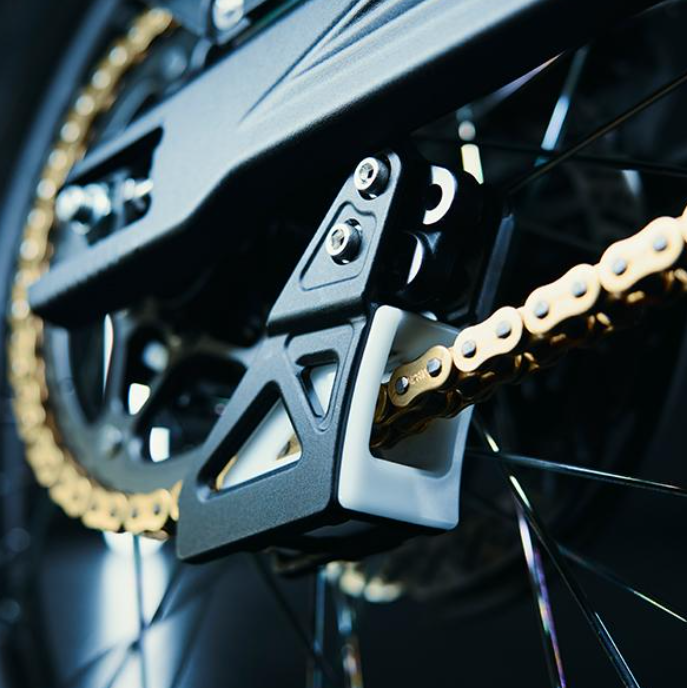
The secondary drive on every Talaria is a conventional chain that wears exactly as a petrol bike chain does, only in silence. Without engine noise you will not hear a dry chain until it is damaged, so inspect it before every ride rather than saving it for the next Talaria oil change.
Chain sizes across the range
The Sting R MX4 runs a 420 chain, which the Competizione build notes describe as the lighter of the two Sting sizes, and the MX5 platform moved to a heavier 428 chain on a 48 tooth rear sprocket to cope with its extra torque. The Komodo steps up again to a 520 chain with a 14 or 15 tooth front and a 50 or 53 tooth rear. Replace like with like.
Tension and lubrication
Check tension with a rider’s weight on the seat, because the linkage on the MX4 and MX5 changes the chain run as the shock compresses. Aim for the free play in your manual, measured at the tightest point after a full turn of the wheel. Clean with a chain brush and a dedicated cleaner, dry it, then apply a light lube to the inner run. Wipe the excess, or it will fling onto the rear rotor.
When to replace
Pull the chain rearwards at the three o’clock position on the rear sprocket. If it lifts far enough to show most of a tooth, the chain is stretched, and hooked sprocket teeth mean the sprocket went with it. Change chain and both sprockets together; a new chain on a worn sprocket wears in weeks. The Talaria parts range carries sprockets and wheel sets.
Brake pads, rotors and fluid
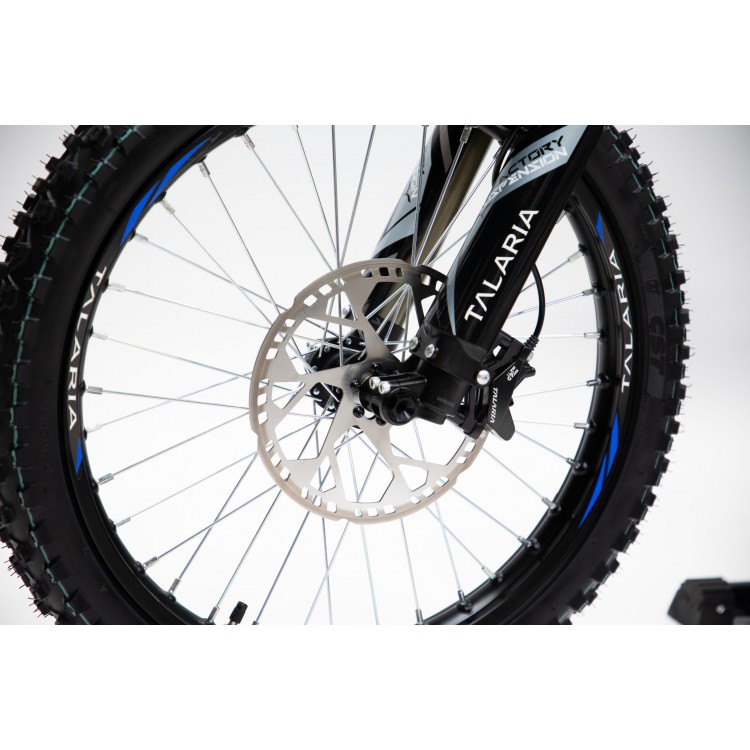
Talaria brake pads last longer than most riders expect because four levels of regenerative braking slow the rear wheel before the caliper does any work. That benefit hides pad wear until the pack is full and regen is limited. Inspect pads by eye every month, and again at every Talaria oil change, regardless of how the lever feels.
Pad inspection
Shine a torch into the caliper from the rear and look at the friction material either side of the rotor. When it approaches the thickness of the backing plate, order replacements. Uneven wear across one pad points to a sticking piston; uneven wear between the two pads points to a caliper that is not centred. Both are easy fixes if caught early.
Rotors across the models
The Sting R MX4 uses 220 mm rotors of 2.3 mm thickness with four piston calipers, the MX4 Expert pairs a 220 mm disc with a Magura MT5 system, and the MX5 Pro thickens the rotor to 3 mm with larger MX style calipers and DOT 3 or DOT 4 fluid. The original MX3 uses smaller 203 mm discs, which is why the 17 inch supermoto wheel set notes a disc swap for MX3 fitment. A rotor worn below its stamped minimum or carrying a lip must be replaced, not machined.
Fluid
Brake fluid absorbs moisture through the hoses and the reservoir cap, faster on a bike washed after every muddy ride. Check the sight glass at every Talaria oil change: fresh fluid is pale straw, tired fluid is tea. Bleed or replace it when the lever grows spongy or the colour darkens, using only the fluid type printed on the reservoir cap.
Bearings and torque checks
The forged 6061 T4 and T6 frame on a Sting does not flex enough to loosen fasteners on its own, but chain vibration over rough ground does, and the swingarm, linkage and headset carry loads a petrol bike would spread over a heavier chassis. A torque check with the manual open, done alongside a Talaria oil change, is a twenty minute job that prevents most of the rattles owners report.
Headset and swingarm
The Sting R gained a stronger headset bearing over the original Sting for a reason. Check it by holding the front brake and rocking the bike fore and aft; a knock means play. Lift the rear wheel and push it sideways to feel for swingarm pivot play. Grease the linkage bearings when you service the shock.
Wheel bearings and axles
Spin each wheel on a stand and listen for roughness. Grip the tyre at top and bottom and rock it; play here is a bearing, not a spoke. Tap around the rim and listen for a dull note among the rings. Axle nuts, sprocket bolts, rotor bolts, caliper mounts and footpeg mounts should be checked against the manual’s figures after the first few rides on a new bike, monthly thereafter, and at every Talaria oil change.
Electrical connections
With the key off, check that the main pack plug seats fully, that the 125 A circuit breaker on the MX4 clicks positively, and that no phase wire insulation shows chafe where the loom passes the swingarm. Pack storage is covered in the Talaria battery guide and charging habits in the Talaria charger guide; both are part of maintenance alongside the Talaria oil change.
Washing without drowning the electrics
A careless wash does more damage than a late Talaria oil change ever will. The battery, controller and display on current road legal Stings and the Komodo are rated IP67, which covers immersion at low pressure. A pressure washer lance is not low pressure. It lifts seals, drives water past bearing shields and forces grit into the throttle mechanism. Wash with a hose on a gentle setting, a bucket and a soft brush, and leave the pressure washer for the van.
A safe washing order
- Let the bike cool and switch it off; a hot motor case quenched with cold water draws moisture inward as it contracts.
- Rinse loose mud from top to bottom with a low pressure hose, keeping the stream away from the display, charging port, wheel bearings and headset.
- Brush the frame, swingarm and wheels with a mild bike cleaner, then rinse.
- Clean and lubricate the chain last.
- Dry with a cloth or a leaf blower, then ride gently for a few minutes to dry the rotors.
After riding lawful green lanes
Riders who take the road legal L1e or L3e on lawful green lanes, the kind catalogued by the Trail Riders Fellowship, come home with clay that dries like plaster. Soak it rather than blasting it. Winter road salt is worse than mud and attacks the anodised finish, so rinse it the same day. The Motorcycle Industry Association publishes wider care guidance for powered two wheelers.
Talaria maintenance schedule
The table sets out a practical Talaria maintenance schedule for a bike in regular use. The Talaria oil change interval is the published MX4 figure; every other interval is a sensible workshop habit rather than a manufacturer figure, so shorten it if you ride in mud, sand or salt.
| Item | Before every ride | Monthly | Every 3000 to 5000 miles | Applies to |
|---|---|---|---|---|
| Gearbox oil | Look for weeps at plugs and output seal | Listen for whine on the stand | Full Talaria oil change with new washer | MX3, MX4, MX5 Pro, Komodo |
| Belt primary drive | Visual check for cracks | Tension and tooth condition | Replace if glazed or frayed | XXX, XXX Pro, X3 |
| Chain and sprockets | Tension, lubrication, no tight spots | Clean, lube, check for hooked teeth | Replace chain and both sprockets together when stretched | All models |
| Brake pads | Lever feel | Torch inspection of friction material | Replace when close to backing plate thickness | All models |
| Brake fluid | Lever firmness | Colour in sight glass | Bleed or replace when dark or spongy | All models |
| Headset, swingarm and wheel bearings | Rock test for play | Spin test and grease where fitted | Replace any bearing with roughness | All models |
| Fasteners and torque | Axle nuts by feel | Full torque check against the manual | Repeat after any crash or component change | All models |
| Battery and connectors | Charge level, connector seated | Inspect loom for chafe, breaker action | Balance charge and storage review | All models |
Frequently asked questions
How often should I do a Talaria oil change?
The Sting R MX4 specification gives a Talaria oil change interval of every 3000 to 5000 miles for the gearbox oil. Treat the lower figure as your target if the bike sees mud, water crossings or hard off road use, and listen for gear whine well before that mileage. The XXX and X3 use a belt and have no oil to change.
How much oil does the Talaria gearbox take?
The Talaria oil change fill volume differs between the MX3 and MX4 case and the reinforced MX5 Pro gearbox, so use the figure and oil grade printed in your owner’s manual rather than a number from a forum. Overfilling forces oil past the output shaft seal and onto the chain; underfilling starves the upper gear. Ask us if your manual is missing.
Is the Talaria MX5 oil different from the MX3 or MX4 oil?
The MX5 Pro has a redesigned, stronger gearbox built to carry more torque, so follow the grade in the MX5 manual rather than assuming the MX3 or MX4 recommendation carries across. The Talaria oil change method is the same: warm the oil, drain from the lowest plug, refit with a fresh washer, fill the stated volume and check for leaks.
Why do my Talaria brake pads last so long?
Because the bikes carry four levels of regenerative braking that slow the rear wheel electrically before the pads do any work. The pads wear slowly, but that hides the day they finally run down, so inspect the friction material with a torch every month and at every Talaria oil change, and change pads before they reach backing plate thickness.
Can I pressure wash a Talaria?
We advise against it. The electrical components on current models are rated IP67, which covers brief immersion, not a directed jet that strips grease from bearings and lifts seals. Use a low pressure hose, a bucket and a brush, and dry the bike before storing it.
Does home maintenance affect my warranty?
Routine servicing that follows the manual, including the Talaria oil change, chain care and pad replacement, is expected of any owner and does not affect cover. Damage caused by incorrect work, wrong fluids or pressure washing is not a manufacturing defect. Every bike we sell is covered by our UK warranty, full terms on the warranty page.
Next steps
Keep a simple service log with the date and mileage of each Talaria oil change, chain replacement and pad change, and the bike will hold its value as well as its performance. Consumables are in the Talaria parts category, the warranty page explains cover for a maintained bike, and the Sting R MX4 remains the reference point for the gearbox platform this guide describes.
