
Uncategorized
Talaria Dragon Review: A First Look at the 2025 Spec Sheet
Mar
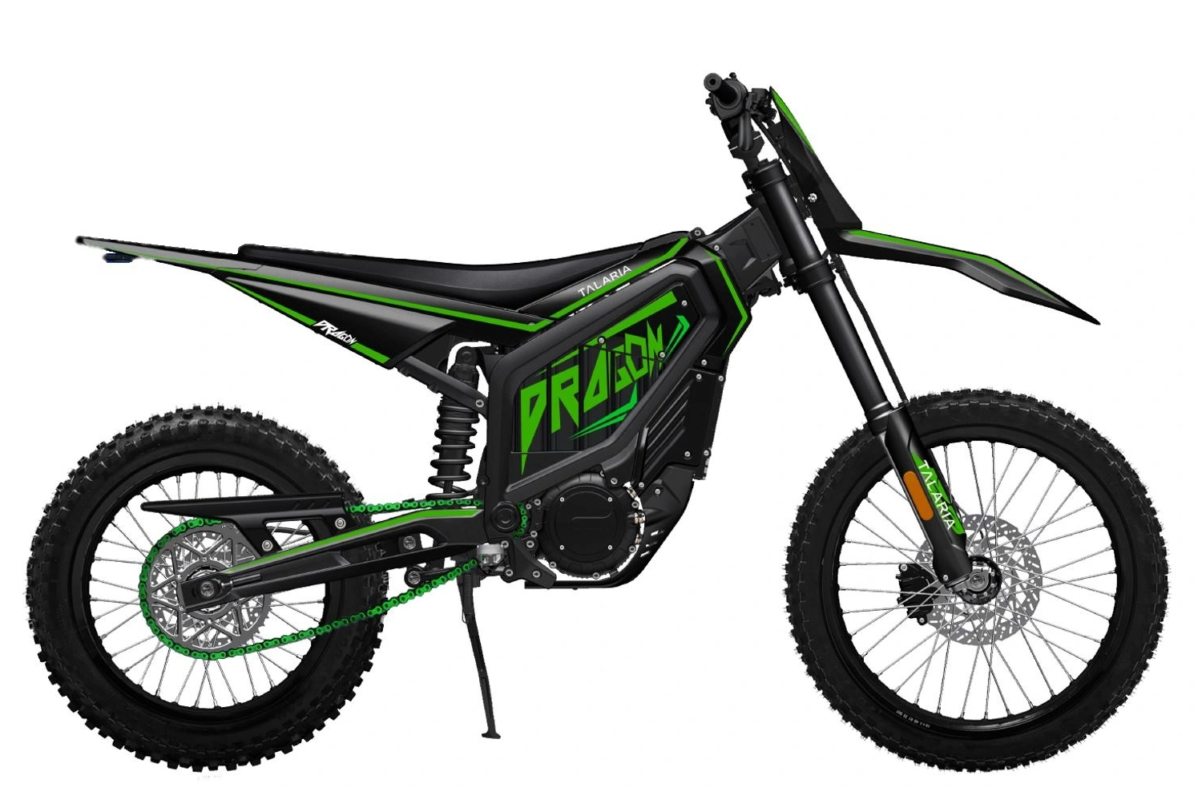
This Talaria Dragon review is a first look built from the specification sheet rather than a ride report, because the Dragon is the newest model in the range and UK owners are still few. The sheet shows a 28 kW, 21 inch front wheel enduro between the XXX Pro and the Komodo, with a 5.2 kWh battery, a 110 km/h ceiling and two versions, off road and L1e road legal. Every figure below comes from the listing, and where the listing includes items we do not consider established Talaria specifications, we say so.
Where the Dragon sits in the range
Any Talaria Dragon review has to start with where the bike sits, and Talaria’s line up now runs in three tiers. The Sting family and the XXX are the lightweight 60V and 72V bikes with 19 inch wheels. The Komodo is the 32 kW, 97.2V flagship on 21 and 18 inch wheels. The new Talaria Dragon lands between them: 28 kW peak, 21 inch front and 18 inch rear wheels, 100 kg, and a battery larger than the Komodo’s. It is a full size enduro chassis with slightly less power than the flagship and noticeably more energy on board.
Two versions and three colours
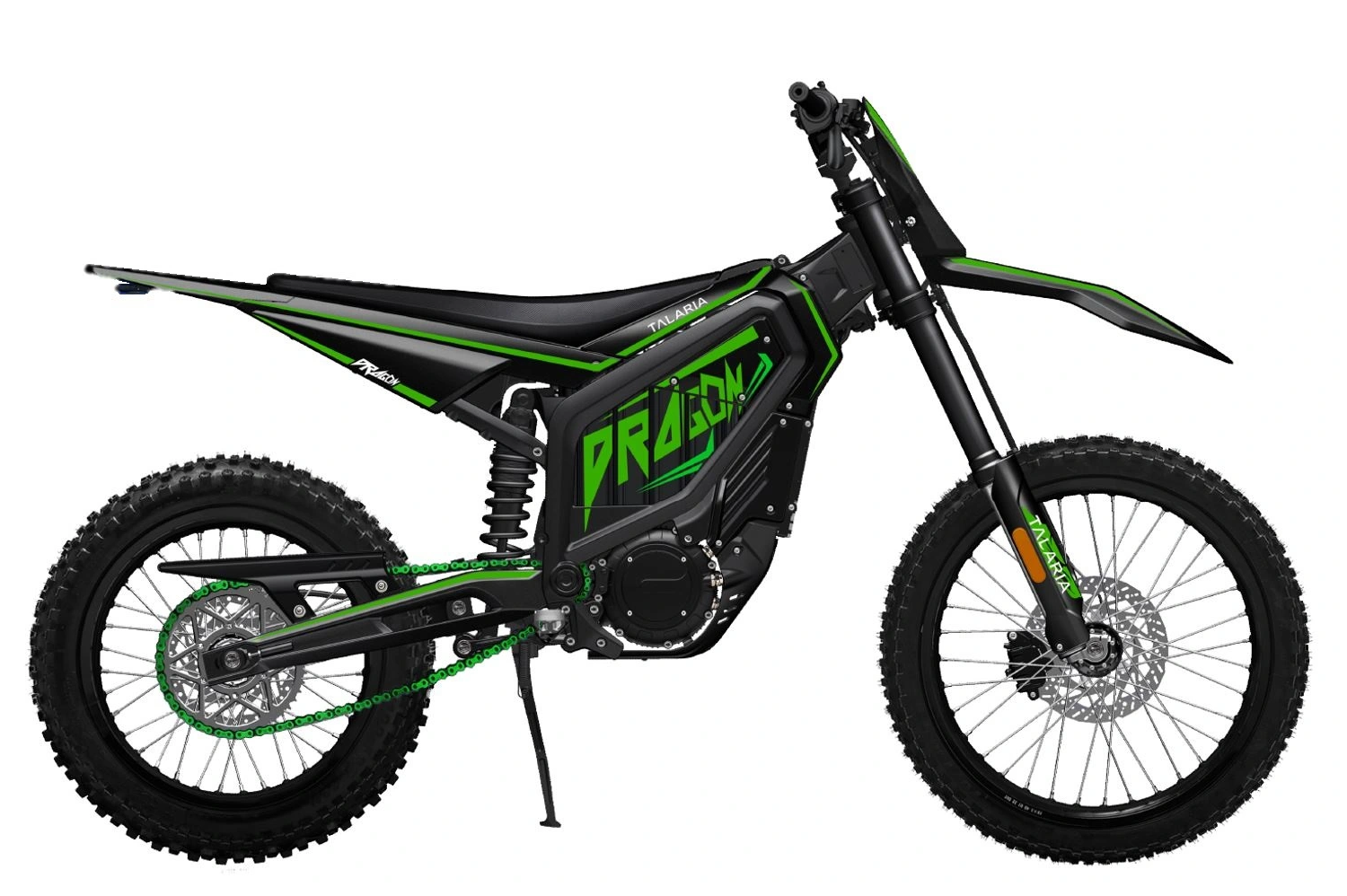
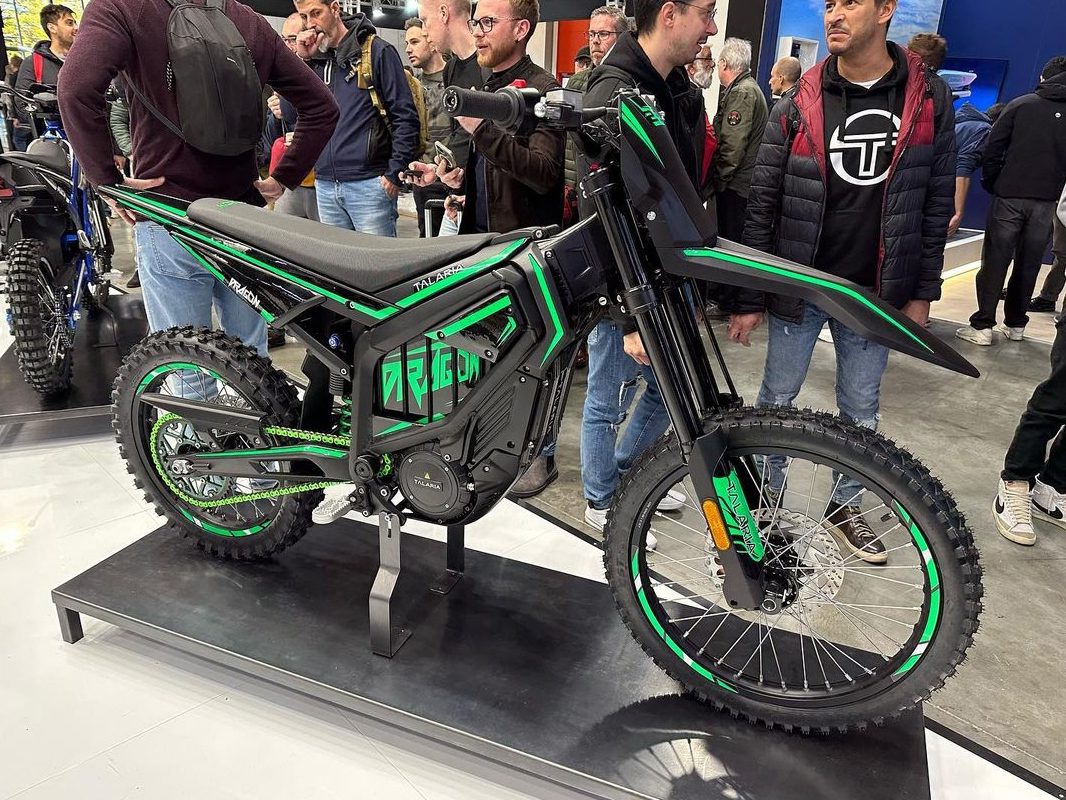
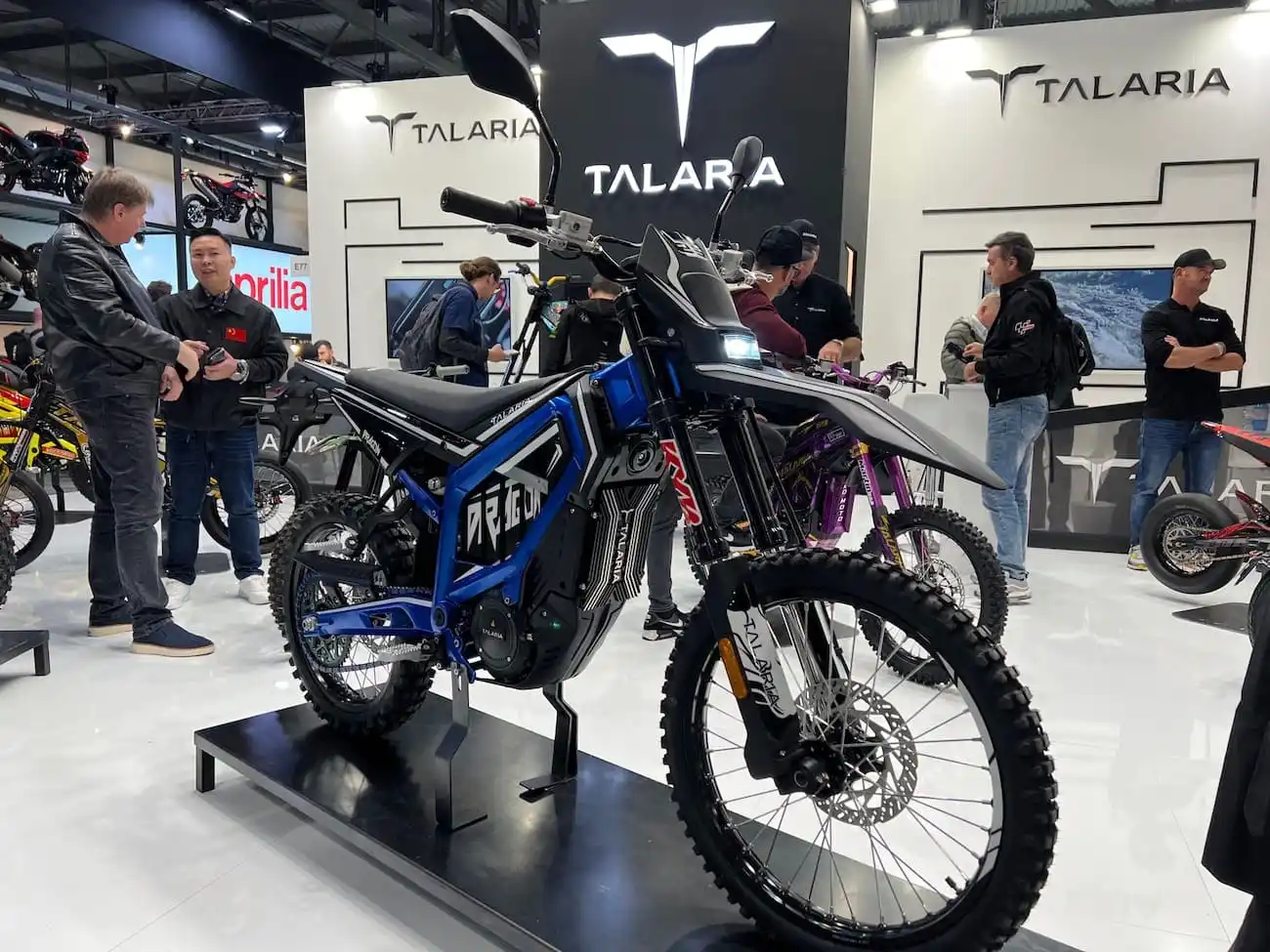
The Dragon 2025 listing offers an MX off road version and an L1e road legal version, in green, blue, or a mixed blue and green finish. That split matters more on the Dragon than on any other Talaria, because the performance figures in this Talaria Dragon review apply to the off road bike on private land. The L1e version is a homologated moped class vehicle and is held to the limits of that class, which we come to at the end.
Who it is aimed at
Riders who found the Sting and XXX too small, who want a 21 inch front wheel and a seat around 880 to 900 mm, and who value range over the Komodo’s last few kilowatts. On paper the Dragon is the long day enduro bike in the range, and the rest of this Talaria Dragon review tests that reading block by block.
Talaria Dragon specs: motor and drive
The drivetrain is where this Talaria Dragon review starts. The Talaria Dragon specs list a mid drive electric motor with 10 kW nominal power and 28 kW peak, the latter expressed as 37.5 hp in one place and 38 hp in another, both of which round from the same kilowatt figure. Rear wheel torque is given as 630 Nm with the 48T sprocket. Drive is by chain through a single speed transmission, and the ride modes are Eco, Sport and Hyper, the same three step layout used on the MX5 Pro and the Komodo.
The 110 km/h figure
This Talaria Dragon review takes the top speed as printed: 110 km/h, a little over 68 mph, which the listing rounds to 70 mph. That ceiling belongs to the off road version on private land only. It sits 5 km/h above the Komodo’s 105 km/h and well above the 75 km/h of the XXX Pro, on an 88V pack rather than the Komodo’s 97.2V.
The acceleration line
The listing also carries a line reading 0 to 60 mph in under 5 seconds. This Talaria Dragon review reports it because it is on the sheet, but treats it as the distributor’s claim rather than a measured result, since no test conditions, rider weight or surface are stated. Talaria does not publish acceleration times for the Sting or the XXX, so this line should be read with the same caution.
Power delivery in context
Ten kilowatts nominal is a large number for a bike of this size; the Sting Pro MX5 is rated at 5.5 kW continuous and the Komodo at 8.6 kW. If it holds up in use the Dragon should sustain climbs and open ground better than any Talaria bar the Komodo, and in this Talaria Dragon review that continuous figure, not the 28 kW peak, is the one a long distance rider should watch.
Battery, range and charging
The battery is where any Talaria Dragon review has to pause, because it is where the bike separates itself. The pack is listed at 88V and 58.5 Ah, approximately 5,200 Wh, and rounded elsewhere on the sheet to 5.2 kWh. That is the largest pack Talaria has put in a bike: the Komodo carries 97.2V 45Ah, roughly 4.4 kWh, and the MX5 Pro 2,880 Wh. The Dragon’s battery weighs 25 kg on its own, against 24.5 kg for the Komodo pack and 12.85 kg for a Sting pack.
Range claim and how to read it
The listing quotes a maximum range of 150 km, or 93 miles, at a steady 25 km/h, which is 15.5 mph. That is Talaria’s standard test condition and a gentle one, so this Talaria Dragon review treats 150 km as a ceiling rather than a trail day expectation. What it confirms is about 18 percent more energy than the Komodo, which at any pace means proportionally more distance. Our Talaria range guide explains how the 25 km/h figure scales to real riding.
Charging
This Talaria Dragon review takes the charge time as given, at 4 hours. For a 5.2 kWh pack that implies a stronger charger than the 3 hour units supplied with the 2.7 kWh Sting R, and it is a sensible figure for an overnight or between sessions charge. The listing does not state the charger’s output, so we do not quote one.
Chassis, suspension and brakes
The frame is aluminium, and the suspension is an adjustable air plus spring fork at the front with an adjustable shock at the rear. The listing gives no travel figures, a gap against the Komodo sheet’s 250 mm fork travel and 90 mm shock stroke, so we leave travel out of this Talaria Dragon review until Talaria publishes it. Air and coil together at the front follows the MX5 Pro.
Brakes
Braking is hydraulic disc at both ends with 220 mm rotors front and rear. That matches the disc diameter used on the Sting R and MX5 Pro, although a 100 kg bike with 28 kW asks more of the same size rotor than a 76 kg MX5 does. The listing does not name the caliper or state piston count, so neither does this Talaria Dragon review.
Wheels and tyres
Spoked aluminium wheels, 21 inch front and 18 inch rear, carry tubed tyres in 90/90 21 and 120/80 18 sizes. Those are conventional full size enduro dimensions, wider at the rear than the Komodo’s CST fitment of 90/100 18, and they are the clearest signal on the sheet that the Dragon is intended for open terrain and rider weights the Sting chassis was never designed for.
Dimensions and rider fit
The listing gives the Dragon’s dimensions in inches, so this Talaria Dragon review converts them. Converted, the bike is about 2,000 mm long, 780 mm wide and 1,200 mm tall, with a 1,379 mm wheelbase and 300 mm of ground clearance. Seat height is quoted twice, as 34.6 inches and as 35 inches or 90 cm, which places it between 879 mm and 900 mm. Kerb weight is 100 kg and the stated load capacity is 220 lb, which is 100 kg.
Against the Komodo’s numbers
For this Talaria Dragon review the Komodo is the natural yardstick. The Komodo sheet lists 2,200 by 810 by 1,220 mm, a 1,380 mm wheelbase, a 910 mm seat and 315 mm of clearance at 98 kg. The two are near identical in wheelbase and weight, with the Dragon shorter overall and a fraction lower at the seat. Riders coming from a Sting will notice the extra 40 to 60 mm of seat height immediately.
The load rating
A 100 kg maximum load matches the MX5 Pro and is well below the Komodo’s 160 kg. Heavier riders, or anyone carrying luggage on a long day, should weigh that before choosing between the two full size bikes, and it is the one figure in this Talaria Dragon review that may decide the purchase.
Dragon against Komodo and XXX Pro
This Talaria Dragon review sets the bike between the two machines it is most often compared with, using only figures from the three product listings.
| Item | Talaria Dragon 2025 | Talaria Komodo 2025 | Talaria XXX Pro 2025 |
|---|---|---|---|
| Peak power | 28 kW | 32 kW | 6 kW |
| Nominal power | 10 kW | 8.6 kW | 2.5 kW |
| Battery | 88V 58.5Ah, about 5.2 kWh | 97.2V 45Ah, about 4.4 kWh | 60V 40Ah, 2,400 Wh |
| Battery weight | 25 kg | 24.5 kg | Not stated |
| Top speed | 110 km/h (about 68 mph) | 105 km/h (about 65 mph) | 75 km/h (about 47 mph) |
| Range claim | 150 km at 25 km/h | 115 km at 45 km/h | 100 km at 25 km/h |
| Rear wheel torque | 630 Nm (48T) | 754 Nm | 233 Nm (48T) |
| Wheels | 21 in front, 18 in rear | 21 in front, 18 in rear | 19 in front, 17 in rear |
| Weight | 100 kg | 98 kg | Not stated on the Pro sheet |
| Charge time | 4 hours | About 1.5 hours per listing | Not stated |
| Versions | MX off road, L1e road legal | Off road | Off road |
What the comparison says
The Komodo keeps the power, torque and load rating advantage; the Dragon takes the energy, range and top speed columns and adds a road legal option the Komodo lacks, which is the central finding of this Talaria Dragon review. The XXX Pro is in a different class and is there to show how far the two full size bikes sit above the 60V range. Our Komodo top speed guide covers the flagship in detail.
What this Talaria Dragon review does not claim
The product listing carries a block of infotainment and safety lines that appear to have been filled from a generic vehicle template: anti lock braking, traction control, stability control, voice control, a radio receiver, music playback, wireless headset connectivity and an anti theft alarm. None of those are established Talaria specifications on any model, and none appear on the Komodo sheet, which is the closest bike in the range. We do not treat them as confirmed and you should not buy on the strength of them.
What we do accept from that block
This Talaria Dragon review accepts the 4.3 inch colour TFT display, which is consistent with the screens on the MX5 Pro and the Komodo, and LED lighting, a speedometer and a trip meter are standard across the range, so those lines are credible. The road legal version is stated to carry a horn and indicators, which are requirements of L1e approval and therefore also credible.
Why we flag it
A Talaria Dragon review is only useful if it separates what the manufacturer has committed to from what a listing has inherited. The motor, battery, dimension and wheel figures are specific, internally consistent and match Talaria’s other sheets. The infotainment block is not, and a careful Talaria Dragon UK buyer will want to see the bike, or a factory document, before relying on it.
Talaria Dragon release date and UK availability
People searching for a Talaria Dragon release date are usually asking a simpler question: can I buy one in the UK yet? Yes. The Dragon 2025 is available to order in the UK now through our product page, in both versions and all three colours, with UK mainland delivery, timescales confirmed at checkout, and covered by our UK warranty, full terms on the warranty page. We do not publish a factory launch date because Talaria has not given us one to quote.
Riding the off road version
Every performance figure in this Talaria Dragon review belongs to the MX version, which is an off road only vehicle. In the UK it cannot be ridden on public roads, byways, bridleways, footpaths or pavements, only on private land with the landowner’s permission. Its 110 km/h ceiling and 28 kW peak are for that setting. Green lanes are public highways and require a registered, insured, road legal machine, as the Trail Riders Fellowship sets out, and a limiter must never be removed from a road legal bike to reach off road performance.
Riding the L1e version
The road legal Dragon is an L1e B moped class vehicle under EU Regulation 168/2013, which means it is limited to 45 km/h, about 28 mph, and can be ridden at 16 with a CBT, a provisional licence, registration, a number plate, insurance and a helmet. The full requirements are on the gov.uk motorcycle and moped pages. It shares the chassis and battery with the off road bike, so the range figure carries over, but the speed and power figures in this Talaria Dragon review do not. Our road legal Talaria category lists every homologated model side by side.
Frequently asked questions
Is this Talaria Dragon review based on riding the bike?
No. It is a first look built from the product specification sheet, cross checked against the Komodo and XXX Pro sheets for consistency. Every figure quoted comes from the listing, and where the listing contains lines we do not consider established Talaria specifications, such as ABS and voice control, we have said so rather than repeat them as fact.
What are the headline Talaria Dragon specs?
The figures this Talaria Dragon review works from are a mid drive motor with 10 kW nominal and 28 kW peak power, 630 Nm at the rear wheel through a 48T sprocket, an 88V 58.5Ah battery of about 5.2 kWh weighing 25 kg, a 110 km/h top speed for the off road version, 150 km of range at 25 km/h, 21 inch front and 18 inch rear spoked wheels, 220 mm hydraulic discs and a 100 kg kerb weight.
When is the Talaria Dragon release date in the UK?
At the time of this Talaria Dragon review the Dragon 2025 is available to order in the UK through our product page, in off road and L1e road legal versions. We do not quote a factory launch date because Talaria has not published one for us to cite. Delivery is to the UK mainland with timescales confirmed at checkout.
Is the Dragon faster than the Komodo?
On the sheets this Talaria Dragon review compares, marginally: 110 km/h against 105 km/h, both off road only figures for private land. The Komodo has more peak power at 32 kW against 28 kW and more rear wheel torque, so it will likely feel stronger out of a corner, while the Dragon carries about 18 percent more battery energy and claims the longer range.
Can I ride the new Talaria Dragon on UK roads?
Only the L1e road legal version, and only within its moped class limits: 45 km/h, age 16 with a CBT, provisional licence, registration, plate, insurance and helmet. The MX off road version cannot be used on any public road, byway, bridleway or footpath in the UK and is for private land with permission. Removing the L1e limiter is not permitted.
Next steps
If this Talaria Dragon review has done its job, the next step is the Talaria Dragon 2025 product page, where you can choose the version and colour and place an order for UK delivery. If you are torn between the two full size bikes, read our Komodo top speed guide alongside this one, and if you want to spread the cost, the options are set out on our Talaria finance page.
