
Uncategorized
Talaria Charger Guide: Charging Times, Amps, UK Mains and Safe Practice
Mar
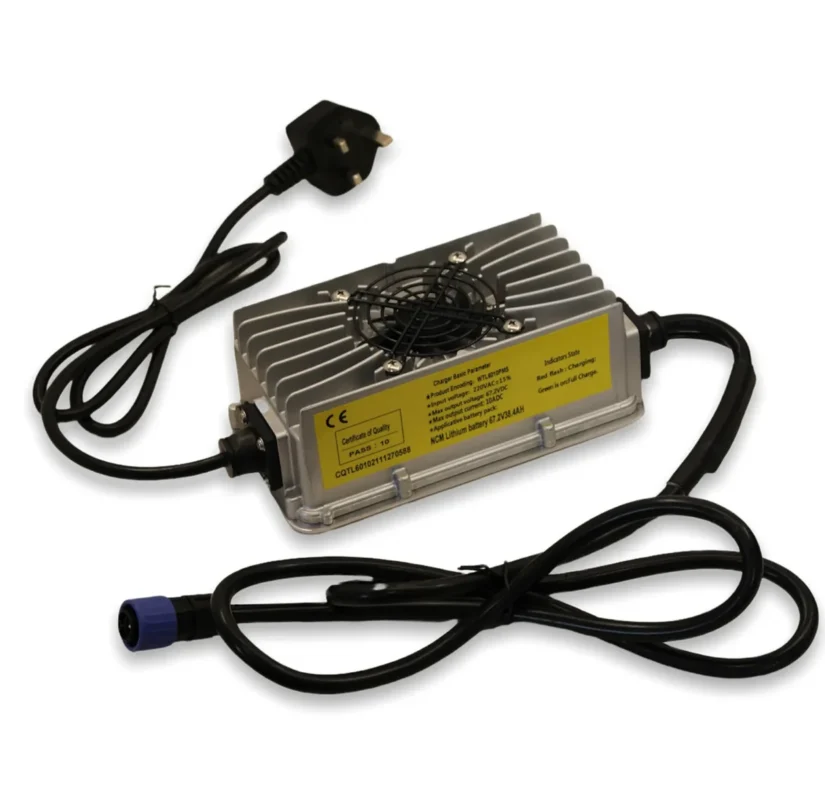
A Talaria charger looks like a simple black box with a mains lead on one end and a battery plug on the other, yet the way you use it has more influence on pack life than anything else you do to the bike. This guide explains how the factory chargers behave, how amps translate into charging time, why a 110V unit needs care on UK mains, when a faster or higher voltage charger is justified, and how to charge in a way that keeps cells balanced and your garage safe.
How a Talaria charger works
Every factory Talaria charger is a constant current, constant voltage supply. From the moment you connect a part used pack it pushes its rated current, say 12A, into the cells and the pack voltage climbs steadily. As the pack approaches its full voltage the charger holds that voltage and lets the current taper away towards zero. The fan runs hard in the first phase and quietens in the second, which is why the last ten percent feels slow.
The BMS does the talking
The charger itself is fairly simple. The intelligence sits in the battery management system inside the pack. The BMS watches every series group of cells, refuses charge if the pack is too cold or too hot, and opens the circuit if any group climbs above its safe ceiling. That is why a Talaria charger can be left to finish on its own: the pack, not the charger, has the final say.
Why voltage must match exactly
A 60V Sting pack is charged to roughly 67V, a 72V MX5 Pro pack to roughly 84V, and the 22s Competizione packs to 92.4V according to the specification sheet, which lists a 6 amp 22s 92.4V charger for those bikes. Connect a Talaria charger built for a higher voltage to a lower voltage pack and the BMS should trip, but you are relying on a safety device to save you from a wiring error. Never mix voltages.
Amps, watt hours and Talaria charging time
Talaria charging time comes down to a simple relationship: the energy in the pack divided by the power the charger delivers, plus the slow tail at the end. A 60V 45Ah Sting R pack holds about 2700 watt hours. A 12A Talaria charger at around 65V delivers roughly 780 watts, so a flat pack needs a little over three hours in theory, and the factory sheet quotes three hours from empty to full. The Sting MX3 sheet gives 2.5 to 3.5 hours for its 38.4Ah pack.
Reading the factory figures
Across the range the published charging times sit in a fairly narrow band. The road legal Sting L1e and L3e sheets both state 3.5 hours. The XXX Pro states 4 hours for its 60V 40Ah pack. The Dragon, with a far larger 5.2kWh pack, still states 4 hours because it ships with a stronger Talaria charger. The Komodo sheet quotes approximately 1.5 hours for its 97.2V 45Ah pack.
Why more amps is not free
Doubling the current halves the bulk phase, but it also doubles the heat generated inside each cell and inside the Talaria charger. Lithium cells tolerate this within limits, and the BMS enforces a ceiling, but repeated high current charging from very low states of charge ages a pack faster than a gentle overnight fill. If time is not pressing, the standard Talaria charger is the kindest option you own.
UK mains and the 110V question
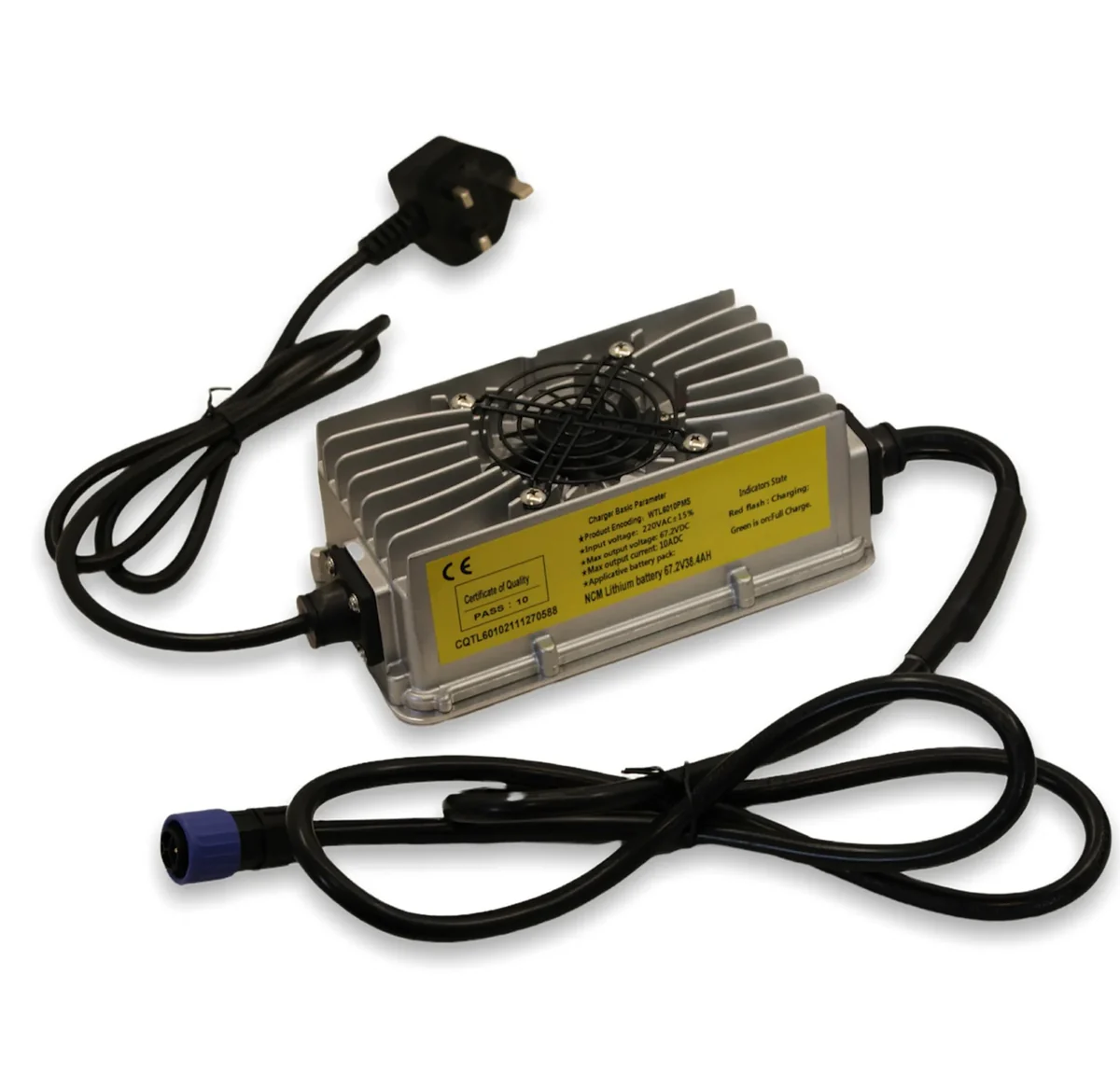
This is the part of the guide that saves people money. The Sting R MX4 OEM battery charger we list is a genuine factory Talaria charger rated 60V 12A, and its listing is explicit that it is built for the standard 110V household outlet used in the United States. UK domestic sockets supply 230V at 50Hz. Plug a 110V only charger straight into a UK socket with a simple travel adaptor and you risk destroying it in seconds.
Check the input label before anything else
Some Talaria charger units are universal input. The XXX Pro specification, for example, lists the charger input as AC 110 to 230V at 50 or 60Hz, so that unit is happy on either continent. Others are single voltage. The label on the underside of the case tells you which you have. If it reads 100 to 240V you can use a plain plug adaptor. If it reads 110V or 120V only, you need a step down transformer.
Using a step down transformer properly
A step down transformer converts 230V to 110V. It must be rated comfortably above the charger’s draw. A 12A Talaria charger at 60V pulls around 800W from the mains once losses are included, so a transformer rated at 1000W or more is the sensible minimum. Site transformers with the yellow 110V sockets are widely available in the UK and are built for continuous load. Do not use a small travel converter meant for shavers.
Which charger belongs with which bike
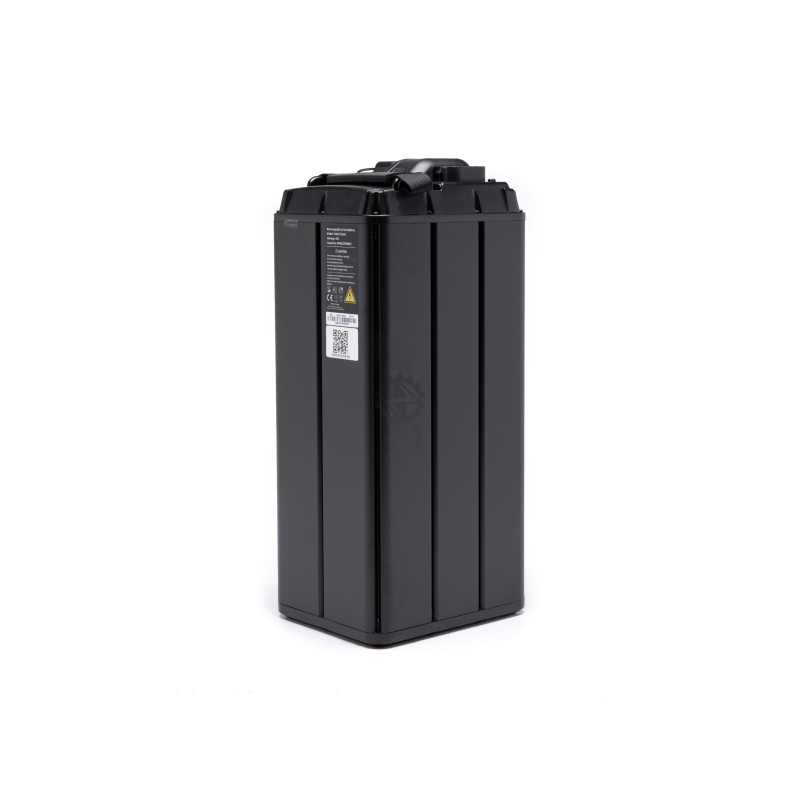
Riders searching for a Talaria Sting charger, a Talaria Sting R charger or a Talaria MX5 charger are usually asking the same question: will the unit in my hand work with the pack in my bike. The answer for any Talaria charger depends on pack voltage first and connector second. The original Sting MX3 and the Sting R MX4 both run 60V packs and share the same charging family. The MX5 Pro moves to a 72V 40Ah pack with Samsung 50S cells, so a Talaria Sting Pro charger is a 72V unit and is not interchangeable with the 60V one.
Connector types
Factory packs use a keyed charging socket on the pack itself. The Competizione packs built at the workshop level use an XT60 connector for charging, which is stated on their sheet. If you buy a replacement pack, confirm the Talaria charger connector as well as the voltage. The 60V 43.2Ah Sting MX4 replacement pack carries a note that it needs a different charger from the stock 60V unit, so read every listing rather than assuming.
Replacement chargers from the batteries and chargers range
Our Talaria batteries and chargers category holds the packs and charging equipment we currently stock. If your original Talaria charger has failed, match the voltage printed on your pack, then match the connector, then check the input voltage for UK use. Those three checks prevent nearly every charging mishap.
Fast chargers and higher voltage packs
A fast charger is simply a Talaria charger with a higher current rating than the factory unit. Where the standard Talaria charger for a 60V Sting is 12A, aftermarket units of 15A, 20A and beyond exist. A 20A charger cuts the bulk phase on a 45Ah pack from roughly three hours to under two. The costs are heat, noise, a heavier unit and a greater load on both the mains circuit and the pack’s charge port.
When a fast charger earns its place
Fast charging suits riders who run two sessions in a day, race at events with mains power in the paddock, or share one charger across two bikes. It suits far less well as a daily default for a commuter on a road legal Sting, where an overnight fill on the standard Talaria charger is available every night. The more often you use high current, the more the pack notices.
72V and 22s packs need their own charger
Any voltage upgrade brings a Talaria charger upgrade with it. The EBMX 72V 42Ah pack listing says outright that it cannot be charged on the stock 60V charger, and the Competizione bikes ship with a 6A 92.4V unit because nothing else will reach their 22 series groups. Budget the charger into any battery upgrade and check the Talaria battery guide before choosing a pack.
Balancing, top ups and pack health
Balancing is the process by which the BMS brings every series group to the same voltage. It happens during the final constant voltage phase, when the charger current has tapered and the BMS bleeds a little energy from the highest groups so the lowest can catch up. If you always unplug at ninety percent to save time, the pack never balances and groups drift apart. Let the Talaria charger finish at least once a week.
Partial charges are fine, deep discharges are not
Lithium cells do not have a memory. Topping up from half to full does no harm. What shortens life is running the pack to the BMS cut off repeatedly, then leaving it flat. If the display shows a low state of charge, charge the same day. If you will not ride for weeks, store the pack part charged, as described in the battery guide, and give it a short charge if it has fallen a long way.
Temperature matters more than people think
Charging a cold pack is one of the fastest ways to damage cells. Lithium plating occurs when charge is forced into cells below freezing. In a UK winter, bring the pack indoors for an hour before connecting the Talaria charger. At the other end, a pack that is hot from a hard ride should be left to cool before charging. The BMS may refuse charge in either case, and it is doing you a favour.
Safe charging at home and away
A charging Talaria battery is a store of energy roughly comparable to a small petrol can. The overwhelming majority of charges pass without incident, but the sensible precautions cost nothing. Charge on a hard, non flammable surface, away from the route you would use to leave the building. Keep a working smoke alarm in the room. Do not charge under a stairwell, in a hallway or in a bedroom.
Cables, sockets and extension leads
Plug the Talaria charger directly into a wall socket where possible. If you must use an extension lead, fully unwind it, because a coiled lead carrying 800W can heat up. Inspect the battery side cable for chafing, and never force a plug that resists. The UK government publishes clear guidance on lithium battery handling and disposal on its batteries and accumulators page, and the Motorcycle Industry Association carries wider safety material for powered two wheelers.
Charge scenarios compared
The table below describes typical charging situations in qualitative terms, using only the published charging times where they exist. Actual figures depend on how empty the pack is, the ambient temperature and the condition of the cells.
| Scenario | Charger used | What to expect | Effect on pack life |
|---|---|---|---|
| Overnight fill on a 60V Sting after a full day | Standard 12A Talaria charger | Around three hours to full per the factory sheet, finished and balanced by morning | Kindest routine available |
| Lunchtime top up between two trail sessions | Standard 12A charger | Half a pack recovered in a long lunch; no balance phase reached | Neutral if a full charge follows that evening |
| Paddock turnaround at a race event | High current aftermarket charger | Bulk phase cut sharply; pack and charger run warm | Acceptable occasionally, poor as a habit |
| Road legal L1e or L3e commuter charging nightly | Standard charger, 3.5 hours per the sheet | Always full and balanced, no planning required | Excellent, provided the pack is never left flat |
| 72V MX5 Pro or EBMX 72V pack | Dedicated 72V charger only | Similar duration to a 60V pack of the same capacity | Same as any pack; using the wrong charger is the risk |
| Komodo full charge | Factory Komodo charger | Approximately 1.5 hours per the specification sheet | Designed for it; still avoid charging a hot pack |
| Winter storage maintenance | Standard charger, short session monthly | Pack held at a middle state of charge | Best possible for a stored pack |
Frequently asked questions
Can I use the Sting R MX4 OEM 110V charger in the UK?
Yes, but only through a step down transformer rated well above the Talaria charger’s draw, since the unit is built for the 110V outlets used in the United States and UK sockets supply 230V. A site transformer of 1000W or more is the sensible choice. Plugging it straight into a UK socket with a simple adaptor will damage it.
How long does a Talaria take to charge from empty?
The factory sheets give three hours for the Sting R MX4, 2.5 to 3.5 hours for the Sting MX3, 3.5 hours for the road legal L1e and L3e models, four hours for the XXX Pro and Dragon, and approximately 1.5 hours for the Komodo. Charging from part used takes proportionally less, with the final ten percent always being the slowest part.
Is the Talaria Sting charger the same as the Sting R charger?
Both bikes run 60V packs and take a 60V Talaria charger, so a Sting charger and a Sting R charger are the same voltage family. Check the connector and the current rating on the label, and confirm the input voltage is suitable for UK mains before use. The MX5 Pro is different: its 72V pack needs a 72V charger.
Will a fast charger void my warranty?
A Talaria charger that matches the pack voltage and uses the correct connector is a normal accessory. Damage caused by an incorrect charger, an overvoltage event or a modified charging port is not a manufacturing defect. Our bikes and batteries are covered by our UK warranty, full terms on the warranty page, so read those terms before choosing an aftermarket unit.
Should I unplug as soon as the light turns green?
There is no harm in leaving the pack connected for an hour after the indicator changes, and it allows the BMS to finish balancing the series groups. Leaving it connected for days is unnecessary. Unplug, let the pack rest, and store it somewhere cool if you will not be riding soon.
Can I charge the battery while it is still in the bike?
Yes. Every current Talaria has a charging socket accessible with the pack fitted. Removing the pack suits riders who keep the bike in a shed and prefer to charge indoors on a hard floor. On the XXX and X3, where the battery is built in, charging in the bike is the normal routine.
Next steps
If your original unit has failed and your pack is 60V, the Sting R MX4 OEM charger is the factory Talaria charger for that pack, remembering the transformer requirement for UK use. Browse the full batteries and chargers range for packs and charging equipment, and read the warranty page before fitting anything aftermarket. UK mainland delivery, timescales confirmed at checkout.
